Summary

  • Members of the Senedd vote in favour of the legislation meaning assisted dying services could be available on the Welsh NHS in future

  • Health is a devolved issue, but the Senedd previously lost a potential veto over whether assisted dying could be legalised in Wales after a vote by UK MPs in Westminster

  • The bill to make assisted dying legal in England and Wales is in the House of Lords and is still some way off becoming law, after more than 1,000 amendments to it were tabled

  • Health Secretary Jeremy Miles opened the debate, saying the vote marks an "unusual constitutional moment for Wales"

  • Tory leader Darren Millar says the law sanitises "assisted suicide", while Labour's Julie Morgan says it would be "an abdication of responsibility if we did not support the motion"

  1. Thanks for joining uspublished at 21:19 GMT 24 February

    We'll shortly be closing our live coverage after a passionate assisted dying debate in the Senedd.

    To recap:

    • Members of the Senedd have voted in favour of assisted dying services being available on the Welsh NHS in the future, should legislation being scrutinised in Westminster become law
    • But Senedd members also backed a Plaid Cymru amendment criticising "the lack of thorough consideration of the constitutional implications of this bill for Wales"
    • The Health Secretary Jeremy Miles admitted the vote marked an "unusual constitutional moment for Wales", with Senedd members having no say on whether assisted dying will become legal or not
    • Tory leader Darren Millar said the law sanitised "assisted suicide", but Labour's Julie Morgan said it would be "an abdication of responsibility if we did not support the motion"
    • Reform's James Evans abstained, despite emotionally supporting the principle of an assisted dying law in a previous debate

    You can read a full round-up of how today unfolded as well as find all the reaction to it here.
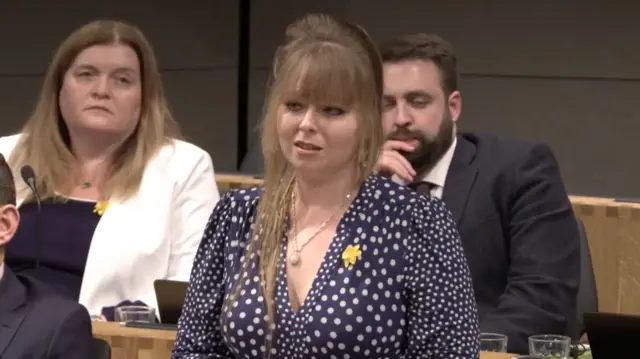
  2. Plaid Cymru's Delyth Jewell: 'Everyone is moved by compassion'published at 21:09 GMT 24 February

  3. How did we get here?published at 21:07 GMT 24 February

    David Deans
    BBC Wales politics reporter

    MPs took the historic step of voting in favour of assisted dying in the House of Commons back last June.

    They voted by a majority for Labour MP Kim Leadbeater’s backbench legislation to become law.

    But it was not the end of the story.

    It is currently in the House of Lords, where the volume of changes proposed by peers has led to fears from supporters that it may run out of time.

    And because it is legislation for England and Wales, the Senedd also gets its say on parts of the law that deal with things it would normally discuss - including whether Welsh ministers should be able to set rules for assisted dying services.

    With Senedd members passing tonight's motion, that will be the case should the legislation being scrutinised in Westminster become law.

  4. 'State should support people at the end of their lives'published at 21:01 GMT 24 February

    Earlier, Tory Senedd leader Darren Millar was the first person to speak against the motion - watch below.

  5. 'Members approached debate with care'published at 20:57 GMT 24 February

    Before the vote was held, Health Secretary Jeremy Miles said members approached the debate with care and "recognising the seriousness and complexities of the issues raised by the bill and its implications for Wales".

    He said the final form of the legislation being scrutinised in Westminster cannot be known during the current term of this Senedd, adding that without tonight's motion members would not have the opportunity to give their view.

  6. Senedd criticises 'lack of consideration' for Walespublished at 20:52 GMT 24 February

    The vote paves the way for services to be available on the Welsh NHS, should the next Welsh government want to introduce them and should the law pass the UK Parliament.

    But Senedd members also backed a Plaid Cymru amendment criticising "the lack of thorough consideration of the constitutional implications of this bill for Wales".

    MSs voted 28 for, 23 against with two abstentions.

  7. Wales' parliament votes for assisted dying lawpublished at 20:51 GMT 24 February
    Breaking

    Politicians in the Senedd have given their consent to Westminster legislation that will allow terminally ill people to obtain a medically assisted death.

  8. What does this vote mean?published at 20:45 GMT 24 February

    The House of Commons took a decision last summer not to give the Senedd a veto on whether assisted dying should be legal.

    That means tonight's vote, due to take place shortly, is not about whether assisted dying should be legal or not.

    But what MSs do have influence over is what kind of service would be available in Wales.

    The Senedd needs to give its consent to that part of the law. If its refused, the backers of this in the UK Parliament have promised to remove the relevant passages.

    Should the bill pass in Parliament – which isn’t certain – then if consent is not granted tonight there’s a chance that assisted dying services could still be made available in Wales, but via the private sector outside of the NHS.

  9. A pause before votingpublished at 20:43 GMT 24 February

    David Deans
    BBC Wales politics reporter

    The debate on the assisted dying motion has ended, with voting due to take place soon. We'll be bringing you the result live.In the meantime the Senedd has moved on to a debate on a piece of environmental legislation.

    It has been a sombre and polite debate, with passion from many of the MSs who spoke. The presiding officer allowed it to continue for for almost two hours.

    Ministers were largely sat quietly in thought as backbenchers and opposition politicians spoke. At one point, Education Secretary Lynne Neagle turned to look at Delyth Jewell, nodding as she argued against the motion.

  10. Voting against 'will make Wales worse place to be'published at 20:38 GMT 24 February

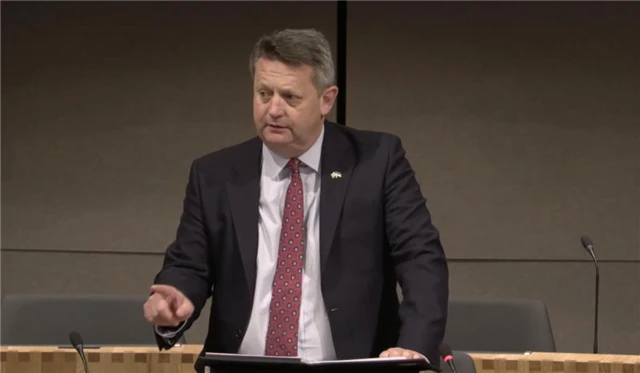
    Labour MS for Blaenau Gwent, Alun Davies, says there is "no compassion or morality" in restricting assisted dying services to just those who can afford it.

    He argues the Senedd has "little choice" but to pass the motion, and says the Senedd would have made "Wales a much much worse place to be" if it voted not to allow assisted dying services on the NHS.

    But Davies argues that this was not how the Senedd should be legislating, and that it should be able to make a "complete decision" on assisted dying in Wales.

    A man stood up talking. He has a black jacket on and a light pink shirt with a red tie. He has short grey hair.Image source, Senedd Cymru
  11. Legislation is 'deeply flawed'published at 20:32 GMT 24 February

    Mark Palmer
    BBC Wales politics assistant editor

    Janet Finch-Saunders, Member of the Senedd for Aberconwy, says the legislation is "deeply flawed" and she will not be supporting it.

  12. Reform's James Evans to abstainpublished at 20:25 GMT 24 February

    Evans, who emotionally supported the principle of an assisted dying law in a previous debate, has told the Senedd that he will abstain on the consent motion.

    He says if the law is to change it needs to change "in a way that's clear", and says the law in the UK Parliament is not "there" and instead a "work in progress".

    "Reform, if it comes, must be done properly," he says, adding that "with a heavy heart" he will abstain "in the hope that the finished legislation will provide me with the confidence to support this bill".

    James EvansImage source, Senedd Cymru
  13. Palliative care staff 'vehemently' against billpublished at 20:21 GMT 24 February

    Welsh Conservative Tom Giffard says he abstained from the previous debate in 2024 after speaking to palliative care staff at Ty Olwen in Morriston Hospital.

    "The bill, as was drafted at the time, made those people who are so passionate about palliative care, who believe so much in the difference in the work they do can make, were vehemently against the bill as was drafted at that time," he says.

    He adds that the legislation being scrutinised in Westminster "changed fundamentally the relationship between medical professionals and the patients they care for".

    "That oath they take, not the harm their patients. They were all of sudden being forced and compelled to offer as an option."

    Tom GiffardImage source, Senedd Cymru
  14. Ex-Plaid leader says rejecting motion 'does not protect Wales'published at 20:07 GMT 24 February

    Adam Price is clearly unhappy with the position the motion is putting the Senedd in, saying he hopes it is the "last time we are put in this invidious position".

    But he says withholding consent would not prevent assisted dying, but provide a "worse version" which would be "available to some, not to others".

    Price says he will back the motion "because the alternative does not protect Wales, it abandons Wales to a private only system".

    Adam Price speaksImage source, Plaid Cymru
  15. Doctors in 'conflicting roles'published at 20:03 GMT 24 February

    Tory MS Sam Rowlands makes clear his opposition to the legislation is rooted in his Christian faith.

    He tells the Senedd being asked to support the motion while "crucial" details are "unresolved".

    Rowlands says the legislation being scrutinised in the House of Lords places doctors in "conflicting roles", and says the priority should instead be "high quality palliative care".

  16. BBC Verify

    Has access to assisted dying expanded elsewhere?published at 19:59 GMT 24 February

    George Herd, BBC Wales

    Plaid Cymru’s Delyth Jewell and Tory Mark Isherwood both raised concerns that where assisted dying has been introduced, there has been an expansion in just who is eligible, and for what conditions.

    Those defending the current proposals in the Terminally Ill Adults bill, such as Lord Falconer, point to the fact the legislation is modelled on what happens in the USA state of Oregon.

    The main provisions there, that an individual must be terminally ill and expected to die within six months, have not changed in 26 years.

    But opponents, including Cardiff University palliative care expert Baroness Ilora Finlay, say records in Oregon do show assisted dying has expanded, external, especially in numbers - from 16 in 1998 to 278 in 2022.

    In Canada, assisted dying initially required a patient to be terminally ill.

    However, after a challenge in the courts, the law was changed in 2021 to include non-terminal conditions classified as a "grievous and irremediable medical condition" where it is "intolerable".

    A similar argument was made in Belgium, where the law was extended in 2014 to allow children with "a capacity of discernment", and are terminally ill, to access assisted dying.

    Records show six have done so since the change.

    But an academic study reviewing all assisted deaths in Belgium, external and published last year found no evidence for what has been described by some as a slippery-slope to expanding assisted dying, stating "safeguards appear effective" there.

  17. 'Ducking our responsibilities' if vote rejectedpublished at 19:57 GMT 24 February

    Jenny Rathbone, Labour MS for Cardiff Central, says the bill being scrutinised in Westminster talks about "people who are already suffering hugely".

    "Some of my constituents have said they don’t want to go anymore," she says, recounting a story of police becoming involved with a person who had agreed with their family that they wanted to stop taking their medication.

    She says the Senedd is "ducking" its responsibility if it does not vote tonight to ensure the Welsh NHS accommodates the "tiny" number of people who want to end their lives if assisted dying is legalised.

  18. 'Wales should be able to decide'published at 19:50 GMT 24 February

    Plaid Cymru MS Heledd Fychan says assisted dying is a "matter of significance for Wales" but criticises the fact they are "not debating the substantive issue".

    She says it is a "hugely emotive issue" and argues people want the Senedd to be discussing the topic fully.

    "We should look at this in the whole. Wales should be able to decide," she says.

    "Wales' voice needs to be heard. The debate should be done properly here in Wales."

    However, she adds: "I personally believe everyone has the right to choose how they die... We can't bury our heads in the sand."

    Heledd FychanImage source, Senedd Cymru
  19. 'Would we leave Wales without access?'published at 19:42 GMT 24 February

    David Deans
    BBC Wales politics reporter

    Labour's Julie Morgan is the first person to give a speech in favour of the motion.

    The debate, she says, is not about the principle of the bill. "The principle of assisted dying... is not a devolved decision," she says.

    The Cardiff North MS fears "it will be an abdication of responsibility if we did not support the motion".

    "Would we want to leave the people of Wales without any access to services if this bill becomes law?," says Morgan, who adds that it is very likely.

    The numbers who would want the service in Wales is "very very small", she says, adding in the first six months there would probably be 40 people.

    "We are not talking about a huge development. We are talking about specific services for a specific group of people."

    Tory leader Darren Millar objects to Morgan suggesting the sponsors of the bill in Westminster respect the Senedd, after the Welsh Parliament voted against assisted dying in 2024.But Morgan says the previous vote was on a "much wider concept" with "no deadlines".

    "It's completely different", she says.

    Julie MorganImage source, Senedd Cymru
  20. Debate is 'moved by compassion'published at 19:38 GMT 24 February

    Plaid Cymru's Delyth Jewell says everyone involved in the debate is "moved by compassion".

    She says she recognises people's "desire not to see someone they love suffer".

    She says that people who are "not surrounded by love" must be remembered, and adds that people in vulnerable positions could feel compelled to end their life.

    "That is not scare-mongoring, that is a reflection of the reality seen in every jurisdiction in the world where assisted dying has been legalised," she says.

    As Jewell speaks, fellow MS Lynne Neagle looks at her and nods.

    Delyth JewellImage source, Senedd Cymru