Summary

  1. 20,000 seafarers stuck after Iran threats, says UN bodypublished at 21:19 GMT

    Jonathan Josephs
    BBC business reporter
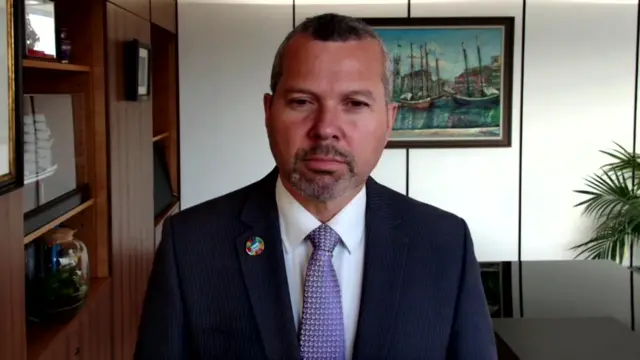
    Arsenio Dominguez wearing a suit over a white shirt and purple tie.
    Image caption,

    Arsenio Dominguez of the UN's International Maritime Organization

    Around 20,000 seafarers are trapped because of events in the Straits of Hormuz, the head of the UN's International Maritime Organization has told the BBC.

    They're stuck because Iran's threats to attack ships means that maritime activity has pretty much ground to a halt in the area. Arsenio Dominguez said that another 15,000 passengers on cruise ships are all being affected.

    The strait is an important route for global trade with about 20% of global oil supplies passing through it in normal circumstances.

  2. Trump again brings up Iranian nuclear programmepublished at 20:54 GMT

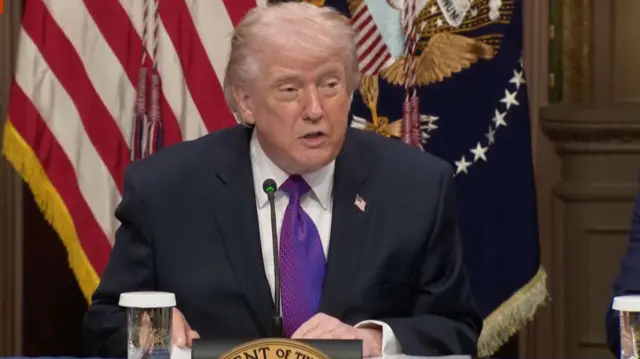
    President Trump, wearing suit and purple tie, speaking into a microphone at a table with an American flag behind himImage source, Reuters

    President Trump is currently speaking at a White House round table unrelated to the war.

    He briefly touched on Iran as he opened the meeting.

    "If we didn't hit within two weeks, they would've had a nuclear weapon," he said of the strikes. "When crazy people have nuclear weapons bad things happen."

    For context: Iran has long said its nuclear programme is peaceful. The Director General of the International Atomic Energy Agency (IAEA) wrote on social media on Tuesday that the organisation can't provide assurance that this is the case.

    "While there has been no evidence of Iran building a nuclear bomb, its large stockpile of near-weapons grade enriched uranium and refusal to grant my inspectors full access are cause for serious concern," he said.

  3. Hezbollah 'won't surrender' as war with Israel escalatespublished at 20:50 GMT

    Alice Cuddy
    Reporting from Beirut

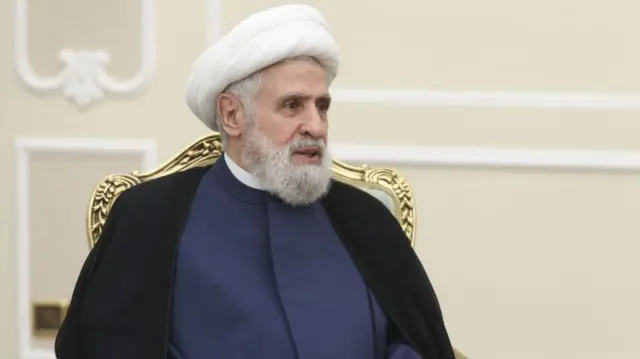
    Naim Qassem sitting on a gilded chair and speakingImage source, Anadolu via Getty Images
    Image caption,

    Hezbollah Leader Naim Qassem pictured in July 2024

    Hezbollah’s leader Naim Qassem has said the Iran-backed group "will not surrender" as the war with Israel continues to escalate.

    In his first public speech since the regional conflict spread to Lebanon on Monday, Qassem said Hezbollah had adhered to a ceasefire deal reached in late 2024, but that Israel "did not abide by any of its provisions".

    "We agreed to the diplomatic solution and considered it an opportunity for the state to assume its responsibility, but we have repeatedly said 'there are limits to patience'," he said in the televised address.

    "Our choice is to confront them to the point of the utmost sacrifice, to the furthest limits, and we will not surrender," he said.

    Hezbollah launched rockets and drones at Israel on Monday after US and Israeli strikes killed Iran's Supreme Leader Ayotollah Ali Khamenei.

    Israel has responded with widespread air strikes and sent troops into the south of Lebanon, with tens of thousands of civilians forced to flee.

  4. Qatar's foreign minister demands Iranian counterpart call 'immediate halt' to attackspublished at 20:32 GMT

    Barbara Plett Usher
    Reporting from Doha

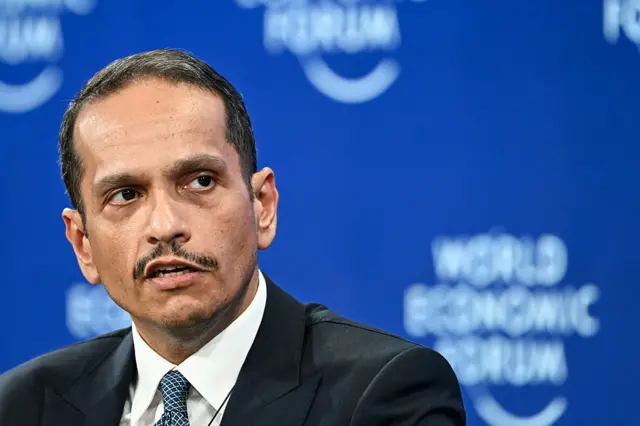
    close-up of Sheikh Mohammed bin Abdulrahman al-Thani speaking at an eventImage source, AFP via Getty Images
    Image caption,

    Qatar's Foreign Minister Sheikh Mohammed bin Abdulrahman al-Thani in January 2026

    Qatar's Foreign Minister Sheikh Mohammed bin Abdulrahman al-Thani has called his Iranian counterpart Abbas Araghchi for the first time since the conflict began.

    Arab officials are furious that Iran has fired hundreds of missiles and drones on its neighbours – including Qatar – targeting US military bases, but also hitting civilian and energy infrastructure.

    Al-Thani "categorically rejected" Araghchi’s assertion that Iran’s attacks in recent days were targeting American interests and not the state of Qatar, according to a Qatari readout.

    He accused Iran of "seeking to inflict harm on its neighbours and drag them into a war that is not theirs", and demanded "an immediate halt" to the attacks.

  5. Israel begins new 'wave of strikes' across Tehran, says militarypublished at 20:04 GMT
    Breaking

    The Israeli military says it has launched another series of strikes across the Iranian capital Tehran.

    "The IDF has begun an additional wave of strikes targeting military infrastructure belonging to the Iranian regime across Tehran," the Israel Defense Forces says in a statement.

    It doesn't offer any further information about a specific location, but says further details will follow.

    News agency AFP reports that its journalists witnessed a powerful explosion in the capital on Wednesday night.

    Earlier on, the Israeli military announced its air force had completed a "wide-scale strike" on an eastern Tehran compound containing command centres and internal security personnel.

  6. 'Our position has not changed' - Spanish minister denies White House comments that country will cooperate with US militarypublished at 20:00 GMT

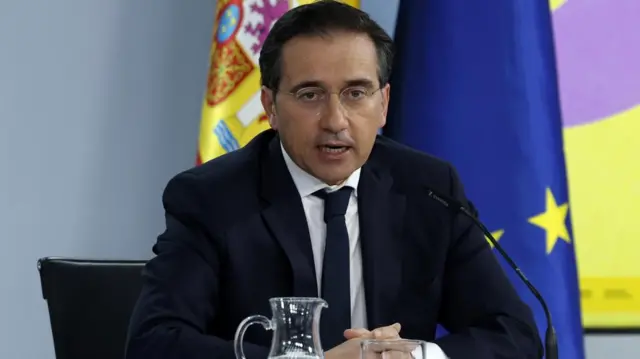
    Jose Manuel Albares speaking at a cabinet meetingImage source, EPA/Shutterstock
    Image caption,

    Spanish Foreign Minister Jose Manuel Albares says he has "no idea" what White House Press Secretary Karoline Leavitt was referring to during a press briefing earlier

    Spain's Foreign Minister José Manuel Albares says his government's position on the war "has not changed" after the White House said Spain has agreed to cooperate with the US military.

    Yesterday, President Trump threatened to halt all trade with Spain after the country barred the US from using its military bases as part of its operation in Iran.

    Albares tells Spanish radio channel Cadena SER: "The Spanish government's position on the war in the Middle East, the bombing of Iran and the use of our bases has not changed at all."

    He adds: “Our position of ‘no to war’ remains clear and unequivocal."

  7. Macron says he asked Israel PM to 'refrain from a ground offensive' in Lebanonpublished at 19:55 GMT

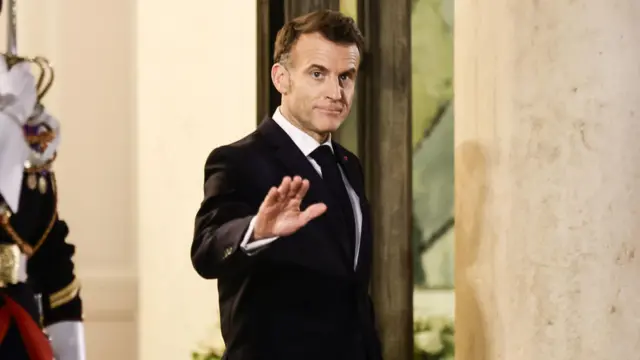
    Emmanuel MacronImage source, EPA/Shutterstock

    French President Emmanuel Macron says he met Israeli Prime Minister Benjamin Netanyahu, as well as Lebanon's President Joseph Aoun and its Prime Minister Nawaf Salam today to discuss the "highly concerning" situation in Lebanon.

    Hostilities between Israel and the Iran-backed group Hezbollah continue to escalate in Lebanon - with reports that the Israeli military entered several Lebanese villages near the UN-demarcated boundary between Lebanon and Israel.

    Hezbollah has also launched rockets and drones at Israel, in response to the US-Israeli strikes on Iran.

    In a post on social media, Macron says: "I reaffirmed the need for Hezbollah to immediately cease its attacks against Israel and beyond."

    He adds that "similarly, I called on the Israeli Prime Minister to preserve Lebanon’s territorial integrity and to refrain from a ground offensive."

    He says France will continue to support the Lebanese armed forces to end the threat posed by Hezbollah, and is taking steps to support displaced Lebanese civilians.

  8. US and Israel have destroyed much of Iran's military capabilitypublished at 19:39 GMT

    Paul Adams
    Diplomatic correspondent

    Iran’s ferocious initial response to the assault by Israel and the United States raised questions.

    Could America’s allies continue to defend themselves? Could their expensive air defences cope with wave after wave of cheap drones?

    Those fears seem to have eased.

    The Americans say the number of ballistic missiles fired by Iran has dropped 86% since Saturday, while the number of drones is down by 73%.

    The United States and Israel have destroyed much of Iran’s capability, although Western officials acknowledge it’s possible the Islamic Revolutionary Guard Corps may be holding some weapons back in order to keep fighting longer.

    Having achieved supremacy in the air, Israeli and American jets are now free to fly, uncontested, over Iranian territory.

    This means they no longer need to rely on so-called “stand-off” weapons - hugely expensive missiles, fired from a safe distance - but can now start to draw on their vast stocks of much cheaper GPS-guided bombs.

  9. White House says Iran is 'paying in blood' for crimes against US - a recappublished at 19:34 GMT

    Sakshi Venkatraman
    US reporter

    White House Press Secretary Karoline Leavitt spoke almost entirely about Iran during her 45-minute press briefing just now.

    Here's what she said:

    • Leavitt repeated many of the lines we've heard from others in the administration - that the objectives of the US operation in Iran is to remove their nuclear ambitions and destroy their navy
    • Iran's leaders are "paying in blood", she said, for what she calls their crimes against the US
    • Asked about what "imminent threat" required the US to attack Iran, Leavitt largely didn't answer the question, but said Trump's "feeling based on fact" was that Iran posed a threat to the US
    • She said the Iranian regime "lied and delayed" during negotiations before the initial US-Israeli attack in order to build up their ballistic weapons supply
    • And on who could be Ayatollah Khamenei's successor as supreme leader, Leavitt said we will have to "wait and see"
  10. BBC presses Leavitt on reported school strikepublished at 19:17 GMT

    The BBC's Washington correspondent Daniel Bush asks about what Iranian authorities have said was a US-Israeli strike on a school in southern Iran - in which they say more than 160 people were killed.

    BBC News has not been able to independently verify the Iranian authorities' death toll.

    "Can you say that there is any evidence that it was not a US strike, and is there any assessment about Israel's potential (or) likely role - if at all?" he asks.

    Leavitt replies that the Department of Defense is "investigating this matter", but reiterates previous comments from US officials that: "The United States armed forces do not target civilians."

  11. Striking Iran 'the right decision and an effective one at that' - Leavittpublished at 19:07 GMT

    Karoline LeavittImage source, Reuters

    The White House press secretary is asked about the "imminent threat" against the US that required the country to attack Iran.

    The reporter also mentions UK Prime Minister Keir Starmer's comments earlier, that there was not a "viable, thought-through plan".

    "I completely reject the premise of your question," Leavitt responds. "President Trump does not make decisions in a vacuum."

    She continues by saying "the president's feeling based on fact" was that Iran posed a threat to the US.

    "That has obviously proved to be the right decision and an effective one at that," she says.

    She doesn't answer the question about Starmer.

  12. Press secretary asked whether goal is regime change in Iranpublished at 18:52 GMT

    Karoline Leavitt is asked about the aims of the US-Israel war with Iran, and whether regime change is the ultimate goal.

    In response, the press secretary restates the goals she outlined at the start of the briefing. But she adds that the US is not opposed to Iranians themselves overthrowing the Iranian government.

    As a reminder you can watch live the White House press briefing at the top of the page.

  13. Spain has agreed to cooperate with US military, after Trump criticism - press secretarypublished at 18:47 GMT

    Spanish PM Pedro SanchezImage source, Getty Images
    Image caption,

    Spanish Prime Minister Pedro Sanchez had hit back at Trump's threat to end trade with Spain, saying 'no to war'

    The press secretary says Spain has now agreed to cooperate with the US military.

    Yesterday Trump threatened to halt all trade with Spain, after the country barred the US from using its military bases as part of its operation in Iran.

    Now, Leavitt says, Spain has heard Trump's message "loud and clear". She adds that the US president expects all European allies to cooperate with the operation.

  14. 'Peace was not a pursue-able path' with Iran, says Leavittpublished at 18:42 GMT

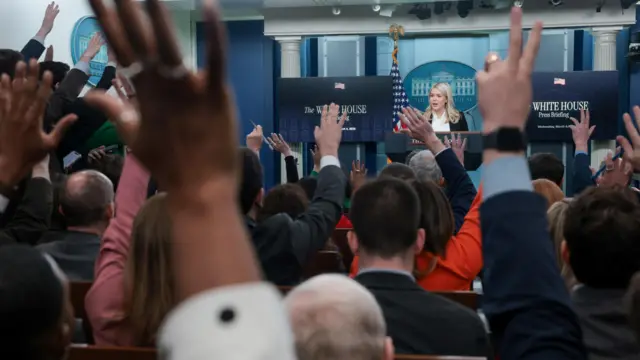
    Reporters raise hands in the air to ask questions of Karoline LeavittImage source, Reuters

    Asked if Trump believes the public supports the war with Iran, Leavitt says: "I think he does."

    She continues, saying: "This is a rogue terrorist regime that has been threatening the United States, our allies, and our people for 47 years."

    She adds that the US president has been "remarkably consistent" on the issue that Iran cannot possess a nuclear weapon and that Trump had determined that "peace was not a pursuable path" with Iran.

  15. US press secretary: Khamenei's succesor? Let's 'wait and see'published at 18:38 GMT

    Moving on to questions from reporters, and Leavitt is asked about reports that Ayatollah Khamenei's son, Mojtaba, could possibly be named his successor.

    The press secretary says she has seen those reports, but that we have to "wait and see" what happens next. She says that the administration hopes freedom and democracy come to the Iranian people.

    • For context: Iran's Supreme Leader Ayatollah Ali Khamenei was killed in initial US-Israeli strikes over the weekend.
  16. Military operation has 'forged a new path' to ensure US security - Leavittpublished at 18:35 GMT

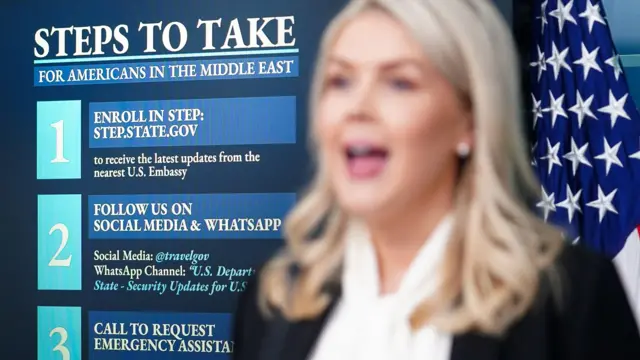
    Karoline Leavitt in front of slides showing what steps Americans should takeImage source, Reuters

    "Operation Epic Fury has forged a new path that would better ensure the security of the United States and our people," Leavitt says.

    "Make no mistake, killing these brutal terrorists is good for America, and makes the world a much safer place," the press secretary adds, as she pays tribute to the US service members who have been killed since the operation was launched.

    Leavitt says more than 17,500 Americans have safely returned to the US from the Middle East since the operation to evacuate civilians from the region began.

    She adds that US citizens in the Middle East looking to return should register with the State Department.

  17. Iran 'chose this path of violence', says press secretarypublished at 18:29 GMT

    Leavitt says that US President Donald Trump prefers to put peace and diplomacy first, while Iran "chose this path of violence and destruction and they are reaping the consequences".

    She says the Iranian regime "lied and delayed and tried to string the US along" during negotiations before the initial US-Israeli attack, in order to buy time so they could build ballistic and nuclear weapons.

  18. Press secretary says US aims to 'permanently extinguish' Iran's nuclear ambitionspublished at 18:27 GMT

    Karoline LeavittImage source, Getty Images

    The White House press secretary says US operations in Iran are aimed at "permanently extinguishing their nuclear ambitions".

    She lays out the objectives we've been hearing from others in the administration over the last few days - including destroying Iran's ballistic missiles and annihilating its navy.

    Leavitt says the US has destroyed more than 20 ships already - something we heard from the US Central Command earlier.

    Iran's proxies, meanwhile, are "hardly putting up a fight" and will no longer be able to destabilise the world, she says.

  19. Iran 'paying in blood' for crimes against the US - press secretarypublished at 18:25 GMT

    Leavitt says Iran's leaders are "paying in blood" for what she calls their crimes against the US, before going on to talk about the regime's actions since the 1979 Iranian Revolution.

    She says past presidents have been "too weak" against Iran, but "Trump is finally the man of action".

  20. White House press secretary addresses reporters in Washingtonpublished at 18:20 GMT

    Karoline Leavitt in front of reportersImage source, Getty Images

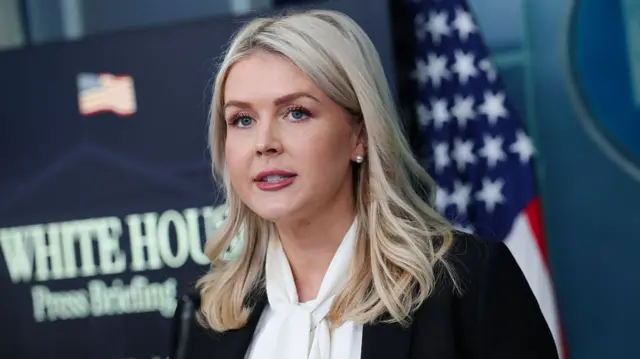
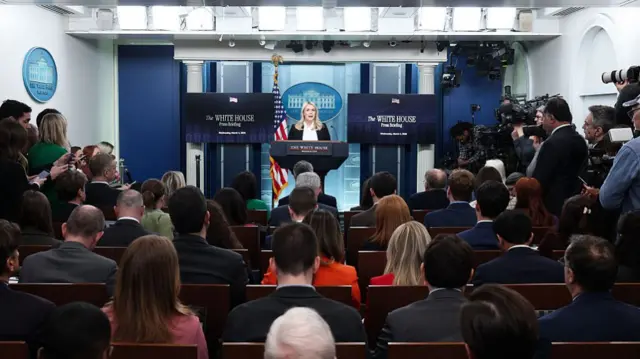
    White House Press Secretary Karoline Leavitt is now addressing reporters in Washington DC.

    The US-Israel war with Iran is likely to be the biggest topic on the table today. We'll update you with the key lines here and you can watch live at the top of the page.