Summary

  1. Unemployment hits a near five-year highpublished at 11:54 GMT

    Jack Grey
    Live reporter

    A waitress in a cafe cutting a slice of cake for a customerImage source, Getty Images

    The UK's unemployment rate hit 5.2% in the last three months of 2025 - the highest level in almost five years, according to the latest figures from the Office for National Statistics (ONS).

    A closer look at the figures

    The ONS says the data shows "weak hiring activity" in the UK, but also outlines that there are more people out of work that are now actively looking for jobs.

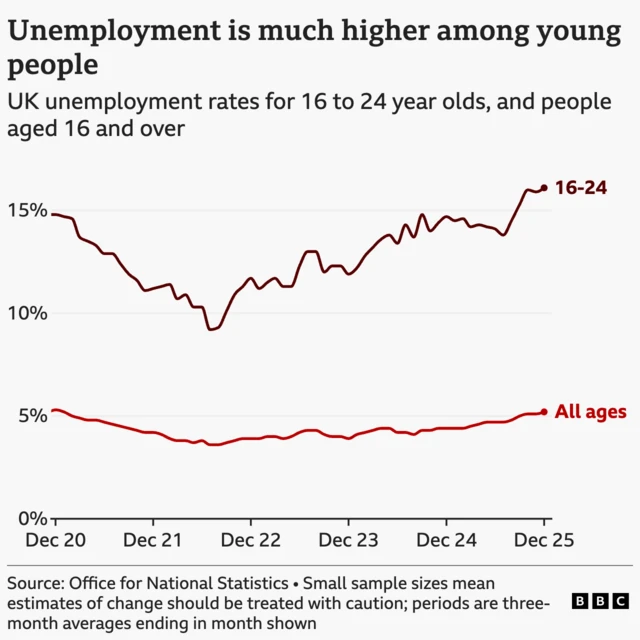
    For 16-24s, the unemployment rate now sits at 16.1% - the highest figure in just over a decade. While for 25-34s it's 4.7%, the highest since 2017.

    Average pay also grew by 4.2%, down from a revised 4.4% in the three months to November.

    Economists say the latest figures would reinforce expectations that inflation will fall back, making it likely the Bank of England would choose to cut interest rates soon, our business correspondent Theo Leggett writes.

    We've got brief explainer on what "unemployment" means in these figures, and how it differs from "economically inactive".

    The political reaction

    Work and Pensions Secretary Pat McFadden says the figures show there are 381,000 more people in work since the start of 2025, but that there is "more to do".

    While Conservative leader Kemi Badenoch accused the Labour government of killing jobs, growth and hope "for the next generation".


  2. Analysis

    It's clear many young people want a job, but can't find onepublished at 11:52 GMT

    Theo Leggett
    Business correspondent

    The core rate of unemployment is 5.2%. But for 16-24 year olds it’s 16.1%. It’s clear many young people want a job, but can’t find one.

    While a lacklustre economy may well be deterring employers from taking on new staff, the lack of entry-level jobs is likely to be causing concern.

    Businesses say the increases in the National Living Wage, which came into effect in April, have made it more expensive to take on junior employees.

    The apprentice rate went up 6%, for example – to £8 per hour. The standard rate for 18-20 year olds went up to £10.85, an 8.5% increase.

    The standard rate for people over 21 went up by just 4.1%, to £12.71 per hour.

    That situation has been exacerbated by the increase in employers’s National Insurance contributions, which also came into force last year.

    Put simply, the costs of employing people have gone up – and this is particularly true of minimum wage jobs. Employing youngsters used to be relatively cheap. Now, not so much.

    The concern is that by boosting minimum wages for young people, the government may be inadvertently pricing them out of the jobs market.

  3. A closer look at the figures for Northern Irelandpublished at 11:26 GMT

    John Campbell
    BBC News NI economics and business editor

    Separate figures released by the Northern Ireland Statistics & Research Agency , externaltoday have indicated the Northern Ireland jobs market remains reasonably healthy with little statistical change in recent months.

    The employment rate in the final quarter of 2025 was 71.9%, after only marginal change in the year.

    The figures also show there was an uptick in the number of proposed redundancies at the start of 2026 - 710 in January 2026, more than three times the monthly average of 220 for 2025.

    The significant increase in January may have been influenced by the plan by Linden Foods to close a facility in County Tyrone which has put more than 300 jobs at risk.

    Figures across the whole of 2025 have shown the typical employee in Northern Ireland saw their pay increase by 6% across the year.

    The preliminary figures from HMRC suggest median monthly pay in January this year was £2,443 - up by £138 from the same month in 2025.

    Public sector pay settlements are likely to have been a significant contributor to the increase in typical pay.

    The HMRC data also suggests that Northern Ireland remains the second lowest earning region in the UK.

  4. Analysis

    Important to treat regional breakdown of employment data with caution - here's whypublished at 11:24 GMT

    Douglas Fraser
    Scotland business & economy editor

    The Labour Force Survey figures, used by the Office for National Statistics to calculate unemployment, are even less reliable for nations and regions of England than for the whole UK, due to problems with the collection of data.

    So when it says the unemployment rate in Northern Ireland is only 2.2%, and falling, treat these numbers with caution.

    Do the same with the latest figures showing London has 7.6% of the workforce seeking work during October to December, up by 1.1 percentage points. The capital has a lot of churn.

    Consider Scotland as well. The ONS’s reported share of the workforce seeking jobs in the last three months of 2025 was 3.8%, significantly below the 5.2% rate for the UK as a whole. That lower rate of unemployment in Scotland has been growing for nearly two years.

    But the Scottish government has published figures that show that data could be out by as much as 0.8 percentage points in either direction. The figures can be described as official "in development".

  5. How the unemployment rate varies across the UKpublished at 11:24 GMT

    As we've been reporting this morning, the unemployment rate across the UK has risen to 5.2% for the last three months of 2025.

    The ONS also provide a breakdown based on area:

    Wales - 4.5%

    Scotland - 3.8%

    Northern Ireland - 2.2%

    England - 5.5%

    And within England:

    North East - 7%

    North West - 5.1%

    Yorkshire and the Humber - 5.7%

    East Midlands - 6%

    West Midlands - 6.1%

    London - 7.6%

    South East - 4%

    South West - 3.6%

  6. Unemployment for 25-34s at highest level since 2017published at 11:07 GMT

    We've heard concerns about youth unemployment this morning, and have taken a closer look at the data for those aged 14 to 24 here.

    Focusing on the unemployment rate for those aged 25-34 in the UK, the latest data shows it hit 4.7% in the last three months of 2025, the highest level since 2017.

    This is up from 4.5% in the three months to November, and means that 4.7% of 25 to 34-year-olds in the UK are out of work and actively seeking it.

    The rate of "economically inactive" people - meaning those out of work and not looking for it - in this age group sat at 11.9%, a rise of 0.1 percentage points but still 0.9 below the 12.8% from a year ago.

  7. 'I've applied for more than 200 jobs - and I'm still unemployed'published at 11:05 GMT

    Steve Jones
    BBC Bradford

    A graphic showing Bradford's cityscape in the background and a photo of a young person sat outside the Job Centre.
    Image caption,

    Unemployment in Bradford is above the regional and national average

    Fatima Rashid has been keeping a spreadsheet of job applications for the past three years.

    The 19-year-old decided to leave school at 16 and has been noting down the roles she has tried - and failed - to land.

    Her tally stands at 205 - and she's still out of work.

    As Fatima's spreadsheet shows, finding a job in Bradford, one of England's most deprived cities, can be tough.

    Recent government data highlights that unemployment in the area is above the regional - and national - average.

    So, in a city where more than a third of the population is under 25, just how hard is it for young people trying to find work? Our colleagues in Bradford have been speaking to people there and looking at the numbers.

  8. Graph shows unemployment much higher among young peoplepublished at 10:57 GMT

    As we've been reporting, the figures today show that unemployment was particularly high for younger workers at the end of last year.

    Among 16 to 24-years-olds, the rate rose to 16.1% at the end of 2025 - the highest it's been in more than a decade.

    As the chart below shows, comparable figures for overall unemployment are much lower.

    The latest data shows it was at 5.2% for all those aged 16 and over in the three months to December, although that has also been rising.

    Here’s the picture for other age groups:

    • 25 to 34 years - 4.7%
    • 35 to 49 years - 3.2%
    • 50 to 64 years – 3.3%
    A line chart titled "Unemployment is much higher among young people", showing the UK unemployment rate by selected age group, from October to December 2020 to 2025. For 16- to 24-year olds, the rate starts at 14.8%, dips to 9.2% by May to July 2022, and then rises to 16.1% by October to December 2025. The rate for people aged 16 and over starts at 5.3%, dips to 3.6% by May to July 2022, and then rises to 5.2% by October to December 2025. The source is the Office for National Statistics.
  9. 'It's discouraging when you don't hear back from companies'published at 10:51 GMT

    Elliot Burrin
    Live reporter

    A man smiling in front of a camera. He's wearing glasses and a green capImage source, Alex Huke

    I've been talking to Alex Huke who graduated with a social sciences degree in July and recently found a job working as an activities coordinator in a care home - after applying for around 40 jobs in hospitality, retail, and care.

    "It's quite discouraging as you don't hear back from a lot [of companies]," he tells me, particularly when applications often have "multiple stages of interviews for a minimum wage job" and require a lot of information from you.

    "I'm 21 and have had four jobs," he says, "but I don't have two years of quite specific experience, like reception work".

    Alex says he sought advice from the JobCentre Plus to support paying for his council tax while searching for a job, but that he didn't find the service very helpful. He has weekly meetings with a job coach until he starts his new position.

    "It felt like it was there to monitor me rather than help me find a job," he says.

  10. Badenoch: Labour's killing jobs, killing growth and killing hopepublished at 10:25 GMT

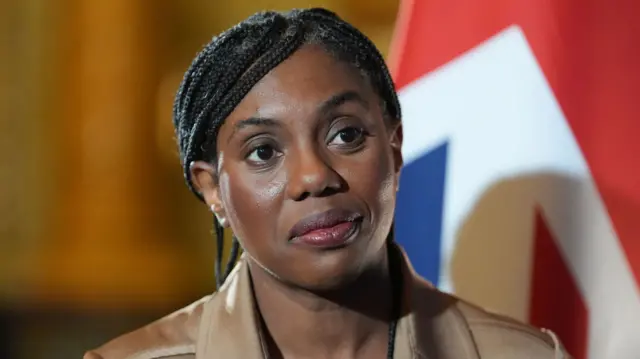
    Conservative party leader Kemi Badenoch has now reacted to this morning's figures - accusing Labour of "killing jobs, killing growth and killing hope for the next generation".

    "Unemployment at a 5 YEAR HIGH under Labour," she writes.

    "While Keir Starmer is distracted by scandals and endless U-turns, families are being punished."

    A headshot of Kemi Badenoch who looks to the side of the cameraImage source, PA Media
  11. Wage growth is still above inflation - but only justpublished at 10:07 GMT

    Mitchell Labiak
    Business reporter

    Today's figures show that wages are still growing, but only just a bit quicker than inflation.

    In other words, though many people’s pay packets are getting bigger, they might not be feeling it in their pockets because prices are rising almost as quickly.

    To put that into numbers, weekly earnings grew across the UK at an annual rate of 4.2% between October and December, but they only grew 0.8% after inflation is factored in. The last time real pay growth was lower than that was two-and-a-half years ago.

  12. Unemployment up and wage growth slows down - a recappublished at 09:53 GMT

    Maia Davies
    Live reporter

    We're continuing to go through the latest UK unemployment data, released by the Office for National Statistics earlier this morning. Here's an overview of what we've been reporting so far:

    The main takeaway: Unemployment reached its highest rate in nearly five years in the last three months of 2025.

    We also learned: Annual wage growth slowed in the same period, redundancies trended up, and more people were looking for jobs.

    The ONS says: The data reflects “weak hiring activity”, according to its director of economic statistcs.

    Analysis: Increases in employers' National Insurance contributions and the National Living Wage, and changes made in the Employment Rights Act, have all contributed to uncertainty, our business editor Simon Jack writes.

    Political reaction: Work and Pensions Secretary Pat McFadden says the figures show there are 381,000 more people in work since the start of 2025, but that there is "more to do". Conservative shadow chancellor Mel Stride says: "Higher taxes - including a tax on jobs, soaring business rates, and anti-business red tape that piles on risk is making it harder to employ people."

    One recent graduate tells us: "It can be really soul destroying when you study for so long and you don’t get anywhere." She tells us 50 applications for entry-level roles have led to only one face-to-face interview. "All my friends are talking about is the job search."

  13. Young people 'on downward escalator', warns former Labour ministerpublished at 09:43 GMT

    Youth unemployment is a "long-term" phenomenon, says the former Labour minister leading a review into the rising number of young people not in work or education.

    Young people are on a "downward escalator" of poor health, poor education, and graduating "into the benefit system" as adults, Alan Milburn tells BBC Radio 4's Today programme.

    He says young people are normally the first to be hit by an economic downturn, "but then it bounces back".

    "That isn't happening," he says, and it won't change without significant action from government and employers.

    He also warns of a more "profound" situation beneath the surface of young people who are economically inactive - meaning they aren't looking for a job.

  14. 'All my friends are talking about is the job search'published at 09:12 GMT

    Hannah Mullane
    Business reporter

    A medium close up of a smiling Lucy Gabb wearing her graduation gown and holding her framed Cambridge University degree outside of a Georgian stone building.Image source, Lucy Gabb

    Lucy Gabb graduated from Cambridge University with a degree in French in July 2025. She works in a cafe in London but wants to get into publishing.

    She says she has applied for more than 50 graduate and entry level roles, leading to only one face-to-face interview. In most cases, she says she gets no reply at all or a fairly quick rejection.

    "The application process is so long for each job it can be really hard to fit it in while working full time and trying to get some relevant work experience," she says.

    "All my friends are talking about is the job search," she says. "It can be really soul destroying when you study for so long and you don’t get anywhere."

  15. Workers are 'paying the price for government failures' - Lib Demspublished at 09:08 GMT

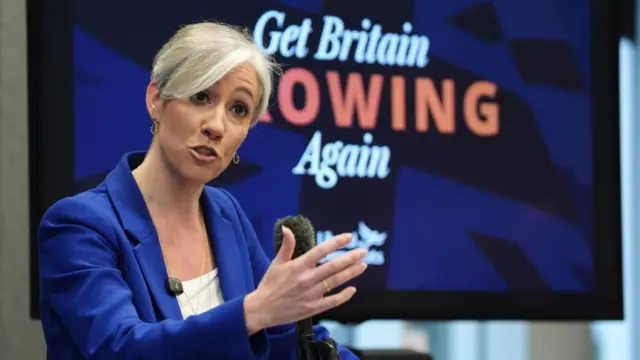
    Daisy Cooper speaking at an event. Behind her is a television screen which reads 'Get Britain Growing Again'.Image source, PA Media

    We're now hearing from Liberal Democrat Treasury spokesperson Daisy Cooper.

    She says the unemployment figures show "it's workers who are paying the price for the government's failures".

    "From the damaging jobs tax to the betrayal on business rates, small and high streets across the UK are fighting to stay afloat, let alone grow," Cooper says.

    She adds that the Lib Dems are calling for an "emergency VAT cut for hospitality" until April 2027 to create more job opportunities.

  16. Analysis

    Uncertainty can lead employers to sit on their handspublished at 09:05 GMT

    Simon Jack
    Business editor

    Today's figures suggest the job market is still weak.

    Employers are still reluctant to take people on for a number of reasons we saw last year: there was a big increase in employers' National Insurance contributions, increases in the National Living Wage, particularly for young people, and there’s uncertainty around the Employment Rights Act. We also had a late Budget.

    All of that creates uncertainty, so employers kind of sit on their hands.

    The good news is that the hiring freeze seems to be thawing just a little bit. The number of vacancies out there has kind of levelled off. But overall you could say that this is still a pretty weak employment market.

    We’re seeing the biggest falls in employment in retail and hospitality. This sector employs quite a lot of young people, and people either at or close to the National Living Wage.

    The broader picture is that a lot of these uncertainties came at precisely the moment in the wider economy when employers were thinking: 'how many people do I actually need? Can I get automation? Can I deploy AI?'

    People are getting a bit more expensive and a bit riskier - so they’re thinking of other ways to invest in the business, in capital rather than labour.

  17. What does 'unemployment' actually mean?published at 08:47 GMT

    It does not simply mean anyone without a job, at least not when it comes to the figures from the Office for National Statistics that we're talking about today.

    For someone to meet the ONS definition, three things must apply: they must be without work, available for work and seeking work.

    Getting more specific, to be "unemployed" you have to have actively sought work in the last four weeks, and be available to start in the next two.

    Those who don't have a job, but do not meet this criteria, are considered "economically inactive" - this group can include students, retirees and those off work with long-term illnesses or disability.

  18. Unemployment for 18-24s reaches 14% - the highest since 2020published at 08:31 GMT

    We're continuing to look through the figures released by the Office for National Statistics earlier and bring you any key lines.

    The unemployment rate of people aged 18-24 in the UK has hit 14%, the data shows.

    This marks a 0.3 percentage point increase from the three months to November, which saw an 18-24 unemployment rate of 13.7%

    Aside from one three-month period in 2020 during the pandemic, which also saw 14%, the last time the UK saw a higher unemployment rate for 18-24s was in 2015.

    For those aged 16-17, the unemployment rate is 34.2%, falling from 34.7% reported in the three months to November.

    The ONS are set to release the latest figures looking specifically at the level of young people (16-24) not in education, employment or training, later this month.

  19. Analysis

    These figures could lead the Bank of England to decide it will cut interest ratespublished at 08:24 GMT

    Theo Leggett
    Business correspondent

    Slow economic growth in the second half of last year, and a late November Budget, contributed to what the ONS describes as weak hiring activity.

    The number of people on company payrolls fell by 130,000 across the year to December, while more people who were out of work were actively looking for a job, pushing the unemployment rate up to a near five-year high.

    Average pay grew by 4.2%, down from a revised 4.4% in the previous survey - with public sector wages still growing much faster than those in the private sector.

    Economists say the latest figures would reinforce expectations that inflation will fall back, making it likely the Bank of England would choose to cut interest rates soon, possibly at its next rates-setting meeting in March.

  20. Youth unemployment 'very high and concerning', recruiter sayspublished at 08:09 GMT

    Some reaction now from Michael Stull, the managing director of recruitment firm ManpowerGroup UK.

    The latest youth unemployment figures are "very high and concerning", he tells BBC Radio 4's Today programme.

    It was a tough end to the year with "a lot of uncertainty in the market", he says.

    "Hiring managers... don't like that uncertainty. Neither do workers - they stay put. So we knew there was going to be a drop in hiring."

    Employers want to take on more workers, he says, but they need more confidence in the market after what he calls a period of instability.