Summary

  1. Experts answering your questions on the ceasefire - watch livepublished at 15:30 BST

    Throughout the day, you've been sending us your questions on the temporary truce that's been called by the US and Iran.

    On hand to answer all of them are the BBC's chief international correspondent Lyse Doucet, deputy economics editor Dharshini David, Pakistan correspondent Caroline Davies, and our correspondent in Washington Sumi Somaskanda.

    • You can watch live at the top of the page.

    Your Voice graffiti banner
  2. Pakistan PM: Ceasefire violations 'undermine the spirit of peace process'published at 15:26 BST

    Ceasefire violations have been reported at a "few places across the conflict zone", says Shehbaz Sharif, prime minister of Pakistan, which is mediating negotiations between Iran and the US.

    In a statement on X, he says: "Violations of ceasefire have been reported at few places across the conflict zone which undermine the spirit of peace process.

    "I earnestly and sincerely urge all parties to exercise restraint and respect the ceasefire for two weeks, as agreed upon, so that diplomacy can take a lead role towards peaceful settlement of the conflict."

  3. Analysis

    Hegseth was triumphalist but details on two-week ceasefire were scarcepublished at 15:20 BST

    Tom Bateman
    US State Department correspondent

    Hegseth was triumphalist in his news conference but in the room few details were forthcoming about the nature of the truce and planned negotiations with Iran.

    His statements were marked by contradiction and a lack of clarity.

    The administration says the aim of the war was to deny Iran a nuclear weapon in the future. Hegseth said at one point Iran would hand over its stockpile of nuclear fuel “right now”. He didn’t say who would do this, how it would happen, or how it would be verified.

    He was later asked about this and said: “They will either give it to us, which the president laid out, or if we have to do something else ourselves."

    On the Strait of Hormuz, Tehran has said its re-opening it during the truce will be under Iranian military coordination. Hegseth was asked about control of the strait, and said the oil tankers “will be sailing” but the US retained options.

    And he was asked about Trump’s post on Tuesday threatening a “whole civilization” would die, and his threat to destroy all of Iran’s power plants and bridges.

    Hegseth quoted the president saying the US could “take it all” including Iran’s “ability to export energy”, adding: “The United States military has the ability to strike those things with impunity”.

    This is not true, Congress has a series of laws limiting US conduct in war and has ratified treaties including the Geneva Conventions, which mean its military and leadership cannot act “with impunity”.

  4. Pentagon briefing on Operation Epic Fury: What we learnedpublished at 15:11 BST

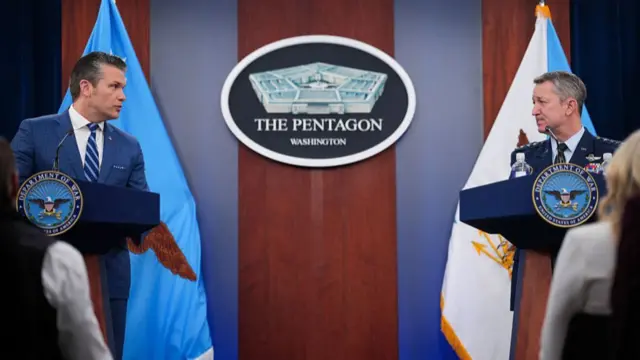
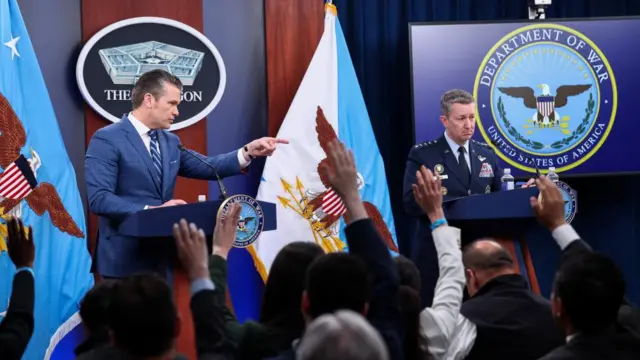
    US Secretary of War Pete Hegseth, left, looks to Chairman of the Joint Chiefs of Staff General Dan Caine as he speaks during a press briefing at the Pentagon.Image source, Getty Images

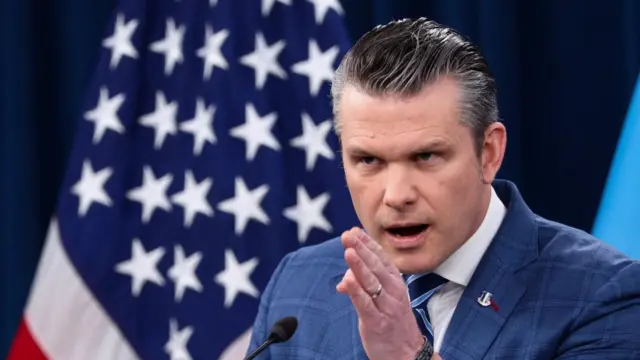
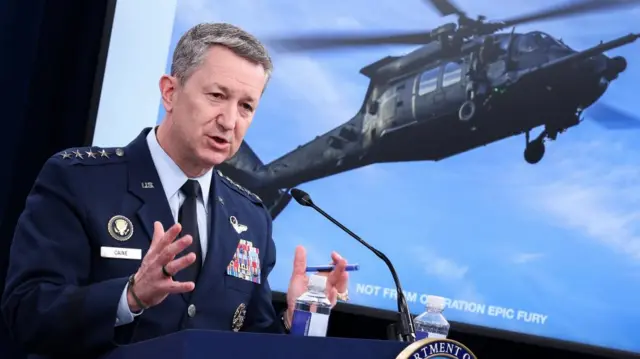
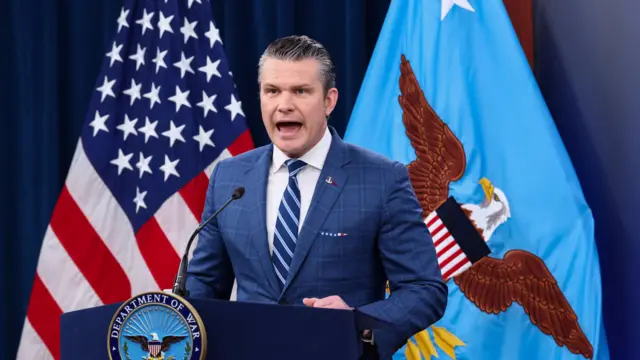
    Here's a roundup from today's earlier Pentagon briefing, where US Defence Secretary Pete Hegseth and Chairman of the Joint Chiefs of Staff, General Dan Caine, updated reporters on Washington's achievements during Operation Epic Fury in Iran.

    Here's what we learned:

    • Hegseth said the US has "decimated Iran's military", calling the operation a "historic and overwhelming victory on the battlefield"
    • The defence secretary suggested that Iran accepted the ceasefire under "overwhelming pressure", and if it had refused Washington's terms then "the next targets would have been their power plants, their bridges, and oil and energy infrastructure"
    • "President Trump had the power to cripple Iran's entire economy in minutes, but he chose mercy," Hegseth told reporters
    • During the 38-day military operation in Iran, the US military struck more than 13,000 targets, Gen Caine said
    • He also stressed that "a ceasefire is a pause" and US troops "remain ready if ordered or called upon to resume combat operations, with the same speed and precision" demonstrated during the war

    Hegseth and Caine both see the ceasefire as a resounding victory, but significant questions remain about the broader deal, as the BBC's Bernd Debusmann Jr writes.

  5. Hezbollah leader's turn 'will also come', Israeli defence minister sayspublished at 14:59 BST

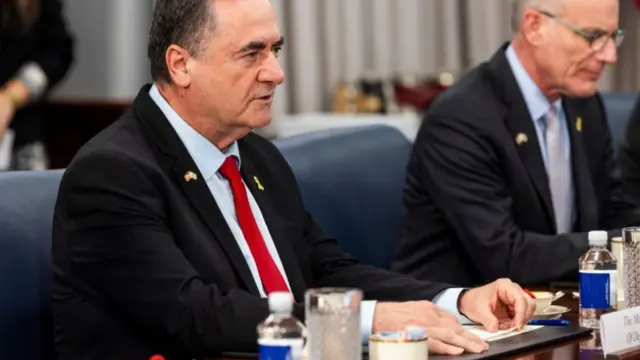
    Israel Katz sits at a table during a meeting, wearing a dark suit, light-coloured suit and red tie.Image source, EPA

    Israel's Defence Minister Israel Katz is warning Hezbollah Secretary General Naim Qassem his "personal turn" will come after announcing the military attacked hundreds of militants in surprise strikes on headquarters throughout Lebanon.

    "We warned Naim Qassem that Hezbollah would pay a very high price for attacking Israel on behalf of Iran - and today we fulfilled another step in the promise," Katz says in a statement.

    "The personal turn of the arch-terrorist Naim Qassem will also come."

    As wide-scale strikes in Lebanon continue despite the ceasefire with Iran, Katz says Israel insisted on "separating the arenas between Iran and Lebanon in order to change the reality in Lebanon and remove threats from the residents of the north".

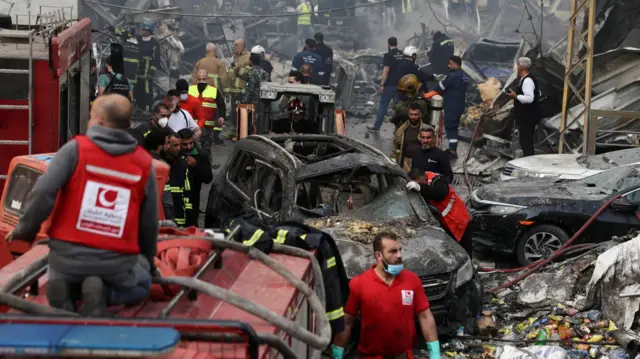
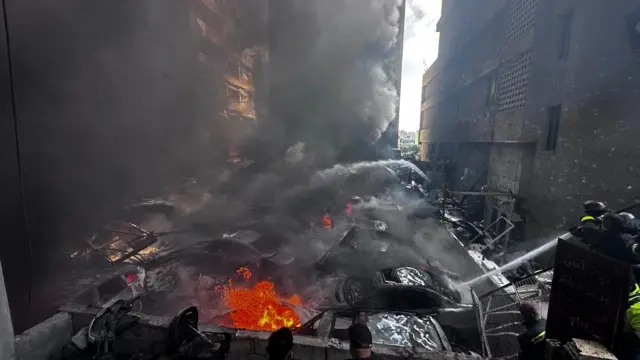
    This picture from Al-Mazraa in Beirut shows the aftermath of an Israeli strike. More than 1,500 people have been killed by Israeli strikes in Lebanon in more than a month of war, Lebanon's health ministry saysImage source, Reuters
    Image caption,

    This picture from Al-Mazraa in Beirut shows the aftermath of an Israeli strike on Wednesday. More than 1,500 people have been killed by Israeli strikes in Lebanon in more than a month of war, Lebanon's health ministry says

  6. Western leaders call on 'all sides' to honour ceasefire - including in Lebanonpublished at 14:49 BST

    A group of Western countries is urging "swift and lasting peace" in Iran, and for "all sides" to adhere to the two-week ceasefire - including in Lebanon.

    The statement is signed by leaders from the UK, France, Italy, Germany, Canada, Denmark, the Netherlands, Spain, the European Commission and the European Council.

    They "welcome" the two-week ceasefire, thanking Pakistan and intermediaries for "facilitating this important agreement".

    "The goal must now be to negotiate a swift and lasting end to the war within the coming days. This can only be achieved through diplomatic means. We strongly encourage quick progress towards a substantive negotiated settlement," the statement reads, adding this is "crucial to protect the civilian population of Iran".

    "We call upon all sides to implement the ceasefire, including in Lebanon."

  7. Lebanese PM pleads for international help to stop Israeli strikespublished at 14:38 BST

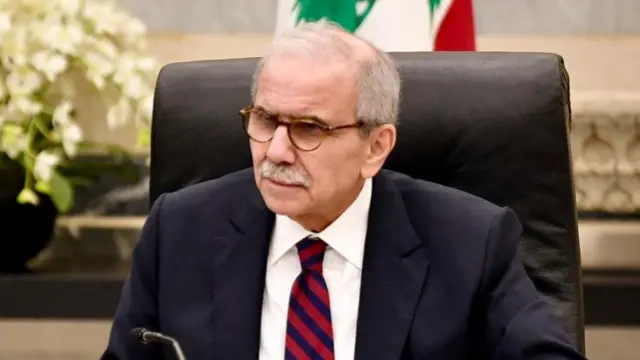
    Salam leads a cabinet meeting at the Government Palace in downtown BeirutImage source, EPA

    The Lebanese prime minister is pleading for "all friends of Lebanon" to stop Israeli military action in the country "by all available means" following a large wave of airstrikes.

    Writing on X, Nawaf Salam says: "Israel continues to expand its aggressions that have targeted densely populated residential neighborhoods, claiming the lives of unarmed civilians in various parts of Lebanon, particularly in the capital Beirut."

    His plea follows a statement from the Israel Defense Forces (IDF), which says it has today carried out the "biggest strikes" across Lebanon since the start of its operation against Hezbollah.

    Salam says the IDF's actions have shown an "utter disregard" for international law, adding: "And all friends of Lebanon are called upon to help us stop these aggressions by all available means."

  8. Citizens should keep roads clear for ambulances, Lebanese authorities saypublished at 14:27 BST

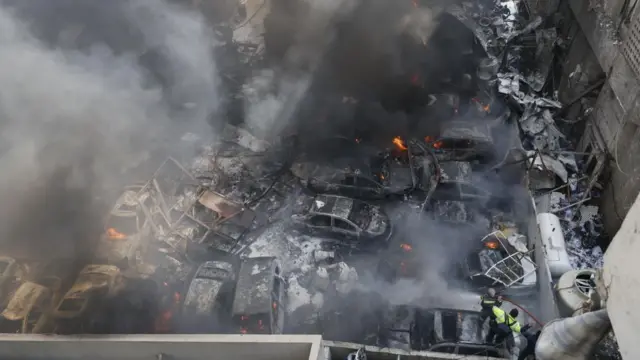
    Smoke rises from burnt out cars hit in an Israeli strike on BeirutImage source, EPA
    Image caption,

    Firefighters are at the scene of scene of an Israeli strike in the Beirut suburb of Corniche el-Mazraa, where thick smoke rises from burning cars

    Arabic news agency Lebanon 24 says on X that hospitals in Lebanon are now overcrowded with victims and that the health ministry is calling on citizens to stay off roads to leave room for ambulances.

    The pro-Hezbollah Al Manar TV channel is reporting multiple deaths and injuries as a result of heavy strikes on Beirut's southern suburbs, southern Lebanon, Bekaa and the mountains, in posts on Telegram.

    In a post on X, LBCI Lebanon News quotes the country's health minister as saying that hundreds have been killed and wounded.

    The state-run National News Agency is reporting that three girls have been killed in an air strike on a house in the town of Adlun, southern Lebanon.

    As we reported earlier, there is a conflict over the extent of the Iran ceasefire, and Israel's Prime Minister Benjamin Netanyahu has said it "does not include Lebanon".

    Smoke rises from burnt out cars hit in an Israeli strike on BeirutImage source, EPA
    Image caption,

    The destruction follows large-scale strikes carried out by Israel against several areas across Lebanon today

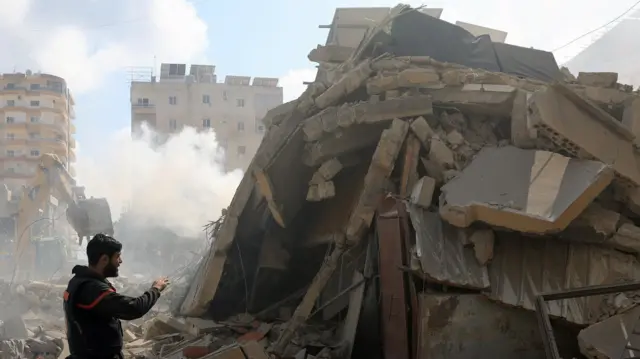
    A rescuer stands next to a pile of rubble at the site of an Israeli strike in Tyre, Lebanon, April 8, 2026.Image source, Reuters
    Image caption,

    A man stands next to a huge pile of rubble in Tyre, southern Lebanon

  9. Reports of numerous casualties across Lebanon following Israeli strikespublished at 14:18 BST

    Hugo Bachega
    Middle East correspondent, reporting from Lebanon

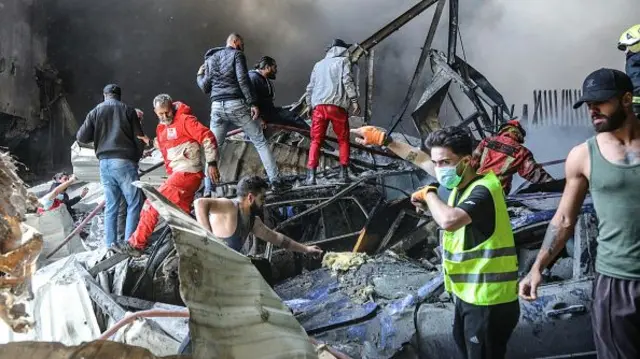
    A group of men climb over the smouldering wreckage of a building. A man in a safety vest and mask appears to be directing their movements.Image source, Getty Images

    There are reports of a high number of casualties across Lebanon, with hospitals overwhelmed and people believed to be under the rubble of collapsed buildings, after a large wave of Israeli air strikes.

    Israel described it as the largest wave of attacks in this conflict, hitting more than 100 of what it called Hezbollah command centres and military sites in 10 minutes.

    Attacks hit the southern suburbs of Beirut, southern Lebanon and the eastern Bekaa Valley.

    This happened hours after the office of the Israeli prime minister, Benjamin Netanyahu, denied the assertion by Pakistan, which helped mediate a ceasefire between the US and Iran, that the deal also covered the devastating conflict here.

  10. Israel says it is carrying out 'biggest strikes' across Lebanon since start of ground operationpublished at 14:08 BST

    Shortly before Hegseth started speaking, the Israel Defence Forces (IDF) announced its "biggest strikes" since the start of its ground operation in Lebanon, and Lebanese media are now reporting extensive bombardment in towns and cities across the country.

    IDF spokesperson Avichay Adraee says in a statement on X that "within 10 minutes and in several areas simultaneously" the army carried out strikes "targeting about 100 headquarters and military infrastructure belonging to Hezbollah".

    He quotes Chief of Staff General Eyal Zamir as saying the IDF will "exploit every opportunity" and continue to strike Hezbollah, adding: "We will continue the raids without stopping."

  11. Analysis

    Much left unclear after last-minute deal and Pentagon briefingpublished at 14:03 BST

    Bernd Debusmann Jr
    Reporting from the White House

    Defence Secretary Pete Hegseth and Joint Chiefs Chairman General Dan Caine clearly see the deal as a resounding, and complete, military victory - but significant questions remain about the broader deal.

    For one, it's unclear what exact circumstances would trigger a resumption of US strikes in Iran, although Hegseth said that American forces would "remain vigilant".

    US officials have also insisted - as Hegseth did in the briefing - that Iran's government is one that has already gone through "regime change", and is now more willing to negotiate.

    While Iran has clearly signalled a willingness to come to the table, it is by no means clear that the regime is transformed and no longer a threat to US interests in the region. Many observers have speculated that those in power may ultimately be more hardline.

    There are also few details on how, exactly, the US will secure the highly enriched uranium still in Iran, despite Hegseth saying that.

    Lastly, the statement last night from Pakistan suggested that the deal also includes Israeli operations in Lebanon, but strikes continue. We don't know how this will impact the larger negotiations.

    We can expect something of a victory lap from the White House today, and at her 13:00 Eastern (18:00 BST) briefing Karoline Leavitt is likely to be peppered with these and other questions.

  12. Infrastructure targets were 'locked and loaded', says Hegsethpublished at 13:51 BST

    Hegseth speaking to press at PentagonImage source, Reuters

    Yesterday, President Donald Trump threatened a "whole civilization".

    Hegseth is now asked if Iran did not come to the table and agree to a ceasefire deal, was the president prepared to wipe out Iran entirely.

    "Like I said, we had a target set locked and loaded of infrastructure, bridges, powerplants," Hegseth says.

    He goes on to call Iran a "terrorist regime" who use key infrastructure for dual use. He says the US also had targets on Kharg Island.

    Hegseth says Iran "understood" their ability to produce and generate power was in Washington's hands and "that's why they came to the table".

    "That type of threat is what brought them to the place where they effectively said 'we want to cut this deal'," he adds.

    Trump had posted on Truth Social on Tuesday: "A whole civilization will die tonight, never to be brought back again. I don’t want that to happen, but it probably will."

    That marks the end of our coverage of Hegseth and Caine's briefing.

  13. Defence secretary says US monitoring Iranian strikespublished at 13:44 BST

    Hegseth is asked about reports of Iran continuing to strike targets across the region and whether a "grace period" was being given to the country.

    The defence secretary responds by saying the US was monitoring the Iranian strikes, but said the country would be wise to "get the carrier pigeon to their troops" in remote locations to halt their attacks.

    He says that "it takes time" for ceasefires to take hold, but that he hopes and believes the agreement will be maintained.

    Our world news correspondent reported this morning that circulating orders to cease fire may be difficult for Iran

  14. 'It's a new group of people,' Hegseth says of Iranian regimepublished at 13:41 BST

    Asked whether Iran handing over its enriched uranium is a "non-negotiable" for the US, Hegseth replies that it has always been non-negotiable that Iran doesn't have nuclear weapons.

    He says Iran will either hand over its enriched material voluntarily or the US reserves the "opportunity" to react in a similar way to Midnight Hammer, the 2025 joint US-Israeli operation in which nuclear sites were bombed.

    He is also asked about whether the current regime in Tehran is different to the regime of the previous 47 years.

    Hegseth refers again to a list of senior figures who have been killed during the campaign.

    "It's a new group of people," he says, adding the current cohort has "a new calculus about what it means to negotiate" with the US.

  15. Hegseth: 'We're not going anywhere'published at 13:37 BST

    Hegseth and Caine speak to press at PentagonImage source, Reuters

    We're now turning to questions. First, Hegseth is asked what role the US military is playing in escorting vessels through the Strait of Hormuz. He's also asked what President Trump means by saying US troops will be "hanging around".

    "We're not going anywhere," is Hegseth's response.

    He says US troops will make sure Iran complies with the ceasefire and comes to the table for a deal. Troops will "stay put, stay ready, stay vigilant" and be "ready to re-start at a moment's notice".

    On the Strait of Hormuz, Hegseth cites the ceasefire's terms, saying Iran has agreed to let ships go through the strait.

    "That will be happening, they will be sailing," he adds.

  16. Rescue of downed pilots 'example' of US courage, suggests Cainepublished at 13:36 BST

    Caine also addresses last weekend's rescue.

    He says the mission to help the two downed US fighter pilots stands as a "direct example" of the courage of the US military during Operation Epic Fury.

    He adds: "This is a story that gets to the very heart and soul of who we are as a joint force."

    He says the joint force's performance was fuelled by their "deep commitment" to each other, but adds that he was "frankly not surprised" by what the troops had been able to do during the operation.

  17. US troops 'remain ready' if called on, says General Cainepublished at 13:27 BST

    Caine speaks to press at the PentagonImage source, Reuters

    Chairman of the Joint Chiefs of Staff General Dan Caine starts his address by remembering the 13 US troops killed in the war.

    "We're grateful for each of them and will continue to mourn their loss," Caine adds.

    He recalls President Trump's military objectives: destroy Iran's ballistic missile and drone capabilities, destroy Iran's navy and destroy their defence industrial base. Caine says that over 38 days the US joint force achieved those objectives.

    Caine welcomes the ceasefire but goes on to emphasise that "a ceasefire is a pause".

    US troops "remain ready if ordered or called upon to resume combat operations, with the same speed and precision we've demonstrated over the last 38 days, and we hope that's not the case," he adds.

  18. Defence secretary says ceasefire chance of 'real peace'published at 13:23 BST

    Hegseth names several senior Iranian figures killed in the US-Israeli military campaign, including the former supreme leader Ali Khamenei, who died at the outset of the war.

    He says Trump has been "clear from the beginning" that Iran will not have nuclear weapons, and that under the terms of the agreement being negotiated, any nuclear material that Iran "should not have" will be removed.

    The defence secretary suggests that the ceasefire provides a chance at "real peace and a real deal," adding that his department has done its part "for now," but that it will be standing ready to make sure Iran upholds every reasonable term.

    Hegseth also calls Israel a "brave, willing and capable ally" to the US. He says the rest of the world and other "so-called" allies of the US "should take some notes".

    Donald Trump has criticised allied Nato nations on a number of occasions in recent months, including the UK and Prime Minister Keir Starmer

  19. Trump chose mercy, Hegseth claimspublished at 13:17 BST

    Hegseth speaks to press at PentagonImage source, Reuters

    Iran accepted the ceasefire under "overwhelming pressure," Hegseth says.

    He says that if Iran had refused Washington's terms, then "the next targets would have been their power plants, their bridges, and oil and energy infrastructure".

    It would have taken Iran decades to rebuild, he suggests, but the regime leader recognised that a deal was better.

    "President Trump had the power to cripple Iran's entire economy in minutes, but he chose mercy," the defence secretary adds.

    A reminder that President Donald Trump first posted on social media about the ceasefire less than two hours before his deadline with Iran was set to expire

  20. Hegseth calls today 'big day for world peace'published at 13:14 BST

    Hegseth goes on to call today a "big day for world peace", and claims Iran "begged for this ceasefire", adding "they've had enough".

    He says it is a "capital V military victory," and claims that Iran's military has been rendered combat ineffective for years to come.

    "The world's leading state sponsor of terrorism proved utterly incapable of defending itself, its people or its territory," he adds.

    Hegseth says the US has achieved its military goals of wiping out Iran's navy and airforce - claiming the US owns "their skies".