Summary

  1. How we found the USS Abraham Lincoln and why it matterspublished at 17:10 GMT 16 February

    Thomas Copeland
    BBC Verify Live journalist

    We’ve spent much of today focused on the Middle East after the US Navy’s nuclear-powered aircraft carrier USS Abraham Lincoln was spotted on satellite images yesterday off the coast of Oman.

    Our verification and satellite experts have been tracking the US military build-up in the Gulf for weeks, as Washington continues to put pressure on Iran over its nuclear programme.

    Here’s a round-up of what we’ve looked at:

    Plus, the fact-checking team has also looked into the UK government’s plans to ramp up defence spending, including assessing how much the rise would cost and if it represents the largest increase since the end of the Cold War.

    We’re working on a full piece about the US military build-up in the Gulf now, so keep an eye on the BBC News front page or app this evening.

    BBC Verify banner
  2. USS Abraham Lincoln: Nuclear-powered giant projecting US military might overseaspublished at 17:00 GMT 16 February

    Thomas Copeland
    BBC Verify Live journalist

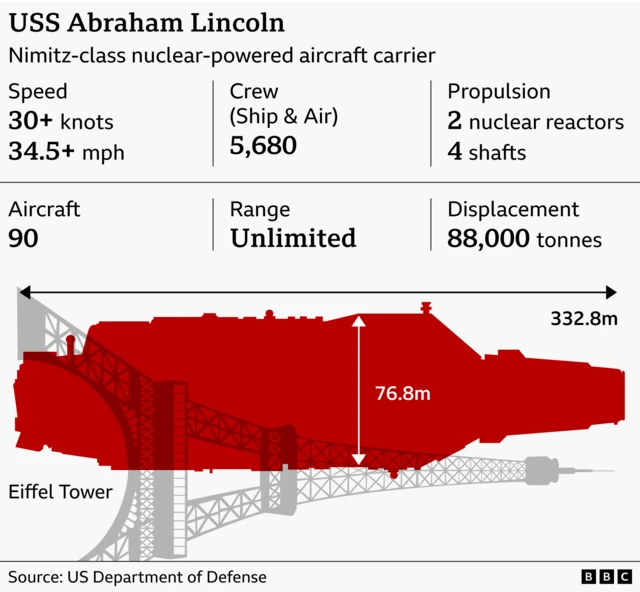
    We’ve been reporting today that the USS Abraham Lincoln aircraft carrier has been spotted in the Arabian Sea as the US ramps up pressure on Iran over its nuclear programme.

    The Nimitz-class aircraft carrier is one of the largest military ships in the world and the flagship of the the US Navy’s Carrier Strike Group Three, which also includes three Arleigh Burke class destroyers.

    The aircraft assigned to fly from the USS Abraham Lincoln are part of Carrier Air Wing Nine, made up of eight squadrons. Among the aircraft designed to operate from its flight deck include the F-35 Lighting II and F-18 Super Hornet fighter jets.

    The ship’s nuclear power system means it can stay at sea for long periods of time without needing to call into port, as it can be restocked with supplies by support vessels.

    A graphic detailing key features of USS Abraham Lincoln and also overlaying its silhouette with that of the Eiffel Twoer laid on its side - both are about the same size
  3. Is the UK planning the biggest increase in defence spending since the Cold War?published at 16:44 GMT 16 February

    Anthony Reuben
    BBC Verify senior journalist

    UK Foreign Secretary Yvette Cooper was asked by Laura Kuenssberg yesterday about the whether the government would be speeding up plans to increase defence spending.

    Cooper said that what they had already announced - the plan to spend 2.5% of the size of the economy measured by GDP on defence by April 2027 - ”is the biggest increase we’ve seen since the Cold War”.

    If you look at this chart from the House of Commons Library, external you’ll see that it doesn’t take much to achieve the biggest increase in defence spending since the Cold War.

    In the 1950s, defence spending was over 7% of GDP. By 1989 when the Berlin Wall came down it was 3.3% and since then it has at times fallen below 2% as successive governments took advantage of what’s been called the “peace dividend”.

    The plan to spend 2.5% of GDP on defence would clearly eclipse any small increases since the 1990s.

    This Flourish post cannot be displayed in your browser. Please enable Javascript or try a different browser.

  4. US military aircraft tracked from UK heading into eastern Mediterraneanpublished at 16:12 GMT 16 February

    Yi Ma
    BBC Verify researcher

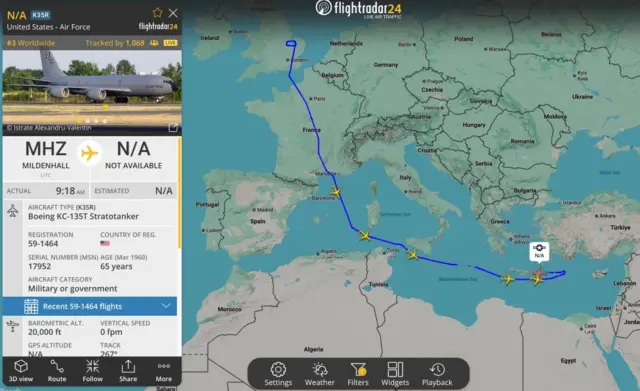
    A screengrab from Flightradar24 showing the six KC-135s flying from the UK towards CreteImage source, Flightradar24

    BBC Verify has been tracking US military aircraft movements in Europe and the Middle East in recent weeks as speculation continues about the potential strikes on Iran.

    Earlier today on public flight-tracking I saw at least six US Air Force KC-135 aerial refuelling tankers had left RAF Mildenhall in Suffolk, eastern England, and were heading south-east across France and through the Mediterranean.

    Data from Flightradar24 shows at least two of the tankers making an approach to the air base at Chania on the Greek island of Crete.

    We‘ll continue to monitor US military aircraft movements.

  5. US military build-up near Iran shows ‘more depth’ than Venezuela, expert sayspublished at 15:41 GMT 16 February

    Richard Irvine-Brown
    BBC Verify journalist

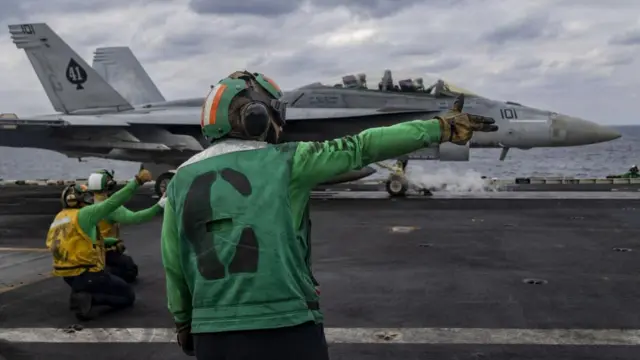
    A US F/A-18 Super Hornet is launched from the flightdeck of USS Abraham Lincoln on 1 FebruaryImage source, US Navy via EPA

    An expert has told BBC Verify that US military preparations in the Middle East show “more depth and sustainability” than those that came before the capture of Venezuela’s former President Nicolás Maduro in January, or the operation carrying out air strikes on Iran’s nuclear facilities in June 2025.

    Justin Crump, CEO of the risk and intelligence company Sibylline, assesses the accumulation of warships and aircraft in the region allows the US to “conduct a fairly intensive and sustained strike rate” of about 800 sorties a day.

    This would aim to ensure any Iranian response to US strikes was “ineffective”, he adds.

    US and Iranian officials set to meet in Switzerland on Tuesday to discuss curbs on Iran’s nuclear programme and the lifting of US economic sanctions.

    Crump sees the military build-up in the Arabian Sea and Mediterranean, combined with the eight air bases which the US can use in the region, as a “deterrent deployment” against Iran which is “capable of being scaled up or down”.

    US President Donald Trump could gradually ramp up pressure and be able to strike Iran while countering “all potential responses”, he told me.

  6. Behind my satellite search for aircraft carrier USS Abraham Lincolnpublished at 14:46 GMT 16 February

    Barbara Metzler
    BBC Verify senior data scientist

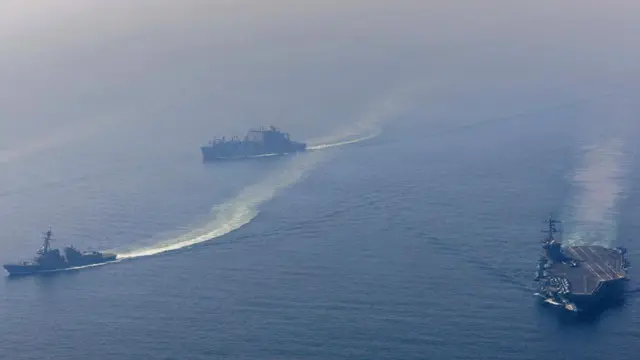
    USS Abraham Lincoln (far-right) seen in the Arabian Sea with two other ships of its carrier strike groupImage source, US Department of Defense via Reuters
    Image caption,

    The US Navy released an image of the Lincoln carrier strike group in the Arabian Sea on 6 February

    I have been trying to pin down the location of the aircraft carrier USS Abraham Lincoln ever since the US Navy announced three weeks ago that it had entered the Gulf region.

    It sounds simple but it isn’t.

    Satellites can only take brief snapshots when they happen to fly overhead and the carrier can be hundreds of kilometres from the coast, where imagery is captured less frequently than over land.

    We did get hints from elsewhere. On 26 January, flight-tracking websites picked up a US V-22 Osprey, external aircraft off the coast of Oman, suggesting a carrier might be operating nearby.

    But even with those hints, I was still scanning through huge stretches of ocean pixel-by-pixel, which can can take hours.

    We use an artificial intelligence tool to narrow it down by flagging ship-like shapes in satellite images. I then verify everything the tool flags myself, hunting for the carrier’s distinctive outline.

    Today, after days of searching, we finally spotted USS Abraham Lincoln roughly 240km (150 miles) off the coast of Oman.

  7. Venezuela and Iran: How does US military build-up compare?published at 14:11 GMT 16 February

    Alex Murray
    BBC Verify journalist

    The military build-up near Iran is not the first ramping up of US forces BBC Verify has examined this year. We have also tracked deployments in the Caribbean ahead of the seizure of former President Nicolás Maduro in Venezuela.

    So how do these situations compare?

    In naval terms, these deployments are currently quite similar. Both feature a carrier strike group - an aircraft carrier accompanied by three destroyers - and several destroyers operating independently.

    The Caribbean also saw the deployment of amphibious assault ships, which can be used as launch platforms for helicopter operations like the capture of Maduro.

    But it’s important to note these deployments face very different situations:

    Venezuela

    • A country relatively close to both the mainland US and a large military base in Puerto Rico, a US territory
    • The Venezuelan military is generally regarded as lacking in sophistication, as well as the ability to either defend or retaliate

    Iran

    • Has a much more powerful military, capable of hitting US bases across a large geographic region
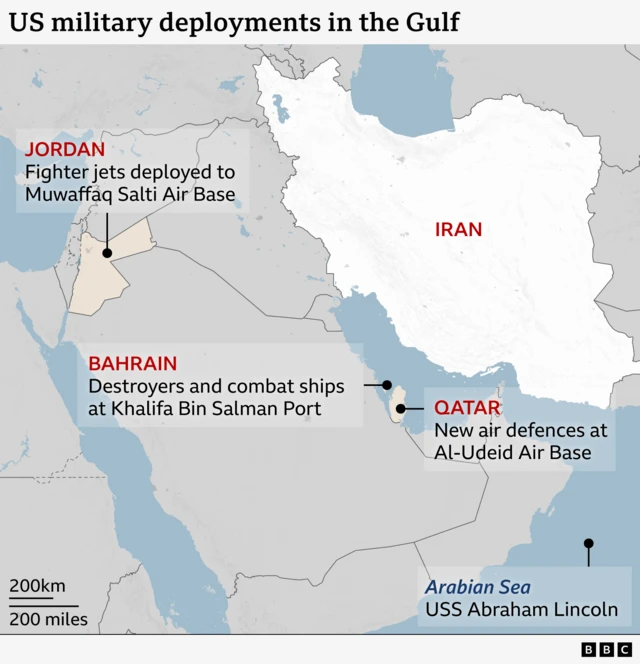
    • The US military relies on a network of agreements with allies in the Middle East, including Qatar, Bahrain, Jordan and Israel, to operate
    • Some allies have signalled concerns about Iran retaliating against them directly, which could limit US options
    Map of the Middle East showing the recent US military deployments around Iran, in the Gulf. Labels on the map say that in Jordan, fighter jets were deployed to Muwaffaq Salti Air Base; In Bahrain, destroyers and combat ships are at Khalifa Bin Salman Port; In Qatar, new air defences have been installed at Al-Udeid Air Base. And in the Arabian Sea, the carrier USS Abraham Lincoln.
  8. Ukrainian university damaged in Russian attack, says rectorpublished at 13:48 GMT 16 February

    Emma Pengelly
    BBC Verify journalist

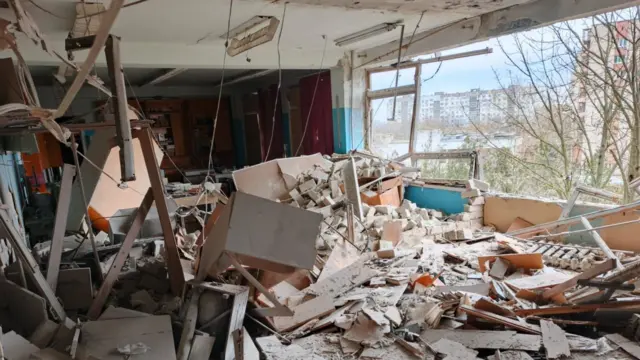
    A damaged classroom at Kherson State UniversityImage source, Oleksandr Spivakovskiy

    We’re examining pictures being shared on social media following Russian strikes across Ukraine overnight, including extensive damage to a university in the south.

    According to Kherson State University’s rector Oleksandr Spivakovskiy, physics laboratories were damaged in the strikes.

    We’ve verified photos shared by Spivakovskiy on Facebook showing windows of a building blown out and a classroom filled with rubble and bricks.

    Since the start of the year, he has reported at least three other Russian attacks which have damaged the university’s buildings.

    Local authorities have reported people injured in attacks elsewhere in Kherson region, as well as in Zaporizhzhia, Kharkiv and Sumy regions.

    At least 16 people have been wounded across Ukraine - and rolling power outages have been reported in parts of Donetsk, Dnipropetrovsk, Cherkasy and Odesa regions.

  9. How much would increased UK defence spending cost?published at 12:35 GMT 16 February

    Anthony Reuben
    BBC Verify senior journalist

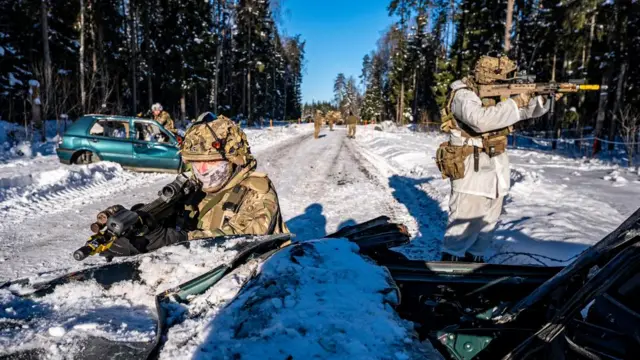
    UK soldiers on exercise in Estonia earlier this monthImage source, PA Media

    It’s been reported this morning that the UK government is considering speeding up planned increases to defence spending.

    Defence spending is usually expressed as a proportion of the size of the economy measured by GDP.

    Last year, the UK spent 2.4% of GDP on defence, according to Nato, external.

    At the moment the government is committed to spending 2.5% of GDP by April 2027 with an “ambition” to spend 3% in the next parliament and meet Nato’s target to spend 3.5% on core defence by 2035.

    The government is now considering spending 3% by the end of this parliament - which could run until August 2029.

    According to the Office for Budget Responsibility, external, which makes forecasts for the government, GDP in 2029-30 will be £3.56tn, so we can estimate:

    • 2.5% of GDP will be £89bn
    • 3% of GDP will be £107bn
    • 3.5% of GDP will be 125bn
  10. Tracking oil tanker intercepted by US in Indian Oceanpublished at 11:46 GMT 16 February

    Kumar Malhotra
    BBC Verify senior journalist

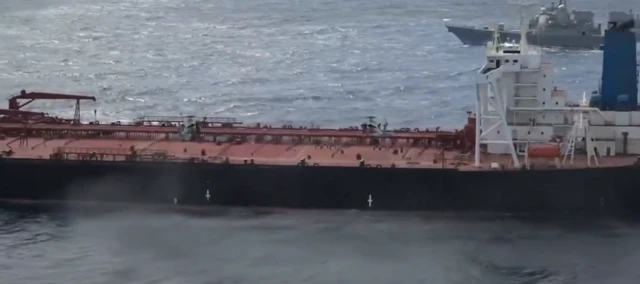
    A screenshot taken from the US Department of Defense video showing the superstructure of Veronica IIIImage source, US Department of Defense

    We’ve been checking the movements of an oil tanker, which the US Department of Defense says it has intercepted in the Indian Ocean.

    The Pentagon said the vessel is Veronica III, which is under US-imposed sanctions. The ship is the second tanker to be intercepted in the Indian Ocean as part of crackdown on the transportation of sanctioned oil.

    The US released a video of the operation to board the ship. In the footage, the ship’s bridge can be seen - and it matches still images for Veronica III on the MarineTraffic tracking site.

    The vessel hadn’t been transmitting its position for a while - but it was seen on MarineTraffic at 07:05 GMT on 15 February moving in a north-easterly direction and has been regularly transmitting since.

    The Department of Defense posted about the interception at 11:35 GMT on 15 February saying it had taken place overnight. It’s not clear what the vessel’s destination might be.

    Veronica III was reported by the monitoring group TankerTrackers.com in January to have left Venezuela, carrying crude and fuel oil., external

  11. Get involved with BBC Verifypublished at 11:08 GMT 16 February

    Rob Corp
    BBC Verify Live editor

    We’re keen to hear what you think the BBC Verify team should be looking into.

    We're interested in investigating claims you may've seen online in your social feeds. We're also keen to know if you've think an image may have been made using artificial intelligence to spread disinformation.

    You can also get in touch with BBC Verify if you've got a question about how we verify video posted online or work with satellite imagery.

    You can send your suggestions to the team here.

    BBC Verify banner
  12. Satellite imagery reveals location of US aircraft carrierpublished at 10:53 GMT 16 February

    Barbara Metzler
    BBC Verify senior data scientist

    BBC Verify has been monitoring the US military build-up in the Middle East over the last few weeks, as Washington continues to put pressure on the Iranian government over its nuclear programme.

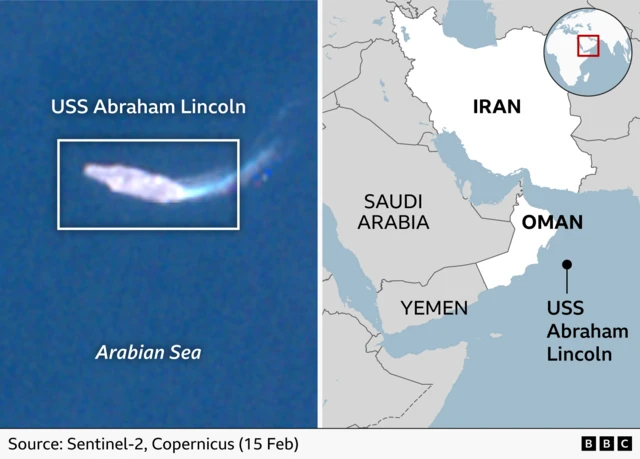
    After reports the US aircraft carrier USS Abraham Lincoln arrived in the Gulf region on 26 January, we have located it in satellite imagery captured yesterday. The nuclear-powered carrier had not been visible in images we reviewed until that point.

    Using publicly available images from the European Sentinel-2 satellites, external, which are widely used for ship-spotting, we identified the Abraham Lincoln in the Arabian Sea - around 150 miles (240km) off the coast of Oman.

    US officials have also said a second aircraft carrier, USS Gerald R Ford, is being deployed to join the Abraham Lincoln and other military assets recently deployed to the region.

    A BBC graphic showing (left) Copernicus satellite image of USS Abraham Lincoln and (right) its location in the Arabian Sea off the coast of Oman
  13. Monday at BBC Verifypublished at 10:30 GMT 16 February

    Rob Corp
    BBC Verify Live editor

    Good morning.

    Over the weekend BBC Verify’s journalists saw reports that the US Navy aircraft carrier USS Abraham Lincoln had been spotted in the Arabian Sea by a satellite.

    Confirming the warship’s location - off the coast of Oman - adds to what we know about the US military build-up in the Middle East as Washington continues to put pressure on Iran over its nuclear programme.

    After the US military boarded a second oil tanker in the Indian Ocean as part of acrackdown on sanctioned oil exports from Venezuela we’re using ship-tracking to see where it was intercepted. We’re checking publicly available tracking sites to see if we can learn what it is carrying and where it is heading.

    Elsewhere, we’re checking reports that strikes overnight have caused damage to energy infrastructure in the Russian cities of Belgorod and Bryansk, both near the border with Ukraine. The government in Kyiv has said it will target energy facilities in Russia following repeated attacks by Moscow on power stations and networks across Ukraine this winter.

    More on all those stories to come across the day.

    BBC Verify banner