Summary

  1. Funeral to be held for top Iranian officials killed in strikespublished at 09:08 GMT

    Ali Larijani speaking to the pressImage source, Getty Images
    Image caption,

    Larijani is the most senior Iranian official to have been killed since Supreme Leader Ayatollah Ali Khamenei

    A funeral for Iranian security chief Ali Larijani and Gholamreza Soleimani, the head of the paramilitary Basij force, will be held in Tehran today, reports the Islamic Revolutionary Guard Corps (IRGC) affiliated news agency, Tasnim.

    The ceremony, which is set to begin at 13:30 local time in Tehran's Enghelab Square, is also being held for the 84 sailors killed when the US sank Iranian warship the Iris Dena with a torpedo on 4 March.

    Iran announced on Tuesday that both Larijani and Soleimani had been killed in Israeli strikes, with Iranian army chief Amir Hatami threatening "decisive" retaliation following the deaths.

  2. Trump has 'completely misunderstood' Nato, says former UK diplomatpublished at 08:50 GMT

    US President Donald Trump in a suit and tieImage source, EPA

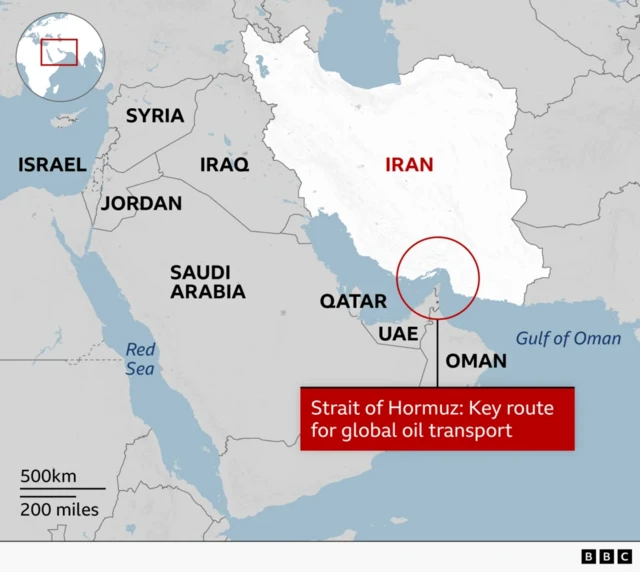
    US President Donald Trump has accused Nato members of making a "foolish mistake" by refusing to help secure the Strait of Hormuz, through which about one-fifth of the world's oil passed pre-war.

    Speaking in the Oval Office on Tuesday, Trump said he had been informed by most allies that they did not want to get involved in the conflict.

    "We don't need any help" from Nato, but "they should've been there", he said, calling their reluctance to send mine-sweeping vessels to the Gulf "unfair".

    Lord Peter Ricketts, a former permanent representative to Nato and ex-chair of the UK's National Security Council, tells BBC Radio 5 Live this morning that Trump has "completely misunderstood Nato", which was "set up as a defensive alliance".

    "[This] a war of US choosing. We were not consulted on it. And it was never part of the Nato deal that allies had to follow America into any war that it chose to undertake.

    He adds: "What he means, of course, is that if we are going to support Nato countries in your area, then we expect your support everywhere else." This is "a wake-up call to all European countries" to work more closely together.

    A locator graphic showing the location of the Strait of Hormuz in relation to Iran and other Gulf states
    Image caption,

    Only a handful of vessels carrying Iranian oil have managed to pass through the Strait since hostilities began on 28 February

  3. Bunker busters a sign US thinks Iran keeping weapons deep undergroundpublished at 08:23 GMT

    Chris Partridge
    Weapons analyst

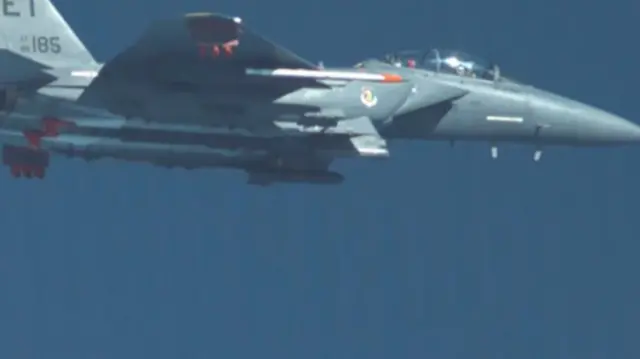
    FILE PICTURES OF GBU-72Image source, USAF
    Image caption,

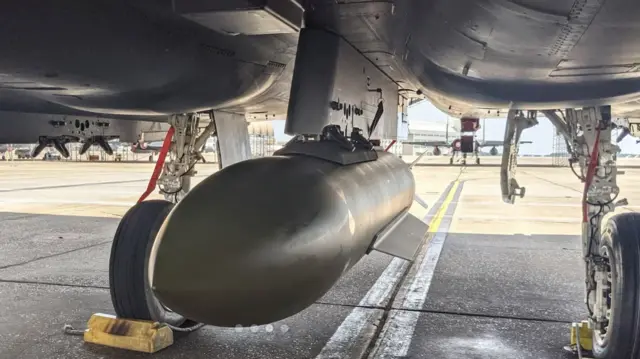
    The GBU-72 bunker buster can be carried by the F-15E Strike Eagles

    News that the US is using 5,000lb (2270kg) bunker busters is further evidence that it thinks Iran keeps many of its weapons buried deep underground.

    US Central Command (Centcom) did not specify which penetrators it used against what it called hardened Iranian missile sites along Iran’s coastline near the Strait of Hormuz.

    But there are two known variants that fit the criteria: the GBU (Guided Bomb Unit)-28 laser-guided bomb and the newer GBU-72 Advanced 5K Penetrator. The latter is the one more likely to have been deployed.

    First tested in 2021, the bomb is a large Joint Direct Attack Munition (JDAM) free-fall precision munition guided to target by satellites and Inertial Navigation System.

    FILE PICTURES OF GBU-72Image source, USAF

    At the time of testing, the US Air Force (USAF) said the GBU-72 was "developed to overcome hardened deeply buried target challenges and designed for both fighter and bomber aircraft".

    “The weapon design and its projected effectiveness were developed using advanced modeling and simulation techniques and processes before the first warhead was forged,” it added.

    Despite its large size, the GBU-72 can be carried by F-15E Strike Eagles, giving military planners greater flexibility in deployment by not relying on B1-Bs, for example, that operate out of RAF Fairford in England.

    Both the US and Israel have pounded Iran’s missile and drone infrastructure, but Tehran’s weapons still pose a significant threat.

    Yesterday, the Islamic Revolutionary Guard Corps said it had targeted Tel Aviv in Israel with Khorramshahr 4 and Qadr missiles - both of which carry multiple warheads - in a statement read on state TV. Footage on social media strongly suggests cluster munitions are being used by Iran.

  4. Iran executes man accused of spying for Israel during 12-day warpublished at 08:17 GMT

    Ghoncheh Habibiazad
    Senior reporter, BBC Persian

    Iranian media reports that a man described as an “Israeli spy” was executed today.

    The man, identified as Koroush Keyvani, was arrested during the 12-day war with Israel in June 2025, accused of passing images and information about the country’s “sensitive sites” to the Israeli intelligence agency, Mossad, according to a report by the Islamic Revolutionary Guard Corps affiliated news agency, Tasnim.

    It reports that Keyvani was initially identified by Israeli security in Sweden in 2023 after clicking on an online advertisement for group trips.

    The report states that he was then recruited by a Mossad officer, and, after two years of training in six European countries and in Tel Aviv, he was sent to Iran to carry out operations.

    The BBC cannot independently verify the claims and accusations in Tasnim’s report.

  5. Israel says 192 in hospital following Iranian strikespublished at 07:57 GMT

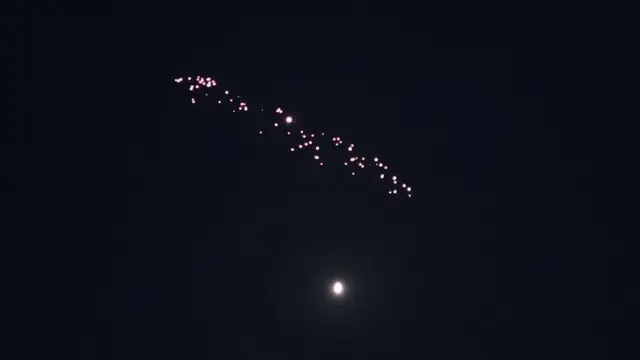
    Streaks of fire and light cross the night sky as an Israeli interceptor strikes an Iranian missile amid the U.S.-Israeli conflict with Iran, over Tel AvivImage source, Reuters
    Image caption,

    It follows Iranian strikes that killed a man and a women in their 70s in Tel Aviv overnight

    Israel's health ministry says 192 people have been injured and taken to hospital in the past 24 hours.

    The health ministry says four of those injured are in "moderate" condition, while 177 are being treated for "minor injuries". It is not clear what condition the remaining 11 people are in.

    It adds that 3,727 people have been admitted to hospital since the beginning of the conflict.

  6. IDF renews evacuation order for southern Lebanonpublished at 07:30 GMT

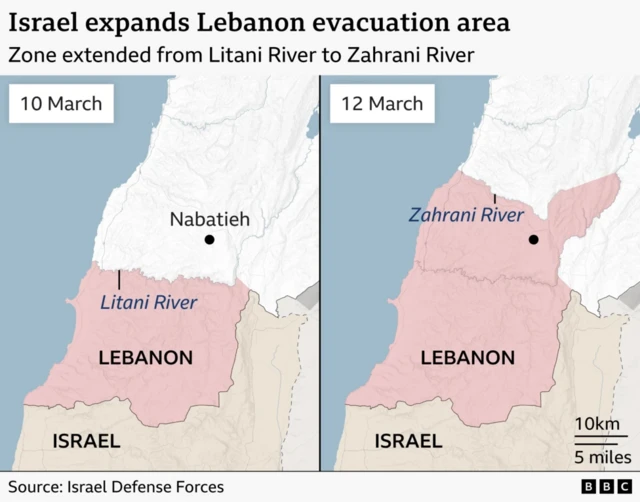
    The Israel Defence Forces (IDF) has issued another evacuation order for residents of southern Lebanon who are south of the Zahrani river, about 40km from the border.

    Israel's military last week expanded its evacuation order for southern Lebanon, telling civilians to immediately move north of the river, about 40km from the border.

    In a statement on X, IDF spokesperson Avichai Adraee said: "Hezbollah terrorist activities are forcing the IDF to operate forcefully against them in that area, and they have no intention of harming you...

    "To ensure your safety we urge you to move immediately to the area north of the Zahrani River. Remaining south of the Zahrani River could endanger you and the lives of your families."

    It follows a wave of Israeli strikes on Lebanon overnight and into this morning.

    A graphic showing the change in the evacuation zone
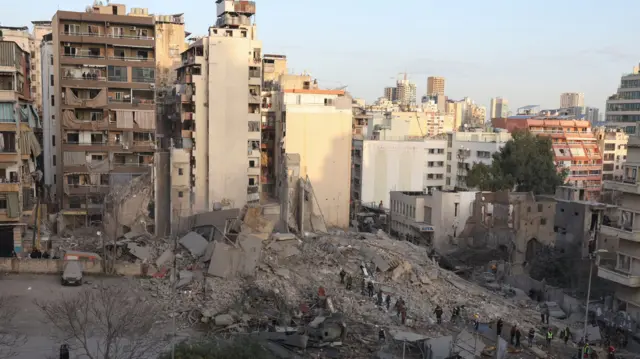
  7. Buildings reduced to rubble in central Beirutpublished at 07:25 GMT

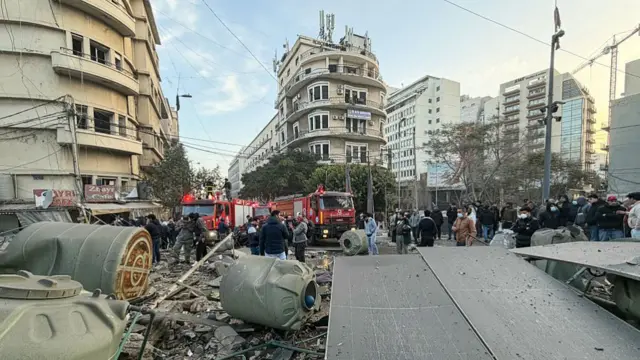
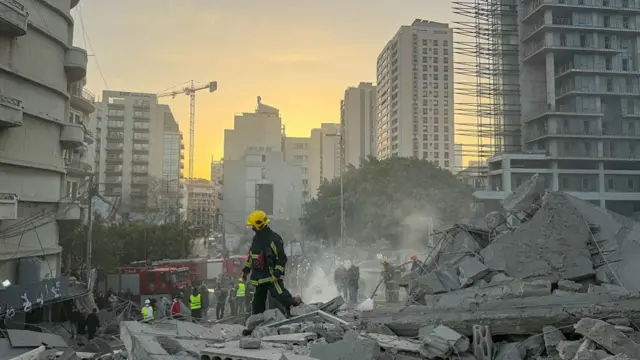
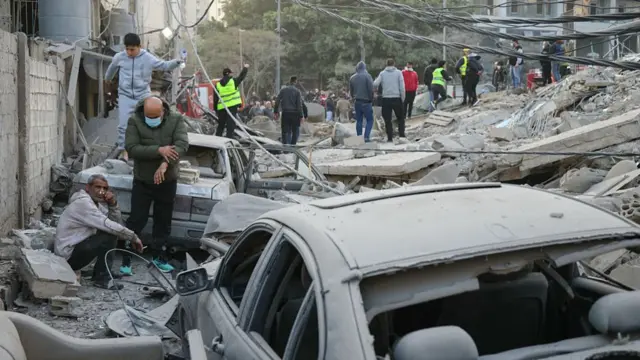
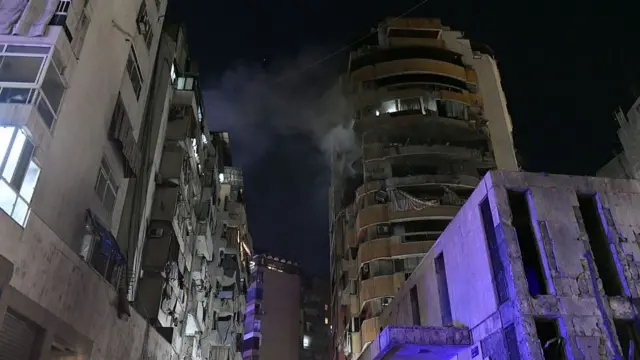
    New images show the extent of damage following Israeli strikes on central Beirut overnight.

    Lebanon's health ministry has so far reported that at least six were killed and 24 injured in the attacks.

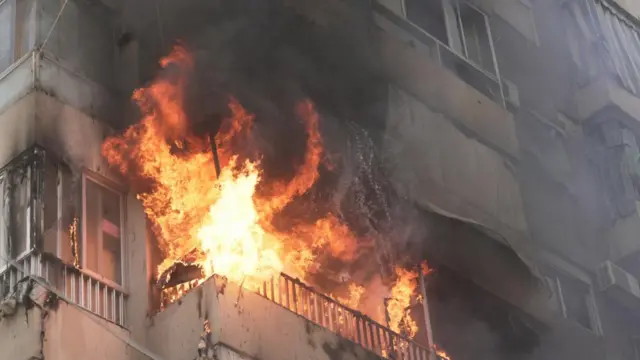
    Flames engulf a building following an Israeli air strike in BeirutImage source, Reuters
    Building reduced to rubble in central Beirut following Israeli strikes overnightImage source, Getty Images
    Building reduced to rubble in central Beirut following Israeli strikes overnightImage source, Getty Images
    Building reduced to rubble in central Beirut following Israeli strikes overnightImage source, Getty Images
  8. Israel attacks central Beirut as Iran renews attacks on Gulf statespublished at 07:12 GMT

    Emergency personnel work at the site of a collapsed building, in the aftermath of an Israeli strike, following an escalation between Hezbollah and Israel amid the U.S.-Israeli conflict with Iran, in central Beirut's Bachoura neighbourhood, Lebanon, March 18,Image source, Reuters
    Image caption,

    At least six have been reported killed in Israeli strikes in central Beirut, with a further 24 injured

    Waves of strikes have been reported across the Middle East overnight. Here's the latest.

    • At least six people have been killed in Israeli attacks on central Beirut, according to Lebanon's health ministry
    • One of the blasts flattened a building in Beirut's city centre.This isn't the so-called Hezbollah heartland in the south, but an surrounded by businesses and hotels, writes the BBC's Wyre Davies from the scene
    • In Tel Aviv, Israel, two people have been killed following Iranian strikes, after Tehran vowed to retaliate for the killing of security chief Ali Larijani
    • Explosions were also reported at the US embassy compound in Iraq's capital, Baghdad, in the early hours
    • Elsewhere in the Gulf, the United Arab Emirates, Kuwait, Saudi Arabia and Qatar all reported intercepting attacks, while air defence alerts sounded in Bahrain
    • Late on Tuesday, the US announced that it had struck Iranian missile sites along the Strait of Hormuz with bombs that are capable of penetrating bunkers
  9. Kuwait and Qatar report interceptions - as alerts sound in Bahrainpublished at 07:00 GMT

    Elsewhere in the Gulf, Kuwait says its air defences were deployed to intercept missile and drone attacks shortly before 00:00 GMT.

    At around the same time, authorities in Bahrain sounded its sirens and issued a warning for its residents to take shelter.

    Qatar's Ministry of Defence says it also intercepted a missile attack targeting its territory in the early hours of Wednesday.

  10. Saudi Arabia says it shot down drone headed for embassy districtpublished at 06:43 GMT

    Saudi Arabia's Ministry of Defence says it has shot down a drone that was headed towards its embassy district, in a statement on X.

    We're also seeing reports of blasts in Dubai and Baghdad in Iraq this morning, as Iran renews its attacks on Gulf states.

  11. Analysis

    Two blasts heard in Dubai as air defence alerts soundpublished at 06:37 GMT

    Azadeh Moshiri
    South Asia correspondent, in Dubai

    At 10:10 local time (06:10 GMT), our team received yet another alert on our phones warning of incoming missile threats - this time, while we were on air on a balcony.

    About 10 seconds later, we heard two blasts in the distance.

    Dubai is far emptier than usual, but as we peered down into the city, construction workers were carrying on with their tasks. Cars were still driving.

    These phone alerts, and the sound of explosions, have become a common occurrence for residents who have chosen to stay.

    The UAE has had to deal with more than 2,000 missiles and drones since the start of the war. The ministry of defence insists they have intercepted most of these attacks, and these sounds are their air defence system at work, guarding the country.

    But what is harder to protect is the image of safety and stability the UAE has worked so hard to build.

    According to Dubai's media office, authorities say they have intercepted the attacks, with no injuries reported.

  12. UAE 'responding to missile threat' as Iran renews Gulf attackspublished at 06:29 GMT

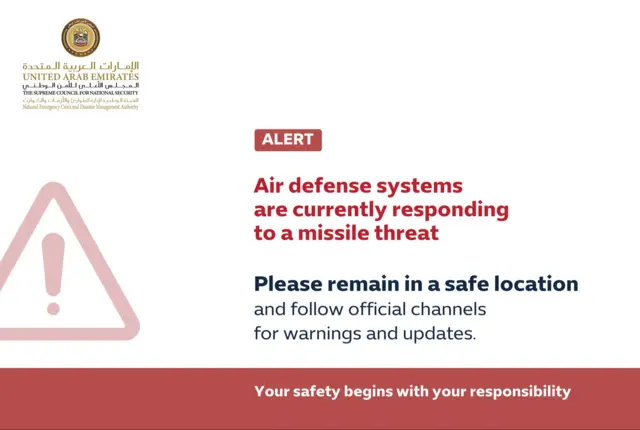
    Emergency teams in the United Arab Emirates say they are "responding to missile threats", as Iran renews its attack on neighbouring Gulf countries after the death of security chief Ali Larijani.

    In a statement on X, the UAE National Emergency Crisis and Disaster Management Authority says: "Air defence systems are currently responding to a missile threat.

    "Please remain in a safe location and follow official channels for warnings and updates."

    The Reuters news agency is reporting loud explosions in Dubai.

    A graphic with the words: "Air defence systems are currently responding to a missile threat. Please remain in a safe location and follow official channels for warnings and updates"Image source, UAE National Emergency Crisis and Disaster
  13. Iran hits Israel with cluster warheads in overnight retaliatory strikepublished at 06:19 GMT

    Yolande Knell
    Middle East correspondent, in Jerusalem

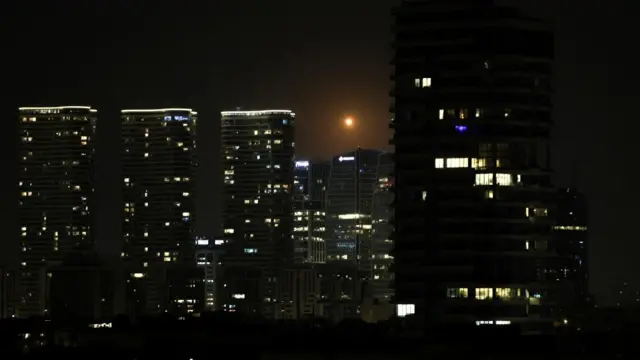
    Iran fired missiles carrying cluster warheads at Tel Aviv overnight in what state television said was retaliation for Israel’s killing of its security chief Ali Larijani.

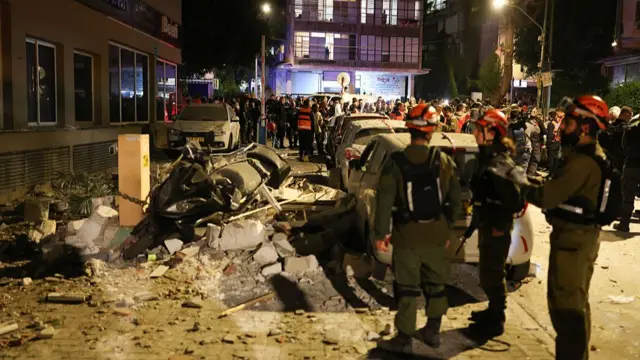
    Two people were killed when their apartment building was hit by bomb fragments.

    Arab Gulf states have also come under renewed Iranian missile and drone fire.

    After Hezbollah kept up its rocket attacks into northern Israel overnight, an Israeli air strike caused a large explosion in central Beirut. Israel’s military has also hit southern and eastern Lebanon as it intensifies its campaign against the Iran-backed armed group.

    As the US and Israel continue to attack Iran, the head of the International Atomic Energy Agency, Rafael Grossi, has repeated his call for maximum restraint to avoid a nuclear accident. On Tuesday evening a projectile hit near the Bushehr nuclear power plant, but there were no reports of damage.

    Streaks of fire and light cross the night sky as an Israeli interceptor strikes an Iranian missile amid the U.S.-Israeli conflict with Iran, over Tel AvivImage source, Reuters
    Image caption,

    Israel intercepts an Iranian missile over Tel Aviv during Tehran's retaliatory strikes

  14. Israeli strike completely demolishes building in central Beirutpublished at 05:51 GMT

    Wyre Davies
    Reporting from Lebanon

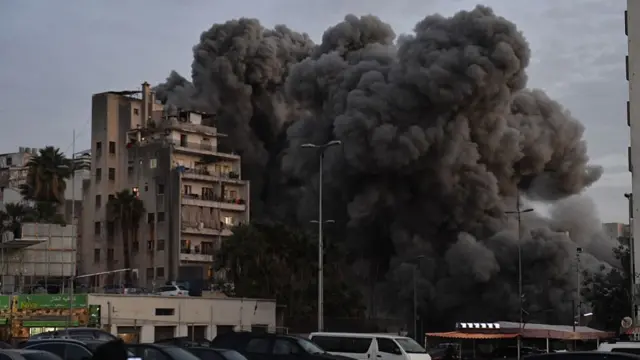
    This is the scene of the latest Israeli airstrike, right in the heart of central Beirut, Lebanon's capital.

    We were jolted awake at around 05:00 this morning by the sound of the blast. This isn’t the so-called Hezbollah heartland of southern Beirut - this is the centre of the city, surrounded by businesses and hotels, and just a short distance from where we’re staying.

    One building is now a pile of rubble. It had been targeted several times in recent days, but this morning it was completely demolished.

    Israel says it is targeting not only Hezbollah fighters and leaders, but also businesses it claims are linked to the group and help finance its military operations.

    Overnight, there were also intensified airstrikes in the south of the country, particularly near the city of Tyre, where thousands of people have been forced to evacuate.

    The Lebanese government says around one million people have now been displaced by the conflict, and more than 800 have been killed.

    Media caption,

    At the scene of Israeli strikes in the heart of Beirut

  15. Beirut wakes to damage from overnight Israeli strikespublished at 05:40 GMT

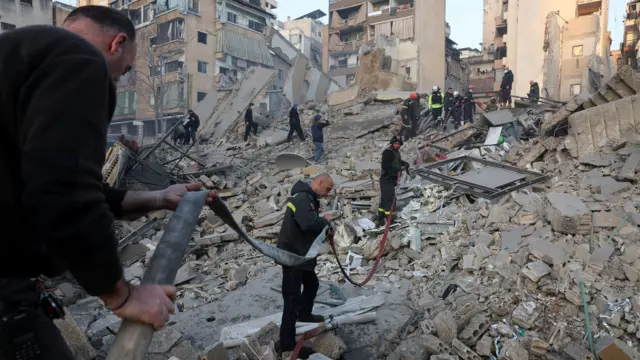
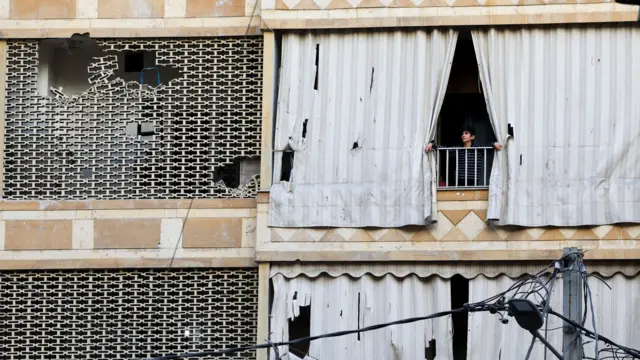
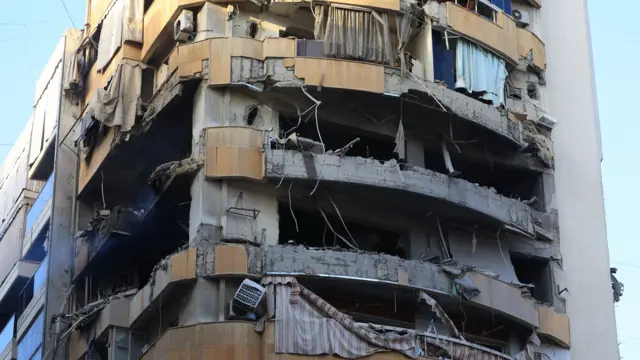
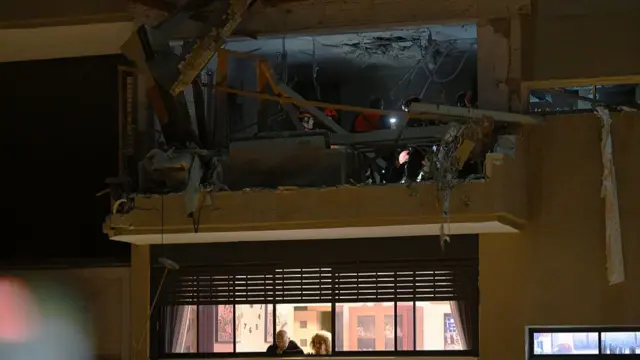
    These pictures from Beirut, Lebanon's capital city, show the extent of the damage after Israeli strikes overnight.

    The health ministry says at least six people were killed and 24 others injured - that number was given before another volley of missiles which came after Israel issued an evacuation warning.

    Lebanon was pulled into this conflict a few weeks ago when Hezbollah, a Lebanese Shia Muslim political and military group, launched rockets and drones into Israel in retaliation for the assassination of Iran's supreme leader and repeated Israeli strikes.

    Israeli strikes hit a building in central Beirut's Bachoura neighbourhoodImage source, Reuters
    Emergency personnel work at the site of a collapsed building in central Beirut's Bachoura neighbourhoodImage source, Reuters
    A person looks out of a balcony in the aftermath of an Israeli strike in Bierut's Zuqaq al-Blat districtImage source, Reuters
    A bombed out building in the Zuqaq al-Blat district in central BeirutImage source, Reuters
  16. Death of Ali Larijani deepens crisis at heart of Iran's leadershippublished at 05:32 GMT

    Amir Azimi
    Editor, BBC Persian

    Iran's security chief Ali LarijaniImage source, Anadolu via Getty Images
    Image caption,

    Larijani was viewed as one of Iran's most influential political figures

    The Israeli air strike which killed Iran's security chief, Ali Larijani, has removed one of the Islamic Republic's most experienced and influential policy makers at a critical moment.

    Larijani was not a military commander, but he was a central figure in shaping Iran's strategic decisions.

    As secretary of the Supreme National Security Council, he sat at the heart of decision-making on war, diplomacy, and national security.

    His voice carried weight across the system, particularly in managing Iran's confrontation with the United States and Israel.

    His death comes amid a broader campaign in which several senior Iranian officials and commanders have been killed within a matter of weeks. This pattern suggests a sustained effort to weaken Iran's leadership structure during wartime.

    Despite his hardline stance against the West, Larijani was often described inside Iran as a pragmatist. He combined ideological loyalty with a technocratic approach, favouring calculated strategy over rhetoric.

    You can read more about the impact of his death here.

  17. Aftermath of deadly Iranian strikes on Tel Avivpublished at 05:12 GMT

    Pictures have emerged from Tel Aviv, in Israel, where a man and a woman in their 70s were killed by an Iranian missile strike overnight.

    Damage from a missile attack on a building in the Tel Aviv suburb of Ramat GanImage source, Alexi J Rosenfeld via Getty Images
    Image caption,

    Emergency workers respond to a missile attack in the Tel Aviv suburb of Ramat Gan

    Emergency services respond to damage from an Iranian missile strike in Ramat GanImage source, Ilia Yefimovich via Getty Images
    Missiles launched from Iran streak across the sky over Tel AvivImage source, Anadolu via Getty Images
    Image caption,

    Missiles launched from Iran streak across the sky over Tel Aviv

  18. 'No one dares to go outside': Unrelenting dread for Iranianspublished at 04:54 GMT

    Media caption,

    Watch: Iranians show daily life under air strikes and regime crackdown

    For many Iranians, there is a fear of all sides: American and Israeli bombing of their cities as well as repression from supporters of the regime.

    But more than two weeks of war has also left many hopeful that this moment could lead to the end of the current regime, which has a history of heavy-handed suppression of dissent, even as people despise the foreign bombs that have sent plumes of toxic smoke into the air.

    The BBC has obtained footage and interviews from the Iranian capital Tehran which evoke a city of strained nerves, of constant waiting for the next air strike and relentless fear of the state security apparatus.

    Baran – not her real name – is a businesswoman in her thirties. She is now too scared to go to work. "With the start of the drone attacks, no one dares to go outside. If I open my door and step out, it is like gambling with my life."

    Read Fergal Keane's report here.

  19. US hits Iranian missile sites near Strait of Hormuzpublished at 04:43 GMT

    The US military says it has struck Iranian missile sites along the Strait of Hormuz with powerful bombs that are capable of penetrating bunkers.

    In a post on X, the US Central Command said US forces had "successfully employed multiple 5,000-pound deep penetrator munitions on hardened Iranian missile sites" along Iran's coastline of the strait.

    "The Iranian anti-ship cruise missiles in these sites posed a risk to international shipping in the strait," the US military says.

    Iran’s effective closure of the waterway - through which roughly 20% of the world’s oil shipments move - has sharply disrupted maritime traffic and contributed to rising global oil prices.

    The huge bombs are likely to be similar to the "bunker busters" that the US used when it attacked three underground nuclear sites in Iran last year.

    Unlike conventional bombs, bunker busters are not designed to explode in the air, on the ground or surface of a target. They are encased in heavy, hardened steel and are made to penetrate deep into the ground before detonating.

    Correction: We have removed an image from this post which was incorrectly captioned as the Strait of Hormuz.

  20. Blasts heard in Beirut after Israel issues evacuation warningpublished at 04:33 GMT
    Breaking

    A view of the structural damage following air strikes carried out by the Israeli military in the Balata Street and El Basta areas of central Beirut, LebanonImage source, Anadolu via Getty Images
    Image caption,

    Damage after Israeli air strikes in the Balata Street and El Basta areas of central Beirut

    We're hearing more reports of an Israeli airstrike in another central suburb in Lebanon's capital of Beirut.

    A witness told Reuters news agency that they heard loud explosions in the city's Bachoura neighbourhood after the Israeli military issued a statement urging the evacuation of a building there.

    For context: Lebanon was pulled into this conflict a few weeks ago when Hezbollah, a Lebanese Shia Muslim political and military group, launched rockets and drones into Israel in retaliation for the assassination of Iran's supreme leader and repeated Israeli strikes.