Rocky wonder 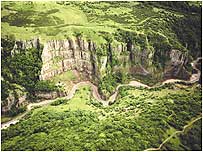 | Cheddar is Britain's largest gorge, boasting an elaborate cave system and limestone cliffs which rise spectacularly from the valley floor. It's also great for wildlife from bats to bugs!
| Cheddar Gorge - a natural wonder.
Photo - Cheddar Caves and Gorge |
Cheddar Gorge lies on the southern edge of the Mendip Hills in Somerset, and is a major tourist attraction, especially in summer.
Cheddar Caves
 Carved out in the Ice Age, the cathedral-sized caves are breathtakingly enormous and you might even run into a distant relative - Cheddar Man. Carved out in the Ice Age, the cathedral-sized caves are breathtakingly enormous and you might even run into a distant relative - Cheddar Man.
Britain's oldest complete skeleton was discovered at Cheddar Caves in 1903, having been buried below ground for 9,000 years.
As well as human life, wildlife has been an inhabitant of these caves for centuries including the British Cave Spider. There's also a colony of Lesser Horseshoe Bats, a highly protected species which don't like to be disturbed. There are at least three roosts in the caves and visitors report regular sightings of them flitting about. In the afternoon the bats start waking up and gradually become more active. Bat adventure  In the evening the bats leave the cave and hunt around the woodlands catching insects. In the evening the bats leave the cave and hunt around the woodlands catching insects.
These creatures have an amazing ability to find their way around in the dark using a bat version of sonar - a series of sound bursts sent out at a frequency higher than humans can hear. There are estimated to be only around 14,000 Lesser Horse Shoe Bats in Britain and all of those confined to Wales and the South West of England. Cheddar Caves and their three roosts are an important stronghold for the species. Whilst in the caves, visitors are guaranteed to see the Cave Spiders, but a bat sighting will be more down to chance. Generally speaking, the later in the day you visit the more likely you will be to see them, although sometimes the bats can be spotted around midday when they become restless.
From top to bottom
 A good way of seeing the changing geology and plant life at Cheddar Gorge is to work your way from the top right to the bottom. A good way of seeing the changing geology and plant life at Cheddar Gorge is to work your way from the top right to the bottom. On your journey you'll see how different wildlife has used specific levels of the Gorge to make their home. Calciferous grassland dominates the Gorge's plateau, and during summer it's packed with summer flowers including stunning Spotted Orchids, and colourful patches of Wild Thyme. The Cheddar Pink is totally unique to the Cheddar Gorge and it's one of Britain's rarest plants, also known as Firewitch. Its family is native to the Mediterranean, and it's so rare that it isn't found anywhere else in the world. The Cheddar Pink blooms around the time of Pentecost, and the Dutch for this religious date is Pinkster, hence the name.
Small mammals  As the gorge gently descends from its upper to mid slopes, a thick cover of hazel and oak coppice takes over from the grassland. As the gorge gently descends from its upper to mid slopes, a thick cover of hazel and oak coppice takes over from the grassland.
It's in here that one of our most endearing British mammals has made its home - the Dormouse. The healthy population of these creatures is due to the
excellent mixture of trees including Hazel and Oaks. This little creature takes about 15 minutes to wake from its deep sleep and torpor. Dormice walks and courses are available through the Mammal Society for those interested in getting involved.  Photo credits Photo credits
Cave and gorge photos copyright and courtesy of Cheddar Caves and Gorge. |