Swan haven 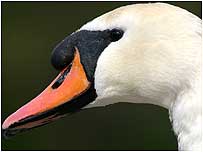 | At eight miles long, the Fleet is the largest tidal lagoon in the UK.
It's also home to a great wildlife spectacle - a swannery where you can see the Mute Swans' annual moult. | | Swan along to Abbotsbury for a fantastic feathered experience. |
 Visitors can enjoy a fabulous Swan spectacle throughout the summer at the swannery which lies at Fleet's western end. Visitors can enjoy a fabulous Swan spectacle throughout the summer at the swannery which lies at Fleet's western end.
The Swannery was created by Abbotsbury's Benedictine Monks who built a monastery during the 1040's.
The monks farmed the swans for their banquets, but the monastery was destroyed in 1539 during Henry VIII's dissolution of the monasteries.
Since then the swannery has been in the hands of the same family, and it's now a popular tourist attraction.
Feathered spectacle
 Abbotsbury Swannery is the only place where you can walk through a colony of nesting Mute Swans, our heaviest flying bird. Abbotsbury Swannery is the only place where you can walk through a colony of nesting Mute Swans, our heaviest flying bird.
In mid summer the Swans begin their annual moult.
It's a vulnerable time for these beautiful birds because when they moult, they can't fly so they gather together for safety as they shed their feathers.
One clever strategy of evolution is that the female Swans moult first.
The males hang onto their feathers for longer so they can continue to protect their youngsters.
And the feathers are even used by the Queen's bodyguards - look out for them on the head-dresses of the Gentlemen at Arms.
Rich marine life
 Although the Swans are fed grain, it's the rich underwater food supply that keeps them at Abbotsbury all year round. Although the Swans are fed grain, it's the rich underwater food supply that keeps them at Abbotsbury all year round.
Meadows of eel grass provide their staple diet and the grass in turn creates a rich habitat for other marine life.
The Fleet is of international importance for its aquatic life.
At one end of the lagoon there are hundreds of Anemones and Sea Squirts.
A typical Sea Squirt has two siphons - water is pumped in through one, sieved for food, then pushed out through the second siphon.
There are also many different types of crab which can be spotted. Chesil Bank
 Another spectacle of nature of a rather different kind is Chesil Beach and Bank. Another spectacle of nature of a rather different kind is Chesil Beach and Bank.
Chesil is truly a natural wonder of the geological kind - its 17 mile-long 'Great Beach' provides a natural barrier to the Fleet lagoon.
It is thought to have been formed at the end of the last Ice Age when debris from landslides was pushed along the coast from Devon as the ice melted and the sea levels rose.
Without it there would be no Swans, no Sea Bass nursery, and no lagoon.
There are fears that the Chesil Bank may one day be breached again, but at present its shelter continues to guarantee the hatching and rearing of thousands of cygnets right in front of your eyes. Photo credits  Sea Squirt copyright and courtesy of Natural England. Sea Squirt copyright and courtesy of Natural England.
Cygnet c/o Wildlfowl and Wetlands Trust. | | SEE ALSO | Watch and ListenAudio and Video links from this page require Realplayer  Today's clip: Today's clip:
Seal safari  On bbc.co.ukOn the rest of the webThe BBC is not responsible for the content of external websites |
Activities |  | Discover nature activities. Summer is a great season to enjoy wildlife during long daylight hours. |
 | Make a difference for people & wildlife in your neighbourhood. |
|



