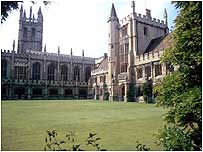
 | Oxford is best known for its dreaming spires, the university colleges and boat race, but this place is far more than just a summer time tourist destination. It's a fantastic place for urban nature in the autumn months. | | Oxford's Magdalen College - a great place for deer spotting |
History and nature
Magdalen College has a fascinating history and is also one of the best places in the city for a wildlife walk. It was founded originally as Magdalen Hall in 1448, and lies within hundred acres of woodlands, walks, and gardens. During the English Civil War Oxford was a Royalist stronghold and became King Charles 1's capital city. The college was an important defence post and its tower was used as a vantage point to watch for any approaching enemy. Magdalen was never attacked and its buildings remained unscathed - today its architecture provides stunning backdrop to explore the autumn colours of the trees around its grounds. Rutting season  The Grove is home to the College's 300-year-old herd of deer - Fallow Deer have a long association with Oxford's Magdalen College going back to the 18th Century. The Grove is home to the College's 300-year-old herd of deer - Fallow Deer have a long association with Oxford's Magdalen College going back to the 18th Century.
Most people think that you have to visit remote places to watch deer in the rutting season but Oxford is one of several exceptions.
Today there are several dozen deer living in the grove with the male bucks fighting it out for the attention of the female fallows. While you're in Oxford it's also worth keeping an eye out for a very different type of deer that makes an occasional appearance at Magdalen. The smaller Muntjac Deer were introduced into England in the 19th Century from China, and have been in Oxfordshire since they escaped from Woburn Park in the 1920's. The Muntjac is our smallest British deer, barely the size of a large dog, and sometimes it's even mistaken for a fox. A walk on wild side  Oxford is a city that is proud of its flora and fauna - it even has its own 'tree trail' where visitors can check out some of the city's oldest and most usual specimens. Oxford is a city that is proud of its flora and fauna - it even has its own 'tree trail' where visitors can check out some of the city's oldest and most usual specimens.
Ancient trees can be found in many places including Magdalen College Deer Park, South Park, and at St Mary's Iffley.
The latter boasts the oldest tree in Oxford - a Yew tree - which is thought to be 1,600 years old, double the age of the church it adjoins.
Magdalen College's walks are renowned for their peaceful atmosphere, removed from the noise of the nearby city.
The college's feeling of seclusion results from its location outside the city walls, which meant that early in its history it had plenty of space in which to expand.
The Grove or Deer Park together with Madgalen's Water Walks around the River Cherwell were both created in the 16th Century.
One of the best known trees at Magdalen is the Great Plane Tree located between New Buildings and the President's Lodgings.
This striking tree was planted in 1801 by Henry Phillpotts, the Junior Bursar at the college.
Twilight safari  Oxford is also a good place for a twilight safari and one secretive but common creature stands out - the Hedgehog. Oxford is also a good place for a twilight safari and one secretive but common creature stands out - the Hedgehog.
Even late in the autumn, there may be a few of these shy creatures still around. The average adult Hedgehog has around 5,000-7,000 spines which are hollow hairs made stiff with keratin. Unlike the quills of a Porcupine they can't easily be removed although if the animal gets sick or stressed a hedgehog can lose its spines. Go on a Hedgehog hunt
|