BBC Review
His film work borrows from both past and present with surefootedness.
Chris Power2009
Before founding krautrock pioneers Can in 1968, Irmin Schmidt was already a noted conductor and keyboardist who had studied composition in Cologne with avant-garde composer Karlheinz Stockhausen. Stockhausen’s experiments with electronic music, which he combined with his own take on the modernist technique of serialism, fed into the music of Can and their contemporaries Kraftwerk, and has gone on to inform Schmidt’s solo work as a composer of music for film and television.
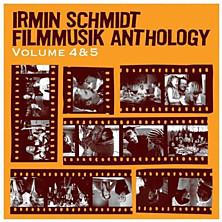
Volumes 4 & 5 of Schmidt’s Filmmusik Anthology, a two-disc set, comprise music composed between 1998 and 2008. Volume 4 begins with eight tracks from the Wim Wenders film Palermo Shooting, the main theme of which circles around a Bach melody in versions led by accordion, trumpet (played by Karlheinz’s son, Markus Stockhausen) and, most affectingly, the cello of Ulrike Schäfer. Around the keening of Schäfer’s instrument Schmidt deploys alternately glimmering and eerily atonal synth lines.
One of the most appealing elements of Schmidt’s compositional style is the way his work can borrow from both past and present with, for the most part, surefootedness. On Ina & Aaron, from the 2004 film Schneeland, processed alto and bass flutes are slowly surrounded by a descending string motif that reaches back to the twilit, menace-laced melancholy of Schoenberg. The pieces from 2006’s Paparazzo, by contrast, employ looped basslines and dubbed-out metallic fragmentations of sound closer to the musical language employed by today’s laptop producers.
If there’s a fault to be found with Schmidt’s compositions it’s his overuse of jazz horns. On Arrow From Beyond (from Palermo Shooting) the trumpet carries the same air of disease and threat that Courtney Pine engendered with his strangulated sax playing for the film Angel Heart. Elsewhere, however, the trumpet and saxophone parts come to sound perfunctory. Their traditional jazz phrasing smacks of incidental music, and sits uncomfortably with the less conventional sound design surrounding them.
This problem is somewhat less evident in Volume 5 which, once past the sub-DJ Krush trip hop of Dangerous, moves through some compelling territory. Totally electronic pieces like the brief, delicate waltz-time shimmer of Tausendschönchen and the haunted, windblown spaces of Im Wald – both from the TV series Bloch – and the glisteningly clean Euro-electro lines of Geisterlied, from Ich werde immer bei euch sein, stand out with particular sharpness and conjure images other than solely those they were written to accompany.
 This work is licensed under a Creative Commons Licence. If you choose to use this review on your site please link back to this page.