BBC Review
He lived the American Dream, but became a casualty of it too.
Adrian Edwards2010
There’s no doubt that Del Shannon lived the American Dream, but it might also be said he was one of its casualties.
Born Charles Weedon Westover, he began playing the guitar and singing at the age of 14. Runaway, which he co-wrote with Max Crook, would be his first hit single. It soared to number one in the US in 1961, and stayed there for five weeks; in the UK it topped the chart for four weeks, but later Shannon would consistently chart higher here than at home.
After fading from the public eye, Shannon turned his talents to producing in the late 1960s. Alcoholism gripped him in the 1970s, and thereafter myriad problems beset his attempts to return to the peak of his powers. Despite an occasional resurfacing, Shannon suffered from depression, and took his life with a 22 calibre rifle in 1990.
Runaway, a forlorn tale of lost love, its rippling piano accompaniment driven by guitar, saxophone and bass rhythm section, guaranteed him a place in the annals of rock’n’roll. While his vocal style, which veered from silky smooth to a wicked rasp before taking off into a soaring falsetto, became his trump card, Runaway also features a surreal, unearthly electronic keyboard solo that gave this single a unique flavour.
It proved a hard act to follow. Shannon’s loud rhythm guitar, characterised by a trace of distortion in reproduction, and too many lyrics that dealt predominantly with broken hearts gave his output a certain sense of similarity. Few of his originals strayed from the model that’d given him success, yet contemporary standards offered him greater variety. The Shannon yodel is certainly apt for From Me to You, a fun replica of the Lennon/McCartney original. The Swiss Maid stands out as pure kitsch with its Alpine echoes of The Lonely Goatherd, and represents something of a high for Shannon’s own material.
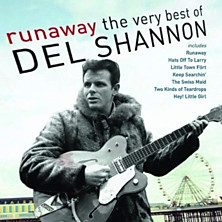
This greatest hits album, which offers a generous 80-minute playing time, has an undoubted nostalgia pull for those who experienced these songs first time round via AM radio, jukebox or Dansette. The records didn’t require the ultimate in hi-fi reproduction, just a good solid beat from the 45rpm disc. Many of the tracks are very brief (some last just over two minutes), fade abruptly and are constructed from a basic tonic-dominant formula. But therein lies much of the charm of revisiting them.
 This work is licensed under a Creative Commons Licence. If you choose to use this review on your site please link back to this page.