BBC Review
They defined the Stax sound, but were always more than just a backing band.
Sean Egan2012
As the house band of Stax, Booker T. & the MG’s defined an entire label’s sound by anonymously shaping countless classic records. However, they were always more than just backing.
Keyboardist Booker T. Jones, guitarist Steve Cropper, bassist Lewie Steinberg and drummer Al Jackson, Jr. didn't stray from their comfort zone – none of them had the technique or confidence to sing. But their own instrumental recordings were, quite improbably, sometimes as compelling as the output of Otis Redding, Wilson Pickett and other artists whose emoting they accompanied.
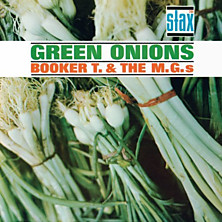
Green Onions was their 1962 debut LP. Beyond the boringly literal front cover is some fine music, not least the title track, a US top-three hit that year. (A trick of the memory tells us it was a concurrent hit here, but in fact it became belatedly famous in this country, making the top 10 in January 1980 on the back of its inclusion in Quadrophenia.) Its organ-dominated duration is percolating, slinky, and in parts vaguely sinister.
Perhaps inevitably, there is nothing else quite as good here, including the presumptuously titled Mo' Onions. But the bluesy Behave Yourself comes within spitting distance, particularly in its extraordinary quasi-Morse code keyboard work.
The rest of the material is non-original, seeing the band addressing well-known songs, picking out their vocal melodies instrumentally, with varying degrees of success. A version of the old 12-bar Ray Charles number I Got a Woman doesn't promise much but possesses surprising vitality.
Twist and Shout works less well, although it's hardly the band's fault that once John Lennon laid down his berserk vocal on The Beatles’ version the following year it made any rendition sans singer feel flimsy.
Lonely Avenue features more exquisite, blurred organ work, but on Can't Sit Down a certain keys-swamped sameyness is beginning to set in. The understated Comin' Home Baby at least ends things on a high note.
This remaster features a pair of bonus tracks in the form of 1965 live recordings from the 5/4 Ballroom in Los Angeles featuring new bassist Duck Dunn, one of which is inevitably Green Onions. Taken at a faster clip, it rather misses the point of the leisurely power of the original.
 This work is licensed under a Creative Commons Licence. If you choose to use this review on your site please link back to this page.