BBC Review
Mixing old school hip hop and serious social issues, this falls short of memorable.
Jon Lusk2009
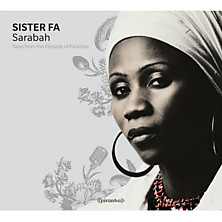
Senegal has the biggest hip hop community in Africa, centred on the city of Dakar, and although she’s now based in Berlin, Sister Fa (a.k.a. Fatou Diatta) is the most high profile female rapper to emerge from that scene. This international debut is her shot at getting beyond that localised market, but, although it certainly has its moments, Tales…seems unlikely to make her a superstar.
Un-American hip hop artists inevitably tend to suffer a credibility gap when compared with their role models, and those rapping in any language other than English are naturally doubly disadvantaged. As with most of her compatriots, Sister Fa’s take on the genre eschews the guns, gangs ‘n’ bling culture celebrated by much modern hip hop. Instead, her lyrics tackle serious social issues such as HIV, arranged marriages, female genital mutilation and the role of Islam. The trouble is, they’re
mostly in Wolof, Manding, Jola and French, so the appeal of the music depends largely on how much you appreciate these languages for their sounds and her flow.
Typically, as here, Senegalese is the generally old school hip hop sound, which means plenty of turntable scratching. A notable exception comes in the form of the rapid-fire digibeats more commonly heard in contemporary
R&B on Sister Fa La. It’s an effervescent highlight, and a lighthearted departure from the generally dour lyrical subject matter, with some enjoyable ‘ego-trippin’ in praise of my style’.
The opening Milyamba is one of three tracks that make use of live (as opposed to sampled) kora, thus giving a local flavour, and there are touches of acoustic guitar in others. Soldat is the other most instantly appealing track, with its skanking keyboards and snappy phrasing.
Nevertheless, too much of the album consists of fairly pedestrian or annoyingly sing-songy melodies that echo playground chants (like Poum Poum Pa) or seem transparently aimed at the ring tone market. And Fa’s forays into soul-styled crooning on the likes of the Des’ree-flavoured Life AM, Assoukatene and Bou Souba Si Ngone are not especially memorable either. So, another one for the ‘download this/skip the rest’ pile.
 This work is licensed under a Creative Commons Licence. If you choose to use this review on your site please link back to this page.