BBC Review
Here’s an essential two-disc set for admirers of Dimitri Mitropoulos.
Michael Quinn2009
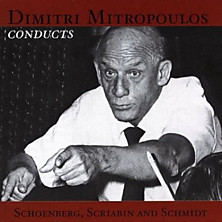
Here’s an essential two-disc set for admirers of Dimitri Mitropoulos, the Philharmonic orchestras of New York and Vienna, and, for that matter, 20th century music.
Mitropoulos’s relationship with the New York Philharmonic had already begun to sour by the time he recorded Scriabin’s Fifth Symphony in April 1953 and, in October the same year, Schoenberg’s Pelleas and Melisande. The friction between conductor and orchestra was so evident that one contemporary critic observed Mitropoulos was “a man obviously swimming upstream”.
But whatever tensions may have been developing in private, in public they translated into muscular, fleet-footed, impassioned performances shot through with a winning blend of virile lyricism, rhythmic certainty and revelatory attention to detail.
You can almost feel orchestra and conductor balefully scowling at each other in the mysterious, crepuscular opening to Scriabin’s last orchestral work, Prometheus: Poem of Fire. What follows is suitably turbulent but Mitropoulos keeps a taut control on the music’s combustibility to coax especially fine contributions from woodwinds, strings and piano.
No less vivid a demonstration of Mitropoulos’s flair for depth of feeling and intensity of expression is Schoenberg’s Pelleas and Melisande. Recorded live, the mono sound foregrounds audience noise but it also frames a compelling performance that moves along at a satisfying lick without diluting the music’s late Romantic ardour or denting its well-honed sense of drama.
Happily, microphones were also on hand to capture the Vienna Philharmonic in their Musikverein home in September 1958 – the year Mitropoulos finally parted company with New York. Verklärte Nacht, in its 1917 arrangement for string orchestra, seems pregnant here with still-to-emerge Expressionism, Mitropoulos making much of its open-ended motivic themes, seething abandon and soaring ecstasy.
The Second Symphony of Franz Schmidt is treated to rapturous playing by an augmented, and occasionally uneven, orchestra. Mitropoulos relishes the echoes of Mendelssohn and Mahler and seems to exult in the unabashed conviction of the music. Effusive and elegant in equal measure, it’s a joyful, at times inspired, performance.
Originally released on two separate discs and re-packaged into this double-disc set in 2005, this mid-price reissue has much to recommend it.
 This work is licensed under a Creative Commons Licence. If you choose to use this review on your site please link back to this page.