BBC Review
Frodo's quest continues. Eerie, brooding, banshees, orcs and elves.
Morag Reavley2003
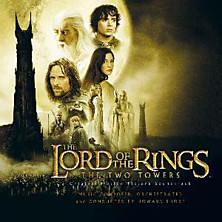
Howard Shore won an Oscar for scoring the first part of The Lord of the Rings trilogy. In 'The Two Towers', the difficult middle part of the Middle-earth saga, he further develops his weird aural landscape. As before, he has created a full-blown orchestral score of Wagnerian proportions, each character and realm with its own musical identity.
With the fellowship now splintered into three, the score of the second part becomes more complex than the first, weaving between the plot strands with different musical themes. Leitmotifs are picked up from the first soundtrack, for example, the perky Hobbit anthem in "Samwise the Brave", and new ones developed as the groups diverge.
The music is mercifully far from airy-fairy. It begins with the fulminant "Foundations of Stone", all serried choirs and pounding percussion. The dark elements invoked in the earlier score now dominate as the struggle of Frodo and friends becomes more intense. But the endless succession of unresolved crescendos and the ever-escalating sense of doom get a bit much.
Elizabeth Fraser (of Cocteau Twins fame), Sheila Chandra and Isabel Bayrakdarian provide banshee accompaniment so high that it approaches ultrasound. The closing track, "Gollum's Song", is an instant winner.Performed by Iceland's latest singing elf Emiliana Torrini (and originally intended for Björk), this elegy is tormented, twisty, infinitely strange. An Icelander singing in English sounds far more otherworldly than the choirs singing in Old English and Tolkiens made-up Sindarin.
Fine qualities aside, the soundtrack is ultimately marred by the partial nature of its form. Driven by the visuals, not its own logic, it is a series of musical vignettes rather than an organic whole. And since Shore has conceived the score for all three films as a single orchestral whole, the music of the middle section by definition lacks resolution.
Die-hard fans of Tolkien (are there any other kind?) will cherish this album as a painstaking musical description of the Middle-earth mythology. The rest may admire its ambition and the haunting set pieces, but without a deep knowledge of the film or books they will inevitably find it... middling.
 This work is licensed under a Creative Commons Licence. If you choose to use this review on your site please link back to this page.