BBC Review
One need only hear this music for a few seconds to identify its creator.
John Eyles2007
After twenty-five years and eighteen albums, it is unlikely that Rabih Abou-Khalil is going to spring any great surprises; long ago he found a distinctive individual style and has stuck to it since – with sufficient variations to keep it fresh and interesting. One need only hear this music for a few seconds to identify its creator. Aficionados will find everything that keeps them coming back for more; the characteristic blend of jazz-inflected Arabic melody with subtle rhythms combines into a hypnotic whole, as ever with Abou-Khalil’s fluent oud playing in a central role.
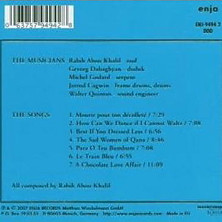
On this album, the variation that stops the music becoming formulaic is the inclusion of guest artist Gevorg Dabaghyan, who plays duduk, a Georgian instrument similar to an oboe. In Dabaghyan’s hands, it has a haunting, mournful sound that dominates the album. The opening track, “Mourir Pour Ton Décolleté” is a prolonged showcase for Dabaghyan, and one of the album’s highlights.
Newcomers to Abou-Khalil can start here with confidence. Although the instrumentation of oud, serpent, duduk and drums may look exotic, the sound is easy on the ear. The serpent, an ancient blown instrument vaguely like a tuba or euphonium - played here by Michel Godard - largely fulfils the role of bass, but there is a fascinating serpent solo midway through “Para O Teu Bumbum” which reveals the instrument’s versatility and hidden depths. For a prime example of the group sound, listen to “Le Train Bleu”, with its half-familiar melodic line, the kind you can sing along to on the second listen. It's just one of the wonders of this album...
 This work is licensed under a Creative Commons Licence. If you choose to use this review on your site please link back to this page.