BBC Review
More wistful, more mournful, and the better for it.
Andrew Mueller2010
Country singers are rare among practitioners of popular music in having reason to look forward to growing older: age, far from wearying their voices, tends to confer further gravitas. Johnny Cash made his best records in his last decade. Conversely, there is no more heartbreaking what-if in 20th century music than the depths, as a singer and writer, that Hank Williams might have reached had he lived past 29.
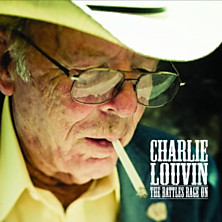
Mid-80-something Charlie Louvin would be first to admit that he isn’t the singer he was, more than half a century ago, when he and his late brother Ira made peculiar, haunting classics of gothic country gospel. The decades have reduced his crystalline trill to a husky drawl, but this isn’t necessarily regrettable. On this album of songs about war, and related matters, Louvin’s obvious frailty makes The Battles Rage On less offputtingly bellicose than it might have been if delivered by a younger artist: the raging battle, in this context, seems as much against the proverbial dying of the light as against America’s foes.
Not that Louvin is shy about naming names. The opening track, Red Foley’s wilfully menacing 1944 hit There’ll Be Smoke On The Water, updates the enemies list: Osama bin Laden in for Hirohito, Saddam Hussein substituted for Mussolini (Hitler keeps his place, weirdly).
Louvin has sung some of these songs before, on the Louvin Brothers’ 1962 album, Weapon of Prayer, a collection of flag-waving ballads at once pugnacious and sentimental. Louvin's revisits of these songs (including Stewart & Tubb’s Soldier's Last Letter and Roy Acuff’s Searching for a Soldier’s Grave) are more wistful, more mournful, and the better for it.
 This work is licensed under a Creative Commons Licence. If you choose to use this review on your site please link back to this page.