BBC Review
The language that evolves is highly articulate and Sanchez has clear points to make.
St.John de-Zilva2008
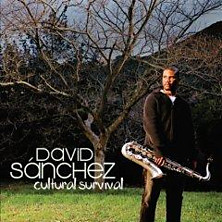
Nearly a century ago W.B Yeats floated his idea of perning in a gyre: Cultures throughout the ages, he mused, developed in a cyclical fashion; evolving with elements of the past and creating new ones. This may be an apt process to describe the possible genesis of grammy award-winning David Sanchez's new LP on Concord. Described by some as post bop with latin influences, it may be fair to say that some critics often miss the point. Sanchez proves that inspiration and creative forces can come from the most profound AND mundane sources. A virtuoso of his talent has the ability to meld those influences into music.
Pretensions apart, many of these compositions do seem to take on their own lives, written by Sanchez then partly improvised and then, no doubt, rewritten. He debates the human condition with simplicity, diversity and complexity in equal measure. Whether his music furthers a debate on colossal subjects like the New Orleans disaster (The Forgotten Ones) or the plight of sugar cane workers (La Leyenda Del Canaveral) is a moot point. The language that evolves is highly articulate and Sanchez has clear points to make. Planting strong motifs with a rhythmical, melodic or even harmonic root gives him the foundation to really flower, with input from his accomplished ensemble.
The eminence of Lage Lund's guitar playing is clear (the piano is notably absent on five tracks) and his varied approach gives the outfit a more earthy feel. His playing on Coast to Coast echoes the African influences Sanchez cites as inspiration, and on their version of Monk's Mood becomes the second voice in the absence of another horn. While Sanchez resonates, Lund pursues and embellishes during Adoracion (a tribute to Eddie Palmeiri) and at other times spikes the pulse that throbs most emotionally to the dynamic bass of Street and Glawischnig.
As a team they work the space with fluidity, intuitively providing counters when needed or breathing whispers to flavour the end of sequences. Three years in the making and now free of the shackles of a major Sanchez seems a more relaxed, but highly inspirational leader. It waits to be seen if, like his predecessors Rollins, Shepp, his mentor Dizzy Gillespie, and of course the great John Coltrane, Sanchez too can add a polemic to the Afro-American debate.
 This work is licensed under a Creative Commons Licence. If you choose to use this review on your site please link back to this page.