BBC Review
The credit really goes to Independent Opera's vibrant productions
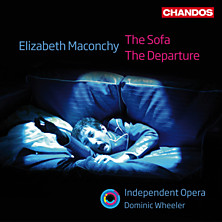
When people think of Elizabeth Maconchy's music, if they do, then it is usually of her string quartets. She just isn't widely performed or recorded, which is both extraordinary and wrong for a composer who was a star of the Royal Academy of Music during the 1930s, and who subsequently enjoyed as many commissions, performances and broadcasts as her contemporaries. No mean feat in an age when to be a female composer was to be at an indisputable disadvantage. Today, even the aforementioned quartets have only been recorded once, and the 2007 centenary of her birth passed largely unmarked. How wonderful, then, for Chandos to record The Sofa (1957) for the first time since the BBC in 1967, and The Departure (1961), on disc here for the very first time. Both operas work particularly well as recordings; their short length helps, but the credit really goes to Independent Opera's vibrant productions.
Those who know the sombre, tightly organised quartets may be surprised by The Sofa's louche, mischievous score. It tells the story of Prince Dominic who is turned into a sofa by his grandmother, midway through a party he is hosting, as punishment for his loose morals. The spell will be broken when a couple makes love on top of him. Independent Opera’s performance is right on the money with its recreation of the frantic, flirty, youthful energy of a party full of hopeful lovers. It’s as frothy as the champagne they're drinking, but without the slurred speech – diction is uniformly crystal-clear. After such hedonistic abandonment, The Departure is a stark contrast. It enacts a final meeting and profession of love between Julia, who has recently been killed in a car crash, and her bereaved husband Mark. The performances of mezzo soprano Louise Poole and baritone Hakan Vramsmo heighten the chilling subject matter; they throw themselves into their tortured characters, and Poole’s pure top notes and richly honeyed lower register send ghostly prickles down the spine. Independent Opera have demonstrated what a sacrilege it is that these two works should have been allowed to gather mothballs for over 40 years.
 This work is licensed under a Creative Commons Licence. If you choose to use this review on your site please link back to this page.