BBC Review
Luscious vocals and effortless, pure top register – a disc to be revisited again.
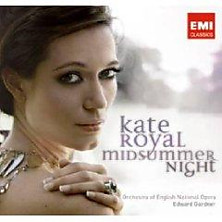
Kate Royal’s first album presented the favourite party pieces requisite for a debut recording alongside carefully chosen, more off-piste numbers which gave a taster of her repertoire knowledge. Midsummer Night takes the same philosophy and stretches it further. This time, the programme is of 20th century operatic repertoire, mixing stock favourites such as Dvorak’s Song to the Moon (Rusalka) with lesser-known gems such as Messager’s Rossignol (Monsieur Beaucaire). Also represented are Britten, Lehar, Barber, Herrmann, Alwyn, Korngold, Stravinsky, Floyd and Walton. The resultant disc is every bit as successful as her debut, perhaps more so.
As the album title would suggest, these are arias whose action takes place after sunset. It’s all down tempo, but by no means uniform in style or mood. The inspiration came from Royal singing The Governess in Britten’s The Turn of the Screw, her first major role in a 20th century opera. The ‘Tower Scene’ aria, How Lovely It Is, particularly struck her. She writes, “The music got under my skin in a way I had not experienced before… I went in search of other arias that shared a similar combination of intensity and abandon”. Her performance of it here is perfect.
Dramatically, she and the orchestra capture the early evening atmosphere with its unsettling undercurrents. Vocally, her voice is so lusciously rich there is a mezzo quality to it; her diction is crystal clear, and her top register effortless, pure and true. Honeyed, with edge. Whilst this may have been the aria that got under her skin, you’d never know the others hadn’t. Royal seems to have a particular gift for getting to the heart of any text, becoming the character and making it her own. Meanwhile, Edward Gardner and the Orchestra of ENO make the perfect ensemble for this repertoire. It feels as if the music is hardwired within their collective psyche. Add the vocal strengths of tenor Andrew Staples for Stravinsky’s The Nightingale’s Aria (The Nightingale), and baritone Thomas Allen for Britten’s Embroidery Aria (Peter Grimes), and you’re left with a disc to be revisited again and again. Even in the daytime.
 This work is licensed under a Creative Commons Licence. If you choose to use this review on your site please link back to this page.