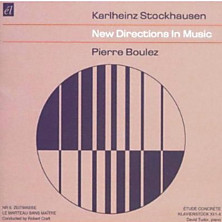
BBC Review
A perfect mix of daring, intrigue and impeccable musicianship.
Daniel Ross2010
Karlheinz Stockhausen became known in his five-decade career for his extravagant musical experiments – writing a string quartet that takes place in four separate helicopters simultaneously probably sealed that reputation. There is equal, if not more, interest to be found in his earliest works, though – electronic experimentation that tested the mettle of a world only just coming to terms with serialism. This re-issue of vintage recordings of some of his landmark early works prove that effortlessly, along with the similarly pioneering work of Pierre Boulez (of whom more later).
Stockhausen’s earliest foray into electronic manipulation and the disc’s opener, 1952's Étude Concrète, is fearsome on first listen, but reveals incredible depth in time. A prepared piano piece, recorded and chopped to pieces electronically, it allows you to hear the absolute guts of the instrument rather than obscure it beyond recognition. Tonality occasionally jumps out, and those are the moments to savour. He was the ultimate studio musician before Brian Wilson or The Beatles had entered one for any length of time, and this work shows him to be more diligent and maniacally dedicated to music's advance than his contemporaries.
The centrepiece of the whole disc is the recordings of both Stockhausen’s Zeitmasse and Boulez’s Le Marteau Sans Maître (“The Hammer Without a Master”). The Boulez work is (though it rarely enters into discussion of such works) the more human, and impeccably realised in this period recording of the work under the baton of Robert Croft. The theoretical processes that govern the work have a bonkers level of complexity, to be frank, but broadly it is the vocal sections that are most rewarding to hear. Based on a poem by the surrealist René Char, Le Marteau mixes the woodwinds in a textural feast of interaction, and the vocal perhaps forms a pre-cursor to Berio’s Sequenza of the following decade. Indeed, alto Margery McKay forms a wonderful backbone for the whole performance.
As a historical document of emerging art, captured with the iron at its hottest, this disc is close to unassailable. The concluding David Tudor premiere recording of Stockhausen’s labyrinthine Klavierstück XI is more than simply a bonus, and the whole is a fascinating affair. In a wider sense, these recordings proved that much of this then-new music was actually playable, performable and perhaps even enjoyable for consumption, given the right preparation. A perfect mix of daring, intrigue and impeccable musicianship, this is more than New Directions in Music – it’s music of the future, captured by its inventors.
 This work is licensed under a Creative Commons Licence. If you choose to use this review on your site please link back to this page.