BBC Review
This edition tells only a small part of a much larger story.
Michael Quinn2009
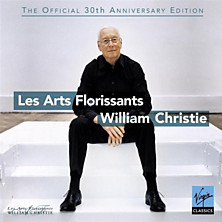
Here’s a bright, buoyant compilation to celebrate three decades of William Christie’s pioneering period-instrument ensemble, Les Arts Florissants.
Or, to be more accurate, the first five years (2003-07) of Christie’s output on Virgin Classics. Absent here are the early agenda-setting recordings for Harmonia Mundi and Erato, so this ‘official’ anniversary edition tells only a small part of a much larger story, the wider arc of Christie’s achievements requiring a considerably grander scope.
Even so, what’s on offer – predominantly 17th century and largely French, with passing glances at England, Germany and Italy – showcases an elegant conductor-scholar with more than a touch of the showman about him.
As you might expect, Charpentier, from whose pastoral opera of 1685 the ensemble takes its name, features prominently. The declamatory Prélude from Te Deum (complete with the Philidor brothers’ borrowed timpani march) sets the bristling tone for much of the baroque bombast that is to follow. But there’s no more sublime reminder of the brittle beauty that characterises much of this repertoire than the concluding track, the ethereal Agnus dei from the Grand office des Morts.
Charpentier’s ‘histoire sacrée’ Judicium Salomonis is represented by a meltingly beautiful account of the Symphonie and Neal Davies adroitly blending gravity and tenderness in the Grand Récit. Campra’s Requiem and motets, both ‘grand’ (Exaudiat Te Dominus) and ‘petit’ (Florete prata), throw an attractive light on an under-recorded figure and on Christie’s elegantly underplayed facility for marrying discrete intimacy and conspicuous gesture.
Boundless gestural energy is to be found in the two extracts from Haydn’s Die Schöpfung, the choir-accompanied duet Von deiner Güt’, O mapped out with sculptural flair.
A firm but flexible grip contrasts the poetic and boisterous aspects of Handel’s Serse – Anne Sofie von Otter softly hymning Ombra mai fìu, Sandrine Piau all brazen blustering in Un cenno leggiadretto. And if high drama gets the better of the brace of Divine Hymns by Purcell, Hosanna to the highest still boasts fine contributions from Christie regulars Paul Agnew and Konstantin Wolff.
The disappointing booklet falls far short of expectations, though, with just a brief two-page ‘interview’ with Christie and no libretti.
 This work is licensed under a Creative Commons Licence. If you choose to use this review on your site please link back to this page.