Website BBC Future publishes an intimate portrait of the East Anglian emergency air ambulance team where the Duke of Cambridge is a pilot
• Exclusive interviews and footage with the Duke of Cambridge, known as Pilot William Wales at work, and his East Anglian Air Ambulance colleagues on what it takes to deliver critical care to patients. • The team are tasked with responding to just 1% of the 2,000-plus calls the East of England NHS Ambulance Service Trust (EEAST) receive daily – often representing the worst of the worst trauma cases. Within four minutes of receiving the call the team are airborne and en route. • Five videos reveal the Duke at his most relaxed as he works within the close-knit team, and heartfelt accounts of the challenges and rewards of the job.
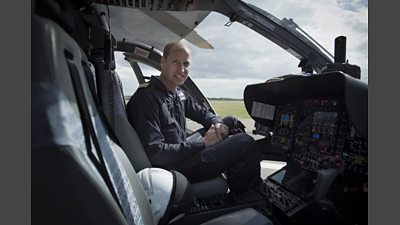
BBC Future, which covers in-depth science, technology and health stories on BBC.com, today published an intimate portrait of the lives and work of the East Anglian Air Ambulance (EAAA) crew, including the Duke of Cambridge – known as Pilot William Wales to colleagues – offering audiences a never-before-seen insight into this unique and often life-saving service and the future King’s role in delivering emergency care.
Launching in National Air Ambulance Week, the video-rich multi-media narrative – ‘Inside the trauma team where Prince William is a pilot’ at www.bbc.com/future – comprises a collection of exclusive films that reveal every step of the team’s process, from preparing the aircraft to answering a call, as well as a gallery of beautiful imagery and a detailed account from reporter Amanda Ruggeri. Amanda and the BBC Future team spent two days on the base with William, co-pilots and the medical team, investigating first-hand what it’s like to be part of EAAA.
“When I put my air ambulance hat on, and I come here and I fly, I’m one of the team,” William told BBC Future. “I want to be a valuable member of the team and I want to get the job the done, and at the end of the day feel like I’ve made a difference and a contribution to whatever it is I’ve done that day.”
Through watching the interviews, audiences will come to understand the important role this close-knit team – just four on each 9.5-hour shift – play in attending the worst medical emergencies, which account for just 1% of the 2,000-plus calls per day EEAST receive. In the last year, the EAAA attended to 2,085 incidents in total, with cases including patients injured by fires, horse-back riding accidents, poisoning and road traffic collisions.
“There are some very sad, dark moments. We talk about it a lot, and that’s the best way of dealing with some of these situations,” says William. “But it’s hard… It can be quite difficult.”
However, the EAAA’s ability to be on scene anywhere within the 5,326 square mile region in a matter of minutes can offer the best chance possible to save the patients.
Doctor Adam Chesters says, “If the phone goes we’re airborne in four minutes, it could be five, six minutes of flying, on the scene in one minute, and then opening a chest and doing open heart surgery two minutes after that.”
“What this aircraft brings is… a ‘critical care’ paramedic and… doctor to the scene – a lot faster than you could possibly do by road or by any other means,” says William. “It’s effectively bringing a hospital [emergency department] to the casualty.”
The unique bond and camaraderie that has developed between the team, and the critical role each person performs, is also woven throughout the multi-media piece. They also discuss what it was like to have a member of the Royal Family join the team.
“There was a tiny bit of nervousness having never met the Duke before, but within 10 minutes, he was just another member of the team,” says Jemma Varela, who has been a critical-care paramedic with EAAA for seven years. “He’s a very popular member of the team. He works hard.”
“It’s rewarding when I come here to do this job,” William tells BBC Future. “I look forward to coming here every day, whether it’s at 5:30am or going to bed at 2am. The shift work is exciting… And the fact that I love working in a team, and that’s something that my other job doesn’t necessarily do. You are more out there on your own a little bit.”
“Fortunately they don’t really care who turns up as long as they’re getting the care and the help that they need,” he adds, in terms of how patients and passers-by on the scene respond to his presence. “I have to say I was a little bit anxious of some of that when I first started, because I didn’t want to bring any chaos or any sort of unhelpfulness to the scene. And actually, it’s worked out better than I could possibly have thought.”
Adam says, “We are a team, a functional unit. It doesn’t matter what your personality type is, who you are, where you’ve come from, what your background is. They understand that this is the important thing they are doing now. And when they’re here, they are part of the team.”
With people’s lives in their hands, the team also reveal the challenges of carrying out procedures and the importance of being able to read each other, from a look or sudden silence, to assessing the situation both on the ground and in the air to ensure they deliver the best possible care to patients.
“It’s a very different environment,” Jemma says. “You miss out on a lot of little cues and things that you can’t have because you’ve got a huge helmet on that’s making your head heavy, making you hot. And you can only hear through your earpieces.”
Adam adds, “And the adrenaline control… As soon as that phone goes, the heart rate goes up – and when you get stressed and that adrenaline response, it can limit your motor skills. You can get a shake… Add to that to the noise, the vibrations, the motion sickness. It’s quite a challenge to condition yourself to that.”
The team also share how they cope with the traumas they witness through debriefing, talking together and banter — of which many examples can be seen in the jokes that William and his colleagues trade in the videos.
Aside from the detailed accounts of how the team prepare themselves for the call, to the challenges of getting to and managing incidents, the BBC Future content includes footage of the specialist aircraft – the H-145 – which has a maximum speed of 145 knots (approximately 170mph) and can be on the scene of an incident in East Anglia within a matter of minutes. The state-of-the-art aircraft’s cabin is 4.6m long and has room for a doctor, critical-care paramedic, patient, extra passenger and two pilots.
Showing viewers around the aircraft, William says to BBC Future, “The power of information at our fingertips – it sounds a bit corny and cliché – but it’s actually amazing.”
The full package ‘Inside the trauma team where Prince William is a pilot’ is available at BBC.com/Future. (To access from UK just search BBC Future)
Contact details
For BBC Future:
Gavin Dawson – Gavin.Dawson@bbc.com / 07730 284611
For East Anglian Air Ambulance:
Jilly Hurley - Jilly.Hurley@eaaa.org.uk / 07527 457467
For Kensington Palace:
Katrina McKeever –katrina.mckeever@royal.gsx.gov.uk / 0207 368 0809 ext 3109
For Association of Air Ambulances
Clive Dickin - info@aoaa.org.uk / 01564339959
Notes to Editors
About BBC Worldwide
BBC Worldwide is the main commercial arm and a wholly owned subsidiary of the British Broadcasting Corporation (BBC). Its vision is to build the BBC’s brands, audiences, commercial returns and reputation across the world. This is achieved through investing in, commercialising and showcasing content from the BBC around the world, in a way that is consistent with BBC standards and values. The business also champions British creativity globally.
In 2015/16, BBC Worldwide generated headline profits of £133.8m and headline sales of £1,029.4m and returned £222.2m to the BBC. For more detailed performance information please see our Annual Review webpage: www.bbcworldwide.com/annual-review
The East Anglian Air Ambulance
The East Anglian Air Ambulance provides its lifesaving service every day of the year. We are a local charity, funded by the people of East Anglia.
- Our doctor/critical-care paramedic teams treat patients with life-threatening or life-changing emergencies at the scene of their accident or emergency (we take the emergency department to the patient).
- We transfer patients to the appropriate hospital rapidly, when necessary.
- We can fly to the most inaccessible places and to anywhere in East Anglia, within 25 minutes.
- We operate two dedicated air ambulances, 365 days a year, across Bedfordshire, Cambridgeshire, Norfolk, and Suffolk.
- This year, our fundraising target is just over £11 million, to maintain our fleet of helicopters and the extended service into the hours of darkness.
- We work in partnership with the East of England Ambulance Service NHS Trust (EEAST), Essex and Hertfordshire Air Ambulance Trust (EHAAT), Magpas, and Norfolk and Suffolk Accident Rescue Services (NARS/SARS) to provide a comprehensive service across all six counties.
- Our crews are specially trained doctors and critical-care paramedics, who play a crucial role in the provision of trauma care throughout the region.
