Tony Hall's speech at the launch of the Annual Plan for 2018/19
Speech by Tony Hall, Director-General of the BBC at the launch of the Annual Plan on Wednesday 28 March 2018.
Published: 28 March 2018
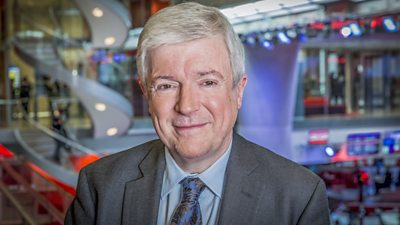
The country needs a BBC that helps society understand itself better, that explores our nation’s differences passionately and robustly, that projects British creativity and values globally, that reminds us every day of the things we hold in common, not just the things that divide us.
Check against delivery
Sign of the times
Good morning everyone.
I’m joining you today from Television Centre in London - the UK home of BBC Worldwide.
It’s a big moment for our colleagues here.
At the end of the week, they’ll be merging with BBC Studios to create a real commercial and creative powerhouse right across production, sales and distribution. A joined-up team that will lead our creative charge globally.
This week also marks a major milestone in our plan to get closer to audiences right across the UK, as we bring everyone across English Regions together with our teams in Wales, Scotland and Northern Ireland as part of an expanded Nations & Region division.
With both these changes, our focus is crystal clear: bringing teams together in every part of the BBC to make sure we have the biggest impact with audiences here in the UK and with audiences right around the world.
The changes we’re making are part of the BBC’s Annual Plan – which we’re publishing today – and which sets out our creative ambitions for the year ahead.
The plan captures a time of profound change for the BBC - but also a time of real excitement and opportunity.
For television viewers, the choice has never been so spectacular. Take your pick from iPlayer, Amazon, Sky or All 4 - the list goes on.
The same is just as true in audio. Whether it’s Radio One, Spotify, Soundcloud or You tube. There’s music everywhere you turn.
And if it’s audio speech you’re looking for, there’s a new generation of podcasts that are rewriting the rulebook.
For British audiences… what’s not to like? Unlimited choice, absolute control.
But what about for us, for the BBC?
Does music streaming spell mortal danger to radio? Can iplayer keep pace with a rapidly-growing Netflix?
It seems only a few short years ago that the BBC, ITV and Sky were thought of as the titans of British media. But what about now? Where does the BBC fit in to the new media world?
There’s no ducking these questions. They are real and I think they tell us that we have a fight on our hands.
A fight for the future of not just the BBC, but public service broadcasting in Britain.
A global fight that will test us – and the whole creative industry in the UK - in so many different ways.
I want to talk to you about it today openly and directly.
And I want to tell you why we should have absolute confidence in our role – in our future - and in all that we stand for.
Learning from Disney
Just before Christmas, a story broke in the US that showed more clearly than ever before the scale of change going on in the media world.
You may remember it. A £45 billion global media company 20th Century Fox decided it was just too small to compete with the big players.
Think about that. A £45 billion company with operations that span the globe decided it simply didn’t have the scale or the creative muscle to compete against the likes of Amazon, Apple or Netflix. Instead, the business - or most of it - is to be sold to Disney. Probably.
What did we learn in that moment?
We learned that the media world is consolidating - being brought together - at a speed we simply haven’t seen before.
Old business models are being ripped up before our eyes.
The stakes are very high and everything is up for grabs. Last month, we saw the US giant Comcast put a £26 billion pound deal on the table for Sky.
Step back from it all for a moment and we can see, more clearly than ever before, that the global media landscape is going to be dominated by four, perhaps five, businesses on the West Coast of America in the years to come. Companies with extraordinary technical, financial and creative firepower.
And that’s even before you think of the media giants in China too.
This extraordinary process of global consolidation is already changing our creative economy in the UK in profound ways.
Ten years ago, around 83 per cent of independent production companies here were either UK or European owned. Today it is less than 40 per cent, with the rest owned by US multinationals.
The direction of travel is clear. And, you’d be forgiven for wondering where this leaves all the rest of us - the traditional media as we now seem to be known.
If a £45 billion company can’t see a way forward, what are the implications for an organisation like the BBC with an annual income just shy of £5 billion? Can we play David to their Goliath?
The funding challenge
Well, I’ve never been more confident in our creativity and our shared determination to succeed.
But I also know there are significant challenges we will need to face together if we’re to realise our full potential in a world of such extraordinary competition.
Funding is one of the most pressing of all. Because at the very moment when British creativity needs to be at its best, investment in UK production is falling.
I know many of you will have felt the effects of this financial squeeze in different ways over recent years and I know how hard you have worked to limit the consequences on screen and on air.
But despite your efforts, there’s no escaping the fact that funding for original British content is falling. Over the last 8 years funding for our services here in the UK is down nearly 20% in real terms – and we’ve got to make more substantial savings in the years ahead.
But it’s not just us, of course. Alongside the very real squeeze on the licence fee, commercial broadcasters - that have also traditionally been major investors in British content - have also been hit by dwindling advertising revenues.
Most worryingly of all, these trends are set to continue. In fact, over the next ten years we expect a very substantial gap to open up between the amount that is spent on UK content now and the amount that will be spent in the future.
The risk that creates is very real. It could mean the gradual loss of content - of stories - that respond to our lives and reflect the country we live in.
That can’t be right – and we simply cannot duck this challenge. Our urgent work is to develop new ways to grow our income so that we can strengthen British production. And I’ll come on to that in a moment.
British creativity matters
Perhaps because of the scale of funding pressures, there are plenty of people that invite me to be a little downcast about the prospects for a media organisation nearing its centenary looking to forge a pathway through this extraordinary online and mobile world.
There are those, of course, who fear British production and British storytelling will be slowly, inevitably pushed to the margins by the bigger global players. And they fear that if this happens, our whole sense of identity, our sense of who we are, might be threatened too.
I see those risks – but the truth is that I’m far more bullish. In the end, I trust British audiences, and time and time again they tell us that British storytelling matters to them.
In fact, despite the remarkable growth of Netflix and Amazon, the channels and on-demand players run by the UK’s public service broadcasters still account for almost 70% of content viewed here – just to be clear that’s almost 70% of all broadcast and on-demand viewing. Even among younger viewers, those aged 16-34 – where undoubtedly we’re seeing the biggest pressures – our share of viewing as public service broadcasters is 57%.
So don’t let anyone kid you that British creativity no longer matters to our audiences – including younger ones.
Instead, we know audiences in the UK are still drawn inexorably to storytelling that reflects the lives and passions of our own square mile. Shows like Derry Girls on Channel Four, Shetland from BBC Scotland or Keeping Faith right now in Wales. Together, they form a vivid tapestry of storytelling that helps us all understand what it is to share these islands right now.
The quality and impact of programme-making in the UK is no accident either. Britain has backed its production talent over the decades – nurtured it, invested in it, and placed it proudly centre stage. Not just the BBC, but ITV, Channel 4 and now Sky too.
In fact, pound for pound, no country in the world has a better record in helping new creative talent to find its feet.
Radio 4, for example, has proven to be the biggest incubator of comedy talent the world has ever seen.
No-one makes the scale of radio drama that we do. And think of the chances we give people. Writers like Sally Wainwright, Steven Moffatt – and the likes of James Corden or Armando Iannucci - all chose to work with the BBC because we gave them the room to learn and hone their craft when they were starting out.
So don’t for a second underestimate the power of our homegrown creative sector – and we need to join together like never before to protect it.
So when I’m asked how we should respond creatively to the new global giants, my answer is clear.
Above all else, we must back new talent like never before. We must provide more opportunity for young, emerging talent than anybody else. And we must ensure the BBC is utterly irresistible for them: the most exciting, the most creative, the most supportive broadcaster in the world.
Britain’s never needed us more
But there’s another reason I’m bullish about our future. Because I believe the case for the BBC - and the case for British public service broadcasting - has never been stronger than it is today.
And it’s a case that goes way, way beyond the marketplace to something much more profound and precious. It’s about the way we live now.
Look around us today, and we see Britain facing greater change and challenge than at any time in the last forty years or more.
Our national debate and discourse is more polarised than at any point I can remember.
Generational, political and social differences seem to have widened markedly. Many people are asking - both at home and around the world - what being British now means.
Technology and social media have brought huge benefits to us all – there’s no getting away from that – but they can add to this sense of social unease and division.
Too often, social media can distort our view of one another and allow us to live in imagined communities where we only really engage with those who share our views. Fake news compounds that challenge, eating away at trust in the media - including in the BBC - and blurring the lines between reality and so-called ‘alternative facts’.
These unprecedented social challenges fascinate me - and they should galvanise us all. They go to the heart of what the BBC is – and our values.
And they tell us that, right now, Britain needs the BBC at its very, very best.
The country needs a BBC that helps society understand itself better, that explores our nation’s differences passionately and robustly, that projects British creativity and values globally, that reminds us every day of the things we hold in common, not just the things that divide us.
The BBC represents a set of democratic ideals that matters greatly to our country: giving a voice to the voiceless, pursuing the truth without fear or favour, and ensuring that the joys of learning and culture and beauty are available to everybody - irrespective of income or background.
The promotion of these ideals would be powerful enough at any time in the BBC’s history – but today they are priceless.
News
So, this year, we won’t just talk about the challenges and distortions of fake news, this year we’ll take them on directly.
We’re going to fight - publicly and globally - for news that people can trust and rely on. The sort of brilliant, curious, passionate journalism day in, day out that saw the News at Ten honoured as the UK’s best news programme at the RTS awards.
In fact, the RTS awards underlined, once again, that - at our very best - nobody comes close to the breadth and impact of BBC journalism either at home or internationally. Whether it’s our coverage of the Grenfell Tower disaster, abuse in football or the international crisis in Yemen, our commitment to tell it straight has never been clearer.
But we know we can do more than deliver brilliant journalism – we can also help audiences to separate the wheat from the chaff.
This month, our news team launched a national training programme, as part of the BBC’s School Report scheme, to help young people at schools right across the country to identify real news and filter out fake or false information. It was inspiring to spend time with some of those young students.
And later this year, we’ll also be inviting news broadcasters from around the world to a global conference in the UK focused on the integrity of news and information on mobile and social platforms. Just as we did at the Children’s Summit in Salford last year, the BBC is going to lead this debate and not wait for others to come up with the answers.
At a time of such flux and disinformation, our global voice in news has never been more important – both as a broadcaster and a beacon of quality and independence. That’s why we won extra money for the World Service – and what a smart investment that’s proving to be. Nothing provides a greater challenge to fake news than a confident, outward-looking BBC, standing up for its values.
For every part of the UK
That also means we’re a BBC that’s going to stand shoulder-to-shoulder with communities right across our country.
So this year will see the biggest transformation of our local and nations services in a generation – and certainly the most radical.
For too long, it’s been London shaping the BBC’s response to the changing shape of a more diverse and more devolved UK. Too many edicts - and a ‘one size fits all’ mentality that stifles creativity. That’s not where the country is, so it’s not where we’re heading. And that’s exactly why the new Nations and Regions division is right at the heart of our plans for the year ahead.
In BBC Local Radio in England, I want the people who know their communities best - our station editors - to shape the development of our local services. I want each of our stations to establish its own sound, its own personality. I want to let local radio off the leash to do what it does best: championing local people, local stories and local talent.
There are big changes in the nations too, supported by the biggest investment in television and journalism for almost 30 years. But, here again, the changes reflect the distinctive needs and aspirations of each country.
In Scotland, we’re planning the launch of a brand new channel with a special news hour at 9pm that’ll blend UK and Scottish coverage.
In Wales, we’re focusing new investment on BBC One and iPlayer, we’re strengthening our mobile services, and we’ve just launched a second Welsh language radio service.
And in Northern Ireland, there’ll be an enhanced online news service with improved news coverage right across the week.
At a time when local media is facing real pressure from changes in the commercial marketplace, I’m proud that it’s the BBC standing up for communities across Britain. We’re showing them – through actions, not words - that we’re on their side.
Creativity
I’m so proud of what we’ve achieved creatively these last few years. Our boldness – and our craft skills – have been rewarded so many times by audiences and critics alike. 18 RTS Awards; 19 BAFTAs tells its own story.
And, again this year, our creativity will do our talking for us.
Who else but the BBC would bring the whole country together for an unprecedented music festival this May – an event that will attract hundreds of thousands to major venues across our four nations to celebrate British and global music-making?
Who else but the BBC would lead our country’s centenary celebrations of the suffragette movement? Or commission a major nine-part series like Civilisations, telling the story of art from the dawn of human history to the present day, on a truly global scale?
Who else but the BBC could truly bring the nation together – together in their tens of millions - for events like the Football World Cup or the Royal Wedding?
And who else but the BBC would reunite Sir Anthony Hopkins and Emma Thompson on screen to star in Shakespeare's King Lear?
Reinventing the BBC
All this brilliant creative work – all your brilliant creative work – is what makes the BBC sing.
But right alongside these exciting programme plans, we also know we need to change radically to ensure the BBC, and public service media in the UK, remains relevant for younger audiences.
We’ve laid strong foundations over the last twelve months. 2018 is about delivery.
The creative and commercial success of our teams in the new BBC Studios will be critical.
I’m delighted to see the rapid progress we’ve already made - winning new commissions from broadcasters across the world, including, of course, the BBC.
We’ve already announced deals with Discovery, Channel 4 and Channel 5, and there’ll be further announcements shortly. The Studios team are proving beyond doubt that BBC programme-making has a future we can all be excited about.
We also have a superb track record in developing major co-productions with some of the very best global partners. It’s a big part of BBC commissioning right now – and series like Blue Planet II are able to attract investment from across the world. This is a model we’re keen to pursue because we know the dividend for viewers is significant.
But let me also say that I don’t believe these developments, on their own, will be enough to address our financial challenges. We know, for example, that there’s a real risk that the market for co-productions could start to fall away as the biggest global players look to take full control of the content they fund.
So it’s vital that, alongside the work of BBC Studios, we begin to explore other potential options to increase our income if we’re to keep pace with the global players and safeguard Britain’s creative track record.
But, in the meantime, we have work to do. We have to ensure we stay focused - reinventing the way we deliver our services to our audiences.
The work to transform iPlayer is already making a real difference. Personalisation is now at the very heart of the design process and already over 25 million people have signed-in so that we can provide them with the tailored service they expect. This year will see major steps forward, with key content available for longer, improvements to the user experience, and much stronger personalisation.
Reinvention is the challenge I’ve set radio too. A little later this year, we’ll begin to transform what we know as BBC iPlayer Radio to provide a bolder and more intuitive mobile platform for our astonishing array of radio and audio content services, including a growing range of podcasts.
We should build on our traditional strengths to be global leaders in audio. And for our younger audiences – children and teenagers – this is also a year of delivery – building on the investment we announced last year. I saw for myself last Friday in Salford how we’re planning to take Newsround into the future – to build on Bitesize – to launch a new and rather wonderful app for the CBBC generation.
I know reinvention isn’t easy for any of us. It challenges and disrupts our ways of thinking and our ways of working. I know many of you find it unsettling. Which is why I think we need to embody something writer and broadcaster George Orwell once said about the nature of change.
“What do I have in common” he once asked, “with the photograph of me as a child that sits on the mantelpiece?”
“Nothing; apart from the fact that I happen to be the same person.”
That’s exactly right. Changed in all respects except that our sense of who we are – and the values that drive us – remain the same.
That is how I want us to think about the BBC at a period of such immense change.
Conclusion
So 2018 is a big year in every way – a determination to reinvent our organisation and to work harder than ever for the audiences we serve… At a time, frankly, when Britain needs us more than ever.
Time and time again, we must demonstrate how the BBC stands up for our audiences and for Britain. In our fight against fake news, in our commitment to diverse communities the length and breadth of the UK, in the values that we project to the rest of the world, and in the creativity that means so much to every one of us.
But we cannot underestimate the way our industry is changing.
The BBC has a long and proud history – we’re an organisation that inspires love and admiration, not just here but around the world.
But in the next phase of our history, we’re going to have to work with others like never before – working with the big tech companies like Google, learning from them, building on what we’re already doing together, to get what we do to as many people as possible. But also working with those we’ve seen in the past as our traditional competitors – ITV, Channel 4, Channel 5, Sky for example – to ensure that what is brilliant and unique in this country – that rich ecology of public service broadcasting – thrives in the new world we’re in.
It’s an opportunity to ensure our very best days really do lie ahead.
So let’s grab it.
Thank you.
