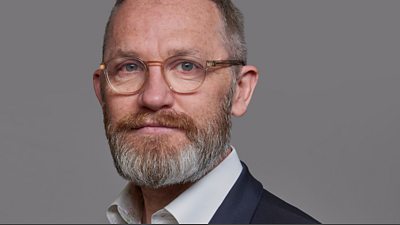
James Purnell's speech to the VLV Autumn Conference
Speech by James Purnell, Director of Radio and Education, to the VLV Autumn Conference in London on Wednesday 29 November 2017.
If we are to hand onto the next generation a BBC as healthy as that we received from the past, then it will need to change to stay the same.
Check against delivery
Leaning towards the light
Writing in 1943, George Orwell wondered whether broadcasting could “popularise poetry”.
T.S. Eliot had suggested smuggling poetry into the music hall, but Orwell favoured radio for the task, calling it a “more hopeful medium”. “It is not certain”, he wrote, “that the microphone is the instrument by which poetry could be brought back to the common people… But I do urge that these possibilities exist, and that those who care for literature might turn their ears more often to this much-despised medium.”
No one I know today would talk of despising radio - it was clearly the social media of its day.
But, as it turned out, radio has helped bring poetry back to the people.
This September, I was sitting not in a music hall but in a church, in Hull, for a special edition of The Verb. John Hegley and Ian McMillan were on stage, celebrating the 35th anniversary of Apples and Snakes, Britain’s pioneering poetry organisation. They talked of the early days - when they felt they were keeping poetry alive. Orwell wouldn’t have been surprised to hear that.
But he might have been surprised to see that they were celebrating victory. Today, poets can get millions of views. They headline music festivals. They are once again part of the national culture.
We were in Hull for Contains Strong Language, a weekend celebrating spoken word and poetry. Simon Armitage told us that he couldn’t remember a time when either had been so popular.
That would also have surprised Orwell. In his day, according to Arnold Bennett, the word ‘poetry’ could disperse crowds faster than a fire hose.
But in the decades since Orwell wrote his essay, Radio 3’s The Verb, and Radio 4’s Poetry Please have made sure new work has trickled into public consciousness.
In recent years, Words First on 1Xtra has opened the floodgates to a new generation of poets and to a new audience.
One of the breakthrough artists from Words First, Isaiah Hull, graduated onto Contains Strong Language this year.
The festival was a success and we are talking to our partners about how it could continue.
This commitment is part of embodying something else that Orwell said about the nature of change.
“What do I have in common?” he once asked, “with the photograph of me as a child that sits on the mantelpiece?” “Nothing; apart from the fact that I happen to be the same person.”
Unrecognisably changed in all respects except that a sense of character remains.
That is how we need to conceive of the BBC in a period of immense change.
As an organisation committed to the same values, but one that is always changing to ensure that it stays essentially the same.
Where Orwell was fighting to get culture into the margins of the BBC, we are putting it in its mainstream.
Last year, for example, Jeremy Deller commemorated the 19,240 men who had died, a hundred years before, on the first day of the battle of the Somme.
1,400 volunteers, dressed as Tommies, congregated, without ceremony, in public places. When approached, they would hand out a card with the details of the dead soldier, their name, rank, battalion and regiment. And their age, if known, though most were very young.
This was a work of art, done in public. But it took broadcasting and social media to turn it into public art.
BBC Local Radio showcased it, and the public shared it. In all, 63% of the population became aware of it.
We don’t do these events often. We do them the whole time.
Take last month.
We’ve been bringing the best of science to the public, through our Tomorrow’s World season.
We’re exploring how beliefs shape societies through Neil McGregor’s magical series Living with the Gods.
We’ve been tempting kids to do science experiments, through our Terrific Scientific campaign.
We’ve made the world’s first animated series to star an autistic character, Pablo, also the first TV programme to feature autistic young writers and child contributors.
And 6Music and Radio 3 collaborated to examine the connections between music and memory.
Every programme done in partnership - with the National Theatre, with Wellcome, the British Museum, 16 theatres, 30 scientific institutions, high tech businesses and universities.
Every BBC programme done with purpose.
That’s why we say the BBC isn’t a media company. We’re not here to beat Netflix or ITV.
We’re a public service. We’re here to make a difference to people’s lives, to make programmes for a public purpose.
To see that purpose shining through every programme, look at our children’s services.
Go Jetters teaches geography. Numberblocks does maths. Newsround is the only TV news service for kids. Hank Zipzer stars characters with learning difficulties.
The Dumping Ground is one of our biggest programmes - it’s the Grange Hill of our day. It just happens to be about kids in care.
And next week the BBC will be hosting the Children’s Global Media Summit - where the leaders of our sector will come together from around the world to debate our purpose, to decide how we could build a healthy media environment for our children.
We make good programmes, but we also make programmes to do good. The trick is to make them one and the same.
The BBC has always been adept at this.
And it is becoming ever more important.
Earlier this month, The Economist ran a front page calling social media a threat to democracy. In the last two years, they reported, 146 million users may have seen Russian misinformation.
If anyone doubts the effect of that misinformation, take this one story from Texas.
A Russian Facebook account organised a protest in Houston, outside an Islamic Centre. A different Russian account launched the counter-protest. The row had been entirely fabricated in the social media world, but still managed to escalate to confrontation and verbal attacks in the real world.
In this social media world of the future, we will need the BBC even more to sort the fake from the news.
Over the last ten years, spending on new British TV programmes has fallen by half a billion, and over the next ten years is set to fall by up to a half a billion more.
In this global media world, we will need the BBC even more to make programmes about British lives.
Middle class homes are almost three times more likely to have Amazon Prime, almost twice as likely to have Netflix.
In this unequal media world, we will need a BBC that serves everyone.
This has always been the BBC’s role - to make great British content and be a trusted guide, for everyone.
In the media of the future, that role will be more important than ever.
And the media of the future will allow us to fulfil that role better than ever.
Take personalisation.
13 million people now sign in to the BBC every month. That will allow us to personalise the BBC - to make it your BBC.
I know the VLV have questioned the benefits of this. You fear “a loss of serendipity and a narrowing of horizons.” You believe that one of the joys of live radio, for example, is coming across a programme that you wouldn’t have chosen.
That is one of the great joys, I agree. But it’s happening less and less, so we are going to have to change if we want to stay the same.
It’s happening less and less, because live consumption is falling. This week, nearly everyone over 55 will watch the BBC live. But only half of young people will. Only a third will listen to a live radio programme.
If they’re not consuming live, they’re not stumbling into the next programme.
But there’s no need to despair. Nine out of ten of those same young people will consume the BBC at least once this week. They will spend much more time with the BBC than they do with YouTube, Facebook and Snapchat combined.
They’ll watch Radio 1’s Live Lounge. They’ll use the sports app. They’ll stream on iPlayer.
Because we’ve innovated over the decades, we’ve managed to remain universal.
And now we will innovate again to preserve serendipity.
That’s why we want people to sign in. Yes, so that we can recommend more of what they want - actually, that’s a very public service goal; reminding me that there’s a new episode of Suzi Klein’s series on classical music and tyrants, for example.
But there are other types of recommendation - programmes that surprise us, programmes that could help us, not just the programmes we would like to see, but programmes we need to see.
That used to be done mainly by turning on the radio and waiting for something unexpected to arrive. That still happens and I hope it always will.
But there will be a growing role for data to do the same. Personalisation will preserve serendipity.
And it will widen horizons too.
In the US, radio drama died out in the 1970s. Until a couple of years ago, they literally weren’t making any.
But then podcasts came along, and audio drama became fashionable. The Homecoming, for example, with Hollywood stars like Catherine Keener and David Schwimmer. Or Crimetown, which does exactly what you’d imagine from the title – it’s a crime drama.
As drama podcasts became cool, our American colleagues got in touch. They were amazed to find that the BBC makes 600 hours of drama a year.
We should be proud of that. We should be proud of our system of public service broadcasting.
But we should also learn from the US.
Can we make drama for the Radio 1 audience?
And if we did, how would they find it?
We’d need somewhere to play it. And we’d need a way of helping them discover it.
We’d need an app. To which they’d signed in.
Well that’s what we are going to do next year. We will re-launch the iPlayer Radio App so that it can recommend shows and remember the stations you like.
We'll delight people who already love the app. But we'll also be able to serve our younger audiences better as they continue the transition to digital. We want people to have a lifelong relationship with BBC Radio, and the new app will help us do that.
Recommending drama each individual might like, or treasures from the World Service.
The perfect music show for this moment, or something completely unexpected.
Preserving serendipity and widening horizons.
We will consider if the changes require a public interest test - where our Board and OFCOM judge whether the public value of such changes outweighs any negative market impact.
If you believe in this vision, if you want every generation to enjoy radio, and for it to have a bright future, then I hope you’ll support us to develop the plans.
But we need one other thing from you. We need you to help us to change.
We want you to be sure that, even as we grow and change in appearance, we remain the same person whose picture you kindly recall from the mantelpiece.
I read the VLV’s submission on our new OFCOM licence and your concerns that the licence didn’t have a quota for hours of drama on Radio 4.
As I’ve said, I think that audio drama has a great future.
But a quota is the wrong measure. The right measure is how we’re serving the public - what is the quality of our drama? Are we innovating? Is it reaching more of the audience?
We are asking ourselves those questions right now, because we are so proud of what we do in drama, because we think it’s the best in the world, but also because we think it can be even better.
Instead of circumscribing our thinking with quotas, let’s have a creative discussion.
I want to involve audiences in our thinking. I want to involve you in our thinking. Then you can judge us by what we do - so can OFCOM, and if they feel we aren’t living up to our promises, then they can direct us to make more drama, or even set a quota once again.
Your organisation was born out of Jocelyn Hay’s fight to stop Radio 4 becoming a 24 hour news station. It was a good fight, and we are all thankful she fought it.
And I’m sure there will be times again in the future for the VLV to resist, to save the BBC from making a mistake.
But this is an era of change. The tipping point in broadcasting has already been passed. Every market in which the BBC operates is being disrupted by global platforms.
To stay the same, we will need to change faster than ever. At times that change may be faster than the VLV will perhaps find comfortable. But if we are to hand onto the next generation a BBC as healthy as that we received from the past, then it will need to change to stay the same.
We won’t do that by dumbing down.
We will do it by serving the public better. By being more ambitious, not less. Our landmark series Civilisations will be a perfect example of that next year.
But we will also keep the BBC healthy by innovating more. And to do that, we need the VLV to be pushing us to change more, and helping us to make the case for that change.
We all have a part to play.
In Hull, on that stage at the back of a church, John Hegley read from one of his most famous poems.
When I put my recycling out
I know my contribution’s
not equivalent to manning of the barricades
in nineteen-thirties Spain
but again,
it’s a lean towards the light
A step in the direction
That seems right.
As we prepare for our centenary, we will need many steps in the right direction, but to do that we need a VLV that doesn’t just save us from ourselves when we’re wrong, but when we’re right, helps us change, helps us lean towards the light.
