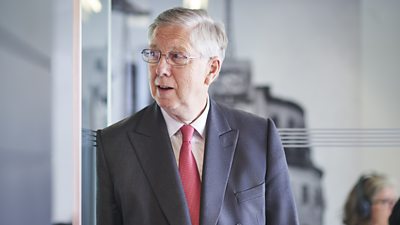
Sir David Clementi's speech at the launch of the Annual Plan for 2017/18
Speech by Sir David Clementi, Chairman of the BBC at the launch of the Annual Plan on Tuesday 4 July 2017.
Published: 4 July 2017
The Plan we are publishing today represents a challenge to each and every one of us. But I believe it is the right challenge.
Check against delivery
It is a huge pleasure to have this opportunity to present to you the Annual Plan for 2017/18, and to do so in this wonderful theatre.
The Board of the BBC is accountable to a number of parties. To our viewers who pay the licence fee, of course. To Parliament under our Charter. To our regulator, Ofcom.
But we are also accountable to you, our staff. You have chosen to work for the BBC. It is you who make the BBC what it is.
So it is fitting that we should present our first Annual Plan, required under our new Charter, to all of you.
Of course, this Annual Plan comes part way through the year it describes - meaning that many of the programmes that will help us achieve our goals have already been broadcast, and many of our plans are already underway.
The new Charter recognises the need for a period of transition in this first year. But in future, the Annual Plan will be published before the start of our financial year in April - as the guide for our work for the twelve months ahead.
I’m really pleased that Tony and I, once we have both spoken, will have the opportunity to take your questions. This is the first opportunity I have had to address an audience such as this.
So, I want to begin by saying how proud I am to have been appointed as your Chairman.
The BBC has been an important part of my life for as long as I can remember: as a young boy listening to Test Match Special on the radio; as a young man watching the World Cup of 1966 and the immortal commentary of Ken Wolstenholme; as an adult watching national events including General Elections and now two referenda.
I was not present at any of these occasions, but I felt as if I was, as I watched them through the lens of the BBC.
Even in the short period I have been Chairman there have been a number of occasions when I have felt an intense pride in the work we do. Let me mention three.
The first was on Tuesday 18 April, driving down the motorway from Cheshire, where I had been for the Easter break. Martha Kearney was talking on the radio about the General Election and interviewing people as if she and her Editor had known for days that we were to go to the polls in June. In truth she had known for about an hour and a half. But the professionalism she showed that day - and that our whole team on TV and Radio showed over a long, seven-week period - was outstanding. Our journalists and presenters, and the editorial and production teams that back them, are placed under huge pressure: in part by the political personalities they deal with; in part by the sheer time demands on getting the programme out. Yet time and again they have risen to the challenges placed on them.
The second occasion was a piece of drama that was broadcast over three days in May and which I thought was outstanding: Three Girls.
A hugely sensitive story, but one that needed to be told, and which reached our screens through a wonderful creative partnership between Charlotte Moore's Content team, and Mark Linsey's BBC Studios team.
And if I am allowed a third, it is to mention the concert from Manchester on 4 June, which brought people together in their many millions to remember those tragically killed in that atrocious attack. Again the professionalism of our team was exemplary, all the more so when you consider the whole project went from creation to broadcast in some six days.
I have, of course, listened to a lot of TV and Radio since I was appointed as Chairman in the middle of February. But the first job was to put together the new Board required under the BBC Royal Charter.
This was in place by 3 April, our official start date, and consists of 12 directors: 8 non executives drawn from a wide variety of backgrounds, and four executives, including the Director-General. In due course we will be joined by two further non Execs, who will become the Members for Wales and Northern Ireland respectively.
This new unitary board replaces the old two tier structure which existed under the last Charter, encompassing a Trust Board and an Executive Board. If you were confused about exactly who was responsible for what, you were not alone. Those who have followed the Debate about the BBC governance and regulatory arrangements will not be surprised to learn that I think the new arrangements are a significant improvement.
It certainly provides much greater clarity about where responsibility of the BBC resides: unambiguously in the single Board that now runs the BBC. At the same time we have a much clearer regulatory arrangement, with Ofcom as our regulator, armed with new powers under the Charter.
There is a section in the Annual Plan which details these new governance arrangements, and sets out the Board Committee structure we are now adopting. These new arrangements, with a single unitary board, importantly encompassing both Executives and Non Executives, allow the BBC for the first time to speak with one voice.
The BBC Board has a number of responsibilities. But first and foremost it is charged with ensuring that the BBC complies with the new Charter - and in particular with the five Public Purposes that are set out in it. You will see them on the screen behind me. These are the ways in which we achieve our fundamental mission to inform, educate, and entertain. And they represent our contract with our audiences - we know that we cannot fulfil our duty to the licence fee payer unless we meet them.
Tony has set the corporation a clear challenge for the years ahead: to reinvent public service broadcasting for a new generation. It is clear that this challenge means finding new ways to meet these Public Purposes.
Today’s Annual Plan sets out our ambition for each of them, along with our detailed creative plans. And it offers a framework against which the Board will be able to assess the performance of the BBC and monitor progress.
There are many challenges and priorities for the year ahead detailed within our Annual Plan. Of course we face the continued challenge of meeting both our public’s and our own high expectations for quality of BBC output against a constrained budget. Beyond the ever present budgetary challenge, I want to pick out three specific challenges this morning.
First, in the current context, it is worth emphasising the paramount importance we attach to our first Public Purpose: ensuring the strict impartiality of the BBC. For nearly a century, the BBC has been the place to which the country comes to make sure it can distinguish fact and fiction. With the plethora of news sources now available, and in an era when fake news, alternative facts and downright lies are flourishing like never before, this can never have been more important. That’s why impartiality, accuracy, and independence are the fundamental principles driving the work of the new Board.
Second, creating a more personal BBC, unique to each user. Tony will be saying much more about this shortly, but I want to stress its importance to the board as a whole. We know that reinventing the BBC for a new generation will mean being at the cutting edge of new technologies. And we know that, over the next few years, data will revolutionise how audiences use and interact with our services. By using data to tailor the experience with each BBC user, we can make our relationship with audiences deeper, and make our content more relevant. Our goal is to get as much of the country as possible signed in to their unique BBC, and to keep tailoring our offer so that our audiences not only get the very best from the BBC, but also feel they are getting great value.
Third, let me say something about BBC Studios. The BBC operates in a global media market and though we are often seen as a big player, we are in fact small compared to the vast global giants that we compete against, and that exert such a powerful influence over our creative and cultural landscape. In this context, the BBC plays a vitally important role as the cornerstone of the UK’s creative economy and a key to our cultural impact abroad. We have a proud tradition as a great programme maker, which we want to build on. Separating it out was a big decision, and it was absolutely the right one. I can assure you that Studios is a top priority for the new Board.
Conclusion
The Plan we are publishing today represents a challenge to each and every one of us. But I believe it is the right challenge. I am sure that, with your talent and commitment, we can achieve the ambitious creative and management goals we have set ourselves and that, together in 2017/18, we will write a further year of the BBC's history: one of which we can all be proud.
