The Planets
Ep. 2/5 -
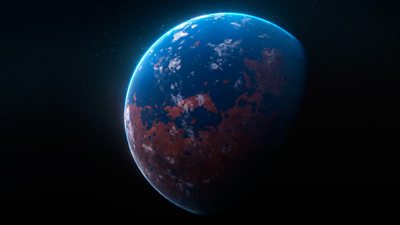
Early in the story of The Planets there was a beautiful water world, an oasis of hope in a sterile universe. But this was not Earth - this was the young Mars. Professor Brian Cox’s continues his tour of the solar system revealing that it was once home to not one, but two blue planets.
Episode two: The Two Sisters - Earth And Mars.
For millions of years Mars enjoyed oceans blanketed by oxygen-rich skies and a temperate climate, whilst at the same moment Earth was a far less favourable habitat. Back then our planet was toxic, cooling more slowly than Mars after the impact that created her companion, the Moon. And both planets were about to face another trial. As they reached the end of their adolescence, a solar system-wide cataclysmic event threatened to destroy both their chances of ever hosting life.
Called the Late Heavy Bombardment, this event saw asteroids rain down on every inch of the planets for tens of millions of years, resurfacing vast areas of both worlds. But as the dust settled, Mars emerged reborn. Billions of tonnes of water had been delivered, returning it to a hospitable water-world once more, in places creating the greatest waterfalls the solar system has ever seen. But deep inside the molten metal in Mars’s core was rapidly cooling. In time it would fail and along with it the planet’s beautiful blue auroras would fade. It was a sign that Mars’s atmosphere was dying, leaving the planet open up to the ravages of the Sun.
Mars is a failed world that long ago had the same potential as Earth, which begs a big question: did life get a start on both worlds? In search of the answer, plans are afoot to take humans to the red planet.
Perhaps one day soon we will become the Martians.
A major new series for BBC Two co-produced by the Open University.
Pictured: A CG illustration of what Mars might have looked like with water
Publicity contact: DG2
