Summer of Commemoration: June to August 2014
Details of BBC programming to mark the summer of commemoration of the start of World War One, June to August 2014.
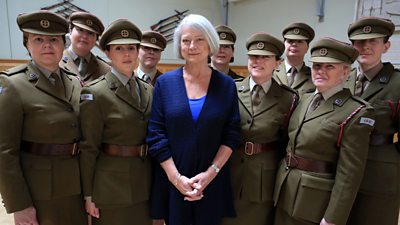
1914: Day By Day
BBC Radio 4
Begins Friday 27 June at 4.55pm
Historian Margaret MacMillan presents a daily programme from June to August chronicling the road to war in 1914. The series tracks the development of the European crisis in real time, day by day, from the assassination of Archduke Franz Ferdinand through to the first week of the conflict.
Each episode draws together newspaper accounts, diplomatic correspondence and private journals from the same day exactly 100 years ago, giving a picture of the world in 1914 as it was experienced at the time.
As well as the war, it gives an insight into the wider context of the world in 1914, including the threat of civil war in Ireland, the sensational trial of Madame Caillaux in France and the suffragettes’ increasingly violent campaign for votes for women.
Written and presented by Margaret MacMillan, Professor of International History at Oxford University, with readings from Stephen Greif, Felix von Manteuffel, Jaime Stewart, Simon Tcherniak and Jane Whittenshaw.
A weekly omnibus edition can be heard on Sundays at 11pm, beginning on 6 July.
Alongside the series and in association with BBC Radio 4, 14-18 NOW and the Cartoon Museum have co-commissioned artists including Steve Bell, Ralph Steadman and Posy Simmonds to interpret global events in the build up to World War One. These original works will be displayed on the Radio 4 and 14-18 NOW websites as well as at the Cartoon Museum.
Presenter/ Margaret MacMillan, Producer/ Russell Finch for Somethin’ Else – 43x5'
CD3
How Britain Went To War
BBC Radio 4
26 July at 8pm
Historian of government Peter Hennessy tells the secret story of how Britain planned for war in the years leading up to 1914.
Drawing on official plans and intelligence reports, he reveals how Whitehall prepared the initial detailed plans for going to war. He examines the official expectations about the likely nature of a war in the leadup to 1914, reveals some of Whitehall’s hidden tensions and assesses the effectiveness of their plan.
In August 1914, the possibility of conflict became a stark reality and Hennessy considers what was going through the minds of ministers and their advisers as the Cabinet agonised over taking Britain to war, while outside No. 10 the crowds cheered.
BBC News Productions. 1x60'
AH2
Month Of Madness
BBC Radio 4
23–27 June at 9.45am
Christopher Clark, Professor of History at Cambridge University, presents a five-part series on the outbreak of World War One. He explains the reasons for the onset of hostilities from the perspective of the key centres of action and decision making – Sarajevo, St Petersburg, Berlin, Paris and London.
Professor Clark is an acknowledged authority on the causes of the conflict and an acclaimed author of historical works on the rise of Prussia and the onset of the war. In this series he disentangles one of the most complex events in history, clarifies controversy and draws insightful parallels with our present fractured world. By highlighting the political and strategic anxieties of the great powers of the time, Clark shows how the assassination of an Archduke in the provincial capital of Sarajevo led to the global catastrophe of World War One.
Blakeway Productions - 5x15'
CD3
Real Time World War One on the Jeremy Vine Show
BBC Radio 2
Weekly from 4 August
Jeremy Vine hosts a real-time journey through the events, voices and music of World War One, going back in time to 1914 to experience the war as it happened.
Jeremy presents events as they unfold: hearing breaking news from the continent and at home (taken from the newspapers of the time); talking to the ‘real people’ of 1914 (actors giving voice to genuine historical accounts); and hosting round-table discussions with contemporary experts on everything from rationing to trench foot.
All this will be sound-tracked by music of the time – including army marching band numbers, classical compositions, and the tongue-in-cheek music hall melodies that would have been most familiar to a 1914 audience.
Real Time World War One will be a completely immersive experience for the BBC Radio 2 daytime audience.
Unusual Productions – 20x5'
AF
World War One – Radio 1 Stories
BBC Radio 1
4, 11, 18 August
To commemorate World War One, BBC Radio 1’s documentary strand, ‘Radio 1’s Stories’, will broadcast three special programmes in August 2014 presented by Greg James. The three documentaries explore the parallels between the experiences of those who fought for their country between 1914-18 and the present day. Across the three programmes we will hear first-hand testimonies from a variety of figures touched by War including British soldiers who have served in Afghanistan, new recruits and young people affected by conflict.
In ‘Veterans: From WW1 to Afghanistan’ we hear interviews with veterans who have left the Armed Forces, many of whom were wounded during service. These interviews will be interspersed with archive material and readings from those who endured the trenches - with some of the Afghanistan veterans telling the stories of their relatives who fought and died in The Great War. The ‘War Children’ documentary will look at personal testimonies to uncover the effect war and conflict has on young people around the world whilst ‘MP3 War’, will look at the links between music and war, in particular how recorded music has played its part on soldiers lives on the frontline.
BBC Radio Productions – 3x60'
BW
Forgotten Heroes: The Indian Army In The Great War
BBC Asian Network
4, 5, 6 August
The Asian contribution to WWI has been almost completely overlooked in the history books, despite the fact that 1.27 million volunteer soldiers from the Indian Army fought valiantly alongside British troops in every major battle from Ypres to Gallipoli. In this programme, on the centenary of the outbreak of the Great War, the Asian Network tells the extraordinary story of these Indian soldiers, revealed through a selection of letters written home by sepoys themselves, which were saved by military censors and have survived to this day.
BBC Radio Productions 3x30'
AF
The World's War
BBC Two
August
Historian and film-maker David Olusoga challenges people’s understanding of World War One, telling it from the perspective of those of who made it a truly global conflict: the hundreds of thousands of Indian, African and Asian troops and ancillaries who fought and died alongside Europeans.
Drawing on personal stories and testimonies and illustrated with rarely seen stills, archive and location photography, The World’s War dissects how the complexities of Empire and the hypocrisies of race played out against the background of a global struggle for dominance.
Part one depicts how, when the European powers went to war, the British and the French drew immediately on the military resources of their respective empires. Sikhs, Gurkhas, Garhwalis and Pathans from the British Raj and Spahis, Zouaves and Senegalese from French North and West Africa were thrown into the front lines and were among the first to experience the hell that was trench warfare. Though billed as a ‘white man’s war’, the conflict quickly became a truly global event, fought by multi-racial, multi-ethnic armies.
Part two explores how Germany enrolled the Muslim peoples of North Africa and the Middle East to join a Jihad against the allies. In Germany, Muslim POWs and deserters held in special camps were indoctrinated to see the German emperor as a lover of Islam and a supporter of national independence wherever the British or French flags flew. Meanwhile, in East Africa legendary German General Paul von Lettow-Vorbeck led an army of African troops in a bitter insurgency war against the allies, a forgotten war that cost the lives of hundreds of thousands of black Africans.
Throughout this series, interviews with a host of writers and historians reveal why the war involved so many different peoples, and how much they contributed and sacrificed in the First World War.
This series has been made in association with BBC Learning which plays a central part in meeting the BBC's purpose of promoting education and learning.
BBC Productions - 2x60'
AT
Kate Adie’s Women Of World War One
BBC Two
August
When war broke out in 1914 and a generation of men went off to fight, the world changed forever. In this fascinating documentary Kate Adie reveals what an extraordinary impact the fighting had on the lives of British women – not just as wives and mothers, but as a visible force in public life, for the very first time.
From transport to policing, munitions to sport, entertainment, even politics, women stepped into the breach and became a part of the war machine, acquiring their own rights and often an independent income.
Kate Adie’s Women Of World War One documents the achievements of women during World War One which in turn paved the way to fairness and equality for the women of Britain’s future.
BBC Productions – 1x60'
AT
Long Shadow
BBC Two
August
Historian David Reynolds explores the legacy of the Great War in a new three-part series for BBC Two. He traces how the conflict haunted the generation who lived through it and how it shaped the peace that followed, often in surprising ways.
For Reynolds, Britain’s experience of the war’s aftermath was peculiar. Unlike other European combatants, the British escaped revolution, militarism and political polarisation, muddling on with coalition politics under a crusty monarch, George V, who was rebranded as a symbol of the nation. And, while the Great War shattered old continental empires, allowing nationalists to seize their moment, the British Empire expanded and England’s union with Scotland and Wales was strengthened. The grim exception would be Ireland, where the blood sacrifices of 1916 left scars that endure to this day.
Examining the conflict’s impact on politics, identity and national memory, Reynolds builds a new and powerful argument about the shadow cast by the Great War and the forces it unleashed which are still grappled with today.
ClearStory - 3x60'
AT
Pipers Of The Trenches
BBC Two
July
For 500 years or more, Scottish regiments advanced and attacked to the tune of the pipes. Two-and-a-half thousand pipers served in the Great War; men from Scotland, Ireland, Canada, Australia and New Zealand. Within a year a thousand of them were dead.
This film brings together stories of unparalleled bravery as descendants of World War One pipers visit the Somme and Gallipoli, the battlefields where their ancestors, unarmed, piped their comrades ‘over the top’.
With behind-the-scenes testimony from serving soldiers, this programme uncovers why these centuries-old tunes, remembering ancient battles, still have a relevance today.
BBC Productions, Scotland - 1x60'
JG
Machine Gun And Skye’s Band Of Brothers
BBC Two
July
In the Great War, friends signed up together and served together, shoulder to shoulder. One burst of machine gun fire could hit scores of men from the same village, farm, town or factory.
Neil Oliver describes the dreadful human cost of a weapon that could fire a devilish 666 rounds per minute – the Maxim Gun.
It had been invented by an American living in London. Yet it was the German army who built them in great numbers and who learned to deploy them with a chilling mathematical precision.
The science of the gun is interwoven with the story of a small company of British soldiers that would come to face these horrific weapons.
BBC Productions, Scotland - 1x60'
JG
Railways Of The Great War with Michael Portillo
BBC Two
Railways of the Great War with Michael Portillo will uncover World War I’s railway story, one hundred years on. Each episode will unearth how the entire conflict, from start to finish, was a railway war: from the very earliest military planning prior to the declaration of war until the signing of the armistice in a railway carriage in Compiegne.
At key locations in Belgium, Luxembourg, France and Britain, Michael Portillo will tell the story of the world’s first war on the rails with help from rail enthusiasts, the descendants of those who fought on the rails, experts in railway and military history and ordinary people who share the belief that we should never forget. He will discover the locomotives and the carriages, which saw active service – the original Iron Horses of War. And he will have access to original artefacts including the Government’s Railway Manual for War (1911) as well as railway poetry, war diaries and memorial souvenirs.
Boundless, part of FremantleMedia UK - 5x30minutes
FD
The Great War
BBC Parliament
“The lamps are going out all over Europe” declared British Foreign Secretary Sir Edward Grey on the evening of August 3rd 1914.
That day he had told a packed House of Commons that Britain was honour-bound to support Belgium and France against any aggression by Germany.
It was mere days after the assassination of Archduke Franz Ferdinand in Sarajevo but the momentum for conflict had been building for years. Britain faced a tangle of treaty obligations and was engaged in an arms race with Germany.
Could the Liberal government have done more to prevent the conflict or was it distracted by its long battle over Irish Home Rule? Mark D’Arcy reports from Westminster on the great Parliamentary speeches and political manoeuvrings which led Britain to war.
BBC News
AH
Debate
The War That Changed The World
Programme One: Nationalism, Bosnia
BBC World Service, Saturday 28 June, 19:00-20:00 BST
From June 2014 the BBC World Service embarks on a series of programmes which show the lasting legacy of World War One on the world we live in today. A partnership with the British Council, the series will be formed of nine debates from different countries around the world. Launching in Bosnia and concluding in Jordan in June 2015, the series will also visit Germany, UK, Turkey, India, Russia, France, East Africa, and the USA. The debates will be presented by Allan Little, Amanda Vickery and Razia Iqbal. In each country they will be joined by a local audience and a panel of historians and cultural figures. Each programme will be centred on a different theme and will offer a different perspective from each country in turn.
A world of empires entered the war; the world that came after was one of nation states. To launch the series, the BBC’s Allan Little will be joined by Balkan historians, Amir Duranovic (University of Sarajevo) and Dr Bojan Aleksov (UCL, formerly University of Belgrade) at the Sarajevo War Theatre in Bosnia, to discuss the drive for nationhood during the First World War and its impact on nationalism to this day.
The debate will be broadcast on the very same day that one hundred years ago a shot rang out on the streets of Sarajevo and set the world on a path to war. The discussion will explore whether the Archduke’s assassin was a nationalist and how the peace made after the First World War influenced the Balkan ethnic conflicts of the 1990s.
Celebrated Bosnian Theatre Director, Haris Pasovic will also give his very personal take on nationalism and the assassination of Archduke Ferdinand in an essay specially commissioned for the series.
SW
The War That Changed The World
Programme Two: The Waging Of War
BBC World Service, Saturday 19 July, 19:00-20:00 BST
The tank, gas, flame throwers, and Zeppelins, the weapons of the First World War were like nothing that had been experienced before. In Dresden, at the German Military Museum, historian and broadcaster, Amanda Vickery will be joined by German historians, Professor Sönke Neitzel and Dr Annika Mombauer to explore the waging of war, its methods and morality. They will be discussing how technological and industrial development revolutionised war and whether or not Germany used methods that were different to other countries.
Artist and photographer, Herlinde Koebl has spent six years studying how more than 30 different national armies relate to the targets they shoot at in training. She delivers a specially commissioned essay bringing morality and war into focus through the photographer’s lens.
SW
The War That Changed The World
Programme Three: The Psychology of War
BBC World Service, Saturday 2 August, 19:00-20:00 BST
What drove men to volunteer for the war? What drove them to the edge of insanity when they got there? In London, at Imperial War Museum, historian and broadcaster, Amanda Vickery is joined by a panel of experts to explore the psychology of war. Dr Dan Todman (Queen Mary, University of London) and Professor Michael Roper (University of Essex) will explore ‘war lust’, comradeship, pitiful tragedy, and how a society picks itself up – or fails to pick itself up - after years of grinding battle.
Professor Joanna Bourke draws on her unique cultural analysis of killing, psychology, pain and war in her specially commissioned essay, “Shell shock and the shock of shells”. Audience members will also contribute to the discussion including some who will recall the experience of their own relatives who returned from the First World War.
SW
Drama
Great War Diaries
BBC Two
August
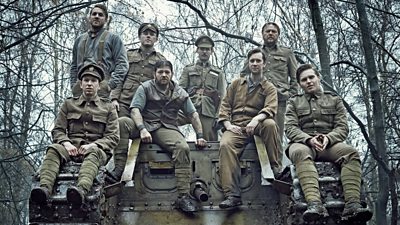
BBC Two’s Great War Diaries brings together 25 broadcasters from around the world to produce television’s global event for the centennial of World War One. Ten years in the making, this is a truly international co-production.
The series tells the story of 1914-18 solely through the eyes of those who lived through it. Inspired by letters and journals, many of which have never been published before, it follows the individual stories of twelve characters whose writings are woven into one compelling narrative. From a young Cossack girl who follows her father into battle, a French schoolboy who witnesses his country under occupation, a traumatised Italian American who ends up in a mental asylum, to a well-to-do young lady who volunteers for work in a munitions factory, their writings focus on what archive and historical analysis cannot reveal: personal tragedy, love, happiness, pain and grief.
Through glorious dramatic reconstruction viewers experience the greatest war mankind had ever seen; not from the perspective of what it was, but of what it was like from within. Great War Diaries reveals the simple human experience of 1914-18, unsullied by historical interpretation.
A LOOKS Film Production in Association with CTVC for BBC and 25 broadcasting partners around the world - 3x60'
AT
Our World War
BBC Three
August
Inspired by the BAFTA Award-winning series Our War, which tracked the first-hand experiences of British troops on the frontline in Afghanistan, BBC Three’s Our World War immerses viewers in the real stories of British troops serving on the frontline during World War One.
Guided by Our War’s eye-witness immediacy and capacity to capture combat experiences through soldiers’ eyes, Our World War plunges audiences onto the frontline, using immersive camerawork and intimate documentary filming styles to bring the First World War to life in a bold, new way.
Writer Joe Barton (Beaver Falls) draws on the first-hand testimonies, interviews, letters and audio recordings of the soldiers themselves to reveal their often hidden and disturbing front-line experiences throughout the duration of the war.
Based on the personal accounts of the 4th Battalion The Royal Fusiliers, The First Day tells the story of a single company of riflemen and machine gunners as they fought the opening battle of the war against an overwhelming German army. For their courage at the Battle of Mons they were awarded the first Victoria Crosses of World War One.
In Pals, young office-worker Paddy Kennedy volunteers to fight alongside his work-mates and friends in a Pals regiment, in the summer of 1916. But to his surprise he finds himself fighting two enemies –the Germans and a system that requires him to kill a friend accused of desertion.
Finally the mechanisation necessary to end the war combined with the overwhelming desire of the soldiers to return home are explored in War Machine. Set in the Battle of Amiens, August 1918, and based on the personal account of a member of the Tank Regiment it follows the tank commander and crew as they fight against the odds pounding their way across enemy territory.
The series stars Shaun Dooley, Gerard Kearns, Luke Tittensor, Chris Mason, Dominic Thorburn and Theo Barklem-Biggs. The background action features serving soldiers - some of whom took part in the award winning Our War series.
Our World War is produced by a multiple BAFTA Award-winning team including Bruce Goodison (Our War, My Murder, Nightshift) who directed The First Day/War Machine and Pals’ director Ben Chanan (The Plot To Bring Down Britain’s Planes, Blackout). Series producer is Sue Horth (37 Days, The Relief Of Belsen and Trafalgar Battle Surgeon ). Executive Producer is Colin Barr (Our War, My Murder and Maxwell).
Alongside the series, the BBC is launching an interactive episode on the 14th August which blends broadcast quality drama with animation. This immersive experience tells the story of the 1st South Staffordshire Battalion during the Battle of the Somme.
The reality of war means making difficult decisions.
The First World War put young people in positions in which they faced tough decisions, minute by minute. Leaders were born in battle and had to make choices that could save or sacrifice lives. What would you have done if it was you?
Based on real accounts from soldiers at the time, the interactive episode of Our World War puts you in charge of a group of men in one of the most deadly conflicts during the Battle of the Somme, the fight for control of High Wood. You will face moral dilemmas and tricky tactical choices. How will you lead your men? Immersed in the world of Our World War, the viewer becomes part of the story.
This series has been made in association with BBC Learning which plays a central part in meeting the BBC's purpose of promoting education and learning.
Our World War: BBC Productions, 3x60'
BR
Our World War Interactive Episode
MA
Home Front
BBC Radio 4
From 4 August at 12noon
Home Front, one of BBC Radio 4’s biggest ever drama commissions, tracks the fortunes of a group of characters as they try to maintain normality while a fast-changing Britain is at war.
Seen initially through the lens of Folkestone, the Kent port through which the British Empire’s troops passed on their way to fight on the Western Front, Home Front will run for four years, with more than 25 hours of drama each year.
Starting in August 2014 and continuing until 2018, Home Front is a new daily drama telling fictional stories against the factual background of the Great War, with every episode set 100 years to the day before its broadcast, in three seasons of eight weeks each year.
Love, loss, social change, the end of innocence, and the evolution from a gung-ho nation to a war-weary nation will all unfold in Radio 4’s wartime epic.
BBC Radio Productions.
ER
Doctors: Foreign Fields
BBC One
Friday 18 July, 1.45pm
BBC One daytime continuing drama, Doctors features a special one off episode as part of the World War One commemorations in July.
Series regular Howard Bellamy (played by Ian Kelsey) wants to discover the true story of his great-grandfather, Hugh Bellamy who served in the First World War and went missing in action never to be seen again. Labelled as a deserter, Howard sets out to find out the truth about Hugh. His journey takes him to France where along the way he meets Zainab (played by Chetna Pandya) who is also tracing the story of her own great-grandfather, Zulman Choudry. Told in flashback, the audience learn what happened to Hugh (played by Ian Kelsey) and Zulman (played by Paul Chaal) as they try to make their way back to the front line from their scattered units.
BBC Productions, 1x30'
FD
Religion
Songs Of Praise
BBC Two
Sunday 3 August
On the eve of the 100th anniversary of the outbreak of the First World War, Bill Turnbull visits Ypres in Belgium. The Anglican St George's Memorial Church, in the centre of the town, was built as a place of pilgrimage for the thousands of visitors, ex-soldiers and families who have visited Belgium over the last century.
Amongst the many memorials to regiments, schools and individual soldiers, British and Belgium choirs sing hymns of the period including What a friend we have in Jesus and Jesu, Lover of My Soul. Back home in Britain, there's also a performance by Eton College Choir of My Soul there is a Country - a tribute to the pupils who died in the Ypres area and in memory of whom Old Etonians built the school next to the Church.
Bill Turnbull also meets second and third generation gardeners of the Commonwealth War Graves Commission. George and Alex Sutherland followed in the footsteps of Walter Sutherland who was the first of their family to work in the war cemeteries in 1919 after serving with the Canadian army. Between them, the three generations have clocked up more than 100 years working for the Commission.
In addition, classical chart toppers Libera sing against the backdrop of the battlefields and discover some of their own family history in connection with the war. Ciaran Bradbury goes in search of the grave of his great, great Uncle Stanley Bradbury who was a Corporal in the Royal Flying Corps while Sam Wiggin wants to find the name of his great, great Uncle George Michie which he has been told is on the Monument to the Missing in Thiepval.
BBC Productions
FD
BBC Radio 4
Radio 4 will reflect the period around the centenary in its regular religious strands and special events. Beginning on 6 July, Sunday will produce a series of five special features looking at the religious responses to the outbreak of war, including the story of the Quaker reaction as told through the remarkable collection of letters and diary accounts from the substantial Quaker archive, presented by Geoffrey Durham. Geoffrey will explore the reaction to those who spoke out against the war, in particular: Edith Maud Ellis who worked in the Friends’ Service Committee, and was one of the Officers who published the pamphlet A Challenge to Militarism without submitting it to censorship, for which she served time in Holloway prison; and John (Bert) Brocklesby, a teacher from Yorkshire who was placed in solitary confinement, sentenced to death, tortured and given hard labour in the cruellest of conditions.
On 3 August, Sunday Worship will come live from Dartford Parish Church with preacher Lord Richard Dannatt, who will reflect on both the terror and necessity of war and pay tribute to the lives laid down at such great cost to preserve our freedom. On 4th August, Thought for the Day will be presented by the Archbishop of Canterbury, Justin Welby. Later that morning James Naughtie will be live in Glasgow to commentate on the Commonwealth Service that will mark the beginning of the centenary commemorations, attended by HRH The Duke of Rothesay. And to round off a World Tonight Special and Centenary Vigil that evening, BBC World Affairs Correspondent Mike Wooldridge will commentate as the nation keeps watch in churches and cathedrals across the country, led by the choir and congregation in Westminster Abbey in a special service of music, readings, prayers and silence, leading up to the moment the final candle is snuffed out at the hour the world’s worst conflict in history began.
Music
BBC Radio 3
BBC Radio 3 is to tell the story of World War One through the music of the time. For two weeks (23 June–6 July) the station will dedicate much of its schedule to exploring war-time composers and musicians from Britain, Europe and across the globe, charting the impact of the war on the classical music world, its orchestral and chamber music, the spread of the gramophone, trench songs, the rise of jazz and the music of non-Europeans swept into the war by Empire. The programmes show how a rich variety of music powerfully expressed the nationalism, pride, escapism, nostalgia, camaraderie, entertainment, grief and loss of a society at total war.
Each day, Radio 3’s schedule will be a showcase for the musical and cultural experience of one of the conflict’s major participants. Across each day Radio 3 programmes including Breakfast presented by Petroc Trelawny and Clemency Burton-Hill, Essential Classics and Afternoon on 3 will focus on the work of the ‘Combatant Composers’, who swapped concert halls across Europe for the front lines.
On 28 June, BBC Radio 3 Live in Concert joins broadcasters across Europe for an historic event. 100 years after the assassination of Archduke Franz Ferdinand, the Vienna Philharmonic goes to Sarajevo and joins forces with the Opera Choir of the National Theatre of Sarajevo for music from France, Germany and Austria in a tribute to peace and international friendship. Sara Mohr-Pietsch visits Sarajevo to explore the significance of the concert.
All of the BBC’s Performing Groups will be contributing to the season, performing works from the World War One period that have not been heard since the war, including the Ulster Orchestra with two works by Charles Villiers Stanford, A Song of Agincourt and the Heroic March and Finale, written and performed to commemorate pupils from the Royal College of Music, in a concert recorded on 13 June at Ulster Hall, Belfast.
Radio 3 presents a week of programmes reassessing the work of Ivor Gurney (29 June – 4 July), musician and poet of great promise, sent to the front and later suffering a series of mental breakdowns. Gloucester-born Gurney never achieved the wide-spread fame of the best-known war poets and throughout the week Radio 3 will celebrate and reassess his words and music. In Composer Of The Week, Donald Macleod is joined by Dr Kate Kennedy to dedicate a week of programmes to Gurney, including specially recorded unpublished material from the BBC Symphony Orchestra, while Drama on 3 broadcasts A Soldier and A Maker Iain Burnside’s musical drama about Gurney’s life based on his poems, letters and songs.
For more details of the full Radio 3 season, click here
The Proms
BBC Radio 3 and BBC Four
To mark the centenary of the outbreak of the First World War, the Proms reflects on the music, musicians and musical legacy of the Great War.
The festival will feature works by composers who lost their lives in the trenches (George Butterworth, Rudi Stephan and Frederick Kelly) and by others who were inspired years after the conflict (including Benjamin Britten and Sally Beamish).
On 4 August, to mark the anniversary of Britain's entry into the First World War, the world premiere of BBC commission, Requiem Fragments (2013), by the late John Tavener is performed in a Late Night Prom and Dame Shirley Williams whose mother, Vera Brittain, was the author of 'Testament of Youth', and former British commander Colonel Tim Collins introduce an anthology of poetry and prose from 1914 in a special Proms Plus Literary event at the Royal College of Music.
Roxanna Panufnik - Three Paths to Peace (European premiere)
World Orchestra for Peace/Valery Gergiev (20 July)
Live On BBC Radio 3
Recorded for broadcast on BBC Four on 14 August
Gabriel Prokofiev - Violin Concerto (BBC commission: world premiere)
Daniel Hope violin
Borusan Istanbul Philharmonic Orchestra/Sascha Goetzel (29 July)
Live on BBC Radio 3
Recorded for broadcast on BBC Four on 31 August
Gurney - War Elegy
BBC Symphony Orchestra/Martyn Brabbins (1 August)
Live on BBC Radio 3
Sally Beamish - Violin Concerto (London premiere)
Anthony Marwood violin
BBC Symphony Orchestra/Martyn Brabbins (1 August)
Live on BBC Radio 3
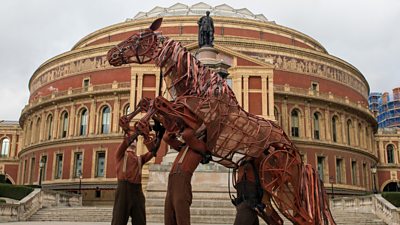
War Horse Prom
Music from the National Theatre’s War Horse, plus war-themed songs performed by the Proms
Military Wives Choir directed by Gareth Malone
BBC Concert Orchestra/David Charles Abell (3 August)
Live on BBC Radio 3
Recorded for broadcast on BBC Two in November
Tavener - Requiem Fragments (BBC commission: world premiere)
Heath Quartet and Tallis Scholars/Peter Phillips (4 August)
Live on BBC Radio 3
Recorded for broadcast on BBC Four on 10 August
Casella - Elegia eroico
BBC Philharmonic/Gianandrea Noseda (8 August)
Live on BBC Radio 3
Bridge - Oration
Leonard Elschenbroich cello
BBC Philharmonic/John Storgårds (14 August)
Live on BBC Radio 3
Butterworth - (orch. P. Brookes) Six Songs from ‘A Shropshire Lad’
Allan Clayton tenor
Roderick Williams baritone
BBC Scottish Symphony Orchestra/Andrew Manze (17 August)
Live on BBC Radio 3
Recorded for broadcast on BBC Four on 22 August
Kelly - Elegy for strings, in memoriam Rupert Brooke
BBC Scottish Symphony Orchestra/Andrew Manze (17 August)
Live on BBC Radio 3
Recorded for broadcast on BBC Four on 22 August
Stephan - Music For Orchestra (1912)
BBC Scottish Symphony Orchestra/Andrew Manze (17 August)
Live on BBC Radio 3
Recorded for broadcast on BBC Four on 22 August
Vaughan Williams - Pastoral Symphony (No. 3)
BBC Scottish Symphony Orchestra/Andrew Manze (17 August)
Live on BBC Radio 3
Recorded for broadcast on BBC Four on 22 August
Britten - War Requiem
Susan Gritton soprano
Toby Spence tenor
Hanno Müller-Brachmann baritone
BBC Proms Youth Choir and City of Birmingham Symphony Orchestra/Andris Nelsons (21 August)
Live on BBC Radio 3
Holst - The Planets
London Philharmonic Orchestra/Vladimir Jurowski (28 August)
Live on BBC Radio 3
Soldier Songs: Foji
BBC Asian Network
The BBC Asian Network will be marking the centenary of WWI through a special musical commission featuring artist performances and community voices reflecting the significant contribution of their ‘Fauji’ forefathers with stories shared in a range of languages including Punjabi, Hindi, Urdu, Gujarati and Bengali.
The station will stage a performance by Birmingham-based Bhangra musician ‘Foji’ (derived from the word ‘Fauji’, meaning ‘soldier’) with stories centred on the journey of Indian soldiers to Europe and their experience of life on the Western Front.
BBC Asian Network’s broader programming will feature young British-Asian voices sharing their personal family histories and perspectives on the Great War and will seek to discover what this centenary really means to modern British-Asian communities.
BBC Radio Productions
AF
Commemoration
World War One Commemoration: Monday 4 August 2014
The BBC Events team will provide extensive live coverage of the major national events here in the UK and in Europe that commemorate the anniversary of Britain’s declaration of war on August 4th 1914. One hundred years on, this series of live events will mark this historic day and remember the millions of those who died.
Throughout the day Huw Edwards, based in London, will host programming on BBC One, BBC Two and the BBC News Channel, bringing coverage of events that take place across the UK. Sophie Raworth will be presenting from just outside of Mons in Belgium.
The day will begin with a Service of Commemoration for the Commonwealth in Glasgow which will be attended by HRH The Duke of Rothesay (as the Prince of Wales is known in Scotland). The service will pay tribute to those from the many Commonwealth Countries who fought in The First World War.
Then as the sun goes down coverage will move to Belgium with a commemoration in the powerfully evocative setting of St Symphorien Military Cemetery where TRH The Duke and Duchess Cambridge will be joined by HRH Prince Henry of Wales. The cemetery at St. Symphorien was established during the First World War as a final resting place for both British and German soldiers killed at the Battle of Mons.
The day will end at Westminster Abbey with a candlelit Vigil Service which will end at 11pm, the moment war was declared 100 years ago. Across the country lights will go out and candles will be lit as communities commemorate the centenary.
Children’s
The Big Performance
CBBC
The Big Performance is set to return to CBBC for a third series and this time choirmaster extraordinaire Gareth Malone challenges six of the UK’s most talented children to produce a performance that marks the centenary of the First World War, with the help of Katy B, Pixie Lott, Conor Maynard, The Vamps and Eliza Doolittle.
The children, aged 11 to 13, know little about the conflict, and so Gareth takes them to visit key World War One memorial sites where he introduces each of them to their varied and fascinating family histories. Jasmine discovers her great great uncle fought with one of the Caribbean regiments, while Molly’s great great aunt served as a nurse. There’s even a surprise for Gareth as he discovers a photograph of his great grandfather in military uniform.
Set with the huge challenge of writing and performing a song that celebrates the memory of their ancestors, the children are stretched to their limit, and so Gareth enlists the expert help of some celebrity friends to produce masterclasses in songwriting and performing. Just one song will be chosen to perform at the finale - whose will it be?
Twenty Twenty Television - 6x30'
FM
War Game
CBBC
War Game is a half-hour animated film which follows the moving story of Will, Lacey and Freddie – three young Suffolk lads who leave their idyllic country lives to fight in the trenches of World War One. Surrounded by the chaos and confusion of war, they can only dream of their football team, their friends and the families they have left behind.
On Christmas Day however, a football game is started between German and British soldiers. Scrambling onto No Man’s Land, the men come face to face with the enemy they have never seen and the true futility of their fight. For a brief moment - differences are forgotten, the men unite and the seeds of hope are planted. But joy has no place in the war and the men are soon recalled to the trenches to continue the battle.
From a football game in the fields of Suffolk to a football game in the heart of Flanders – War Game shows the realisation of three young men’s ambitions to play for England and the ability of the human spirit to exist even in the harshest conditions.
War Game is based on the book by Michael Foreman and features the voice talent of Kate Winslet and a powerful and moving sound track from the composer Julian Nott.
The Illuminated Film Company – 1x30'
CB
Horrible Histories
CBBC
Multi-award-winning comedy sketch show Horrible Histories is back for a one-off World War One special, stuffed with the usual mix of fascinating facts, popular pastiches and gruesome gags.
This special 40-minute episode – featuring Mat Baynton, Martha Howe-Douglas, Simon Farnaby, Larry Rickard, Jim Howick and Ben Willbond – reveals how Girl Guides were used to pass on secret war-time information; tells of the terrors of trench life – all fleas, bangs and number twos in a bucket; and hears a frustrated captain try to explain the not-so-simple reasons for Britain joining the war.
Horrible Histories also divulges more about the extraordinary football match that took place during the Christmas Day Truce, and discovers what happened to turn a German Shepherd dog into an Alsatian. There’s also a song from the Suffragettes all about how women’s roles were changed by the war.
A Lion Television in association with Citrus Television production - 1x40'
CB
Harriet's Army
CBBC
Harriet's Army is a gripping new three-part CBBC drama series, set during World War One and following a group of children in a small English town as they hold the Home Front and discover the true enemy within.
Fourteen-year-old Harriet is a girl who doesn’t fit in, and when she’s kicked out of the Girl Guides for getting involved in a fight, her father doesn’t know what to do with her. As war breaks out and the efforts of the Scouts and Guides are volunteered in support of the war, Harriet feels sidelined and forms her own ‘army’ of misfits, mounting their own patrols and searching for German spies.
Harriet's Army highlights the astonishing and genuinely important role played by the children and young people who were left behind when their fathers and brothers went to fight in the trenches.
CBBC Productions - 3x30'
CB
Operation Ouch! Goes Back In Time
CBBC
CBBC’s Operation Ouch! is packed with incredible facts about the human body and fronted by identical twins Dr Chris and Dr Xand van Tulleken, who experiment and explore their way through the fascinating world of medicine and biology.
In this special episode, the doctors turn back the clock to find out more about what medicine was like in World War One. They look at the little critters that infested the trenches, and set up a massive experiment to show viewers how soldiers’ bodies had to cope with the pressures exerted from huge explosions.
A Maverick Television production - 1x30'
CB
My Story
CBeebies
My Story World War One Centenary special takes a mother and her daughter on a fascinating journey into the past. Together they discover what it was like to be a child 100 years ago, between 1914-1918, as they find out what school was like, what games they played and what food they ate. They also find out how much life changed for the women and children left at home while the men went to war. Narrated by broadcaster Nicky Campbell, My Story brings history to life for pre-schoolers.
BBC Productions, Scotland - 1x15'
HH2
Poppy's Day
CBeebies Radio
Poppy’s Day tells the story of a little girl who, on her way home from the dentist, notices people wearing red poppies on their coats. She and her family talk about the sentiment behind the tradition of wearing poppies. The story ends with Poppy and her family taking part in a Remembrance service, during which wreaths are laid, a two-minute silence takes place and The Last Post is played. As the crowds begin to leave, Poppy places her bravery sticker, given to her by the dentist, next to wreaths that have been laid, because she feels that the people being remembered were all very brave and deserve the sticker more than she does.
My CBeebies Favourite Day
CBeebies Radio
A boy and his father talk about his Great Grandfather's war medals, a trip to Buckingham Palace to see the changing of the Guard and a visit to The Guards Chapel in London for a Remembrance service.
CBeebies Radio is a daily web-based radio show for pre-school children, bbc.co.uk/cbeebies/radio
Digital
1914 Live – the BBC tells the story of the war in a way never done before
On 28 June, 100 years on, the BBC will tell the story of one of the defining moments of the last century, the assassination of Archduke Ferdinand, in a way never done before with its online proposition 1914 Live.
The BBC will report on the day as if it was 1914 but with 2014 technology - combining modern news formats with historical archived content - allowing audiences to experience and relive the events of 100 years ago as breaking news in real time, today.
In collaboration with Professor Margaret MacMillan, 1914 Live will unfold through a live blog at bbc.co.uk/ww1 from 9.30am-2pm and will receive the BBC’s full live treatment including; ‘live’ video from across Europe, text commentary and contributions from a host of BBC News’ team of correspondents - including Frank Gardner, Allan Little and Bridget Kendall.
The team will bring their specialist expertise to analyse the security, political and diplomatic implications on the day, allowing the audience to be immersed in the twists and turns of history as it is written:
- Allan Little will feature in on-the-ground video reports from Sarajevo throughout the day
- Nicholas Witchell, Bridget Kendall and Frank Gardner will give video reports from London covering Britain’s perspective on the royal couple, the diplomatic and security implications of the visit
- Bethany Bell in Vienna, Stephen Evans in Potsdam, Christian Fraser in Paris and Oleg Boldyrev in St Petersburg will give reports on the reactions from across Europe
The 1914 Live blog will also be available through BBC World Service in the following languages: French, Persian, Arabic, Somali, Spanish, Uzbek, Kyrgyz, Hindi, Chinese, Russian, Portuguese, Turkish, Urdu and Pashto. The live blogs will available across desktop, mobile and tablet.
Adrian Van Klaveren, Controller, World War One Centenary: “Digital is at the heart of our WW1 season and this project links different parts of the BBC so we can use our expertise in news reporting and digital innovation to tell the story of the war in a fresh way. The assassination of Archduke Ferdinand is a key moment in history, which we are retelling for the 21st century – with audiences able to relive the breaking news of 100 years ago as if it was happening today.”
Professor Margaret MacMillan, said: “The world of a hundred years ago may seem remote to us—those faded photographs of people in funny clothes—but BBC's 1914 Live will use modern communications to bring it alive. The assassination came as many Europeans, just like us today, were starting their summer holidays. They greeted the news with shock or indifference but had little inkling that their world was about to be turned upside down.”
Margaret MacMillan is also the presenter of Radio 4’s 1914: Day By Day, a 43-part series chronicling in real time the road to war in 1914.
The BBC News correspondents involved in the project are: Special Correspondent Allan Little, Security Correspondent Frank Gardner, Royal Correspondent Nicholas Witchell, Diplomatic Correspondent Bridget Kendall, Berlin Correspondent Stephen Evans, Vienna Correspondent Bethany Bell, Paris Correspondent Christian Fraser and Oleg Boldyrev from the BBC Russian Service.
As outlined in Tony Hall’s speech last autumn, the BBC is putting an emphasis on its live digital offering - building on the technology used to deliver London 2012 and a range of events, audience data and feedback since then. This has enabled the BBC to bring audiences even closer to a wide range of events across PC, tablet, mobile and connected TV, with a seamless live experience that brings all the BBC's live content in one place and can introduce innovative new features. The technology can be used for any live or ‘as-live’ event, such as World Cup Rewind and now 1914 Live, from across the BBC and can easily be scaled up for major events, such as the Commonwealth Games and Glastonbury.
BBC iWonder – Interactive Guides
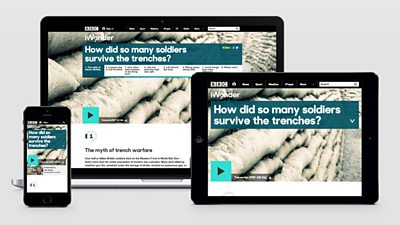
BBC iWonder is a new factual and educational brand from the BBC designed to unlock the learning potential of all BBC content. The interactive guides – curated by experts and BBC talent – aim to feed curiosity by exploring different perspectives on thought–provoking questions sparked by everyday life, either through BBC programmes, current events, seasons and anniversaries.
As part of the BBC’s World War One season BBC presenters, historians and other talent - including Dan Snow, Kate Adie, Ian McMillan, Greg James, Hugh Pym and Neil Oliver - will tackle of a range of subjects, with an array of guides already available and more to come throughout 2014.
The upcoming World War One iWonder guides explore topics ranging from the radical design of World War One memorials and the development of gas as a weapon, to the impact of WW1 on international treaties and how flight took off during the war.
Presenters include BBC Health Editor Hugh Pym who tells the story of his grandfather, Tom Pym, who was a chaplain on the front line and John Rhys-Davies (Gimli, LOTR) on how much of The Lord of the Rings was inspired by WW1.
From the trenches to poetry and propaganda, whether the subject of the First World War is completely new to someone, or it’s a chapter in our nation’s story they have grappled with at length, the World War One iWonder guides enable people to interact with the Great War topics that interest them.
Rich with original video and audio content, the BBC iWonder guides are designed to give people access to content in a new and more interactive way, which will deepen understanding, and challenge preconceptions. They have been built to work consistently across laptops, tablets and smartphones.
World War One specific guides can be found at bbc.co.uk/ww1. More iWonder guides will launch throughout 2014 which cover topics and genres across the full range of BBC output, from science to natural history, arts, food, religion and ethics – available at bbc.co.uk/iwonder.
WW1 UNCUT
As part of its World War One Season the BBC has commissioned a series exclusively for BBC iPlayer, called WW1 UNCUT. The collection will see 13 episodes launch in total, starting from April through to July 2014.
Produced by Ballista Media, WW1 UNCUT consists of a series of short films that explore a variety of defining World War One features. From the trenches and a soldier’s kit to war myths and weapon testing, the shorts explain war topics in an educational yet entertaining way, giving the content a fresh and current feel.
Historian and broadcaster Dan Snow is the collection’s lead presenter; other presenters include Michael Douglas (The One Show), Dr Saleyha Ashan (Trust Me I’m A Doctor) and Sam Willis (Nelson’s Caribbean Hell-Hole).
The full list of episodes is:
1. Trenches and barbed wire (available now)
2. A soldier’s kit (available now)
3. Breaking deadlock (available now)
4. Machine guns and rifles (available now)
5. Dogs and other animals (available now)
6. A Tommy’s sex life (available now)
7. Origins rap battle (available from 19 June)
8. Combat in the skies (available from 19 June)
9. Myths and confusion (available from 19 June)
10. WW1 Explosions & Submarines (available from mid-July)
11. Medicine of WW1 (available from mid-July)
12. General v Soldiers (available from mid-July)
13. World City of the Trenches & WW1: Beyond the Western Front (available from mid-July)
Across the UK
World War One At Home
The BBC’s ambitious World War One At Home season continues to unearth local stories about the global conflict. This year and next, the series will feature 1400 stories about life on the home front during the Great War, showing the impact on families and communities across the nation.
Broadcast on local and national radio and TV outlets, World War One At Home has so far discovered stories from Perth to Porthcurno, and from Newtownards to St Asaph. 450 stories have already been heard, and a further 250 will be broadcast on every BBC local radio station as well as regional news bulletins in England (and on national networks in the Nations) from 4 – 11 August.
All will be added to the BBC World War One At Home website www.bbc.co.uk/ww1, a growing collection which features audio clips and striking ‘then and now’ images. A handy mapping tool helps people see how the war changed their neighbourhoods, and allows searches by post code as well as theme (such as tanks, horses, food, war in the air) or by BBC station.
The radio and TV stories are complemented by World War One At Home Live, a national tour which will continue in August and September visiting county shows, summer festivals and bustling shopping centres the length and breadth of the UK. The family-friendly events include hands-on activities, performances and interactive sessions designed to appeal to all ages.
The Tour will feature a mix of eight flagship events supported by BBC Learning, as well as 17 others across England which will be attended by local and national BBC presenters. In August World War One at Home Live visits places including Dundee (BBC Radio Scotland, 1 August), Bristol Balloon Fiesta (BBC Radio Bristol, 8-10 August) as well as Leicester City Festival (23, 24 August) and Rhyl (Rhyl Airshow , BBC Wales on 30 August).
Tour venues and dates are listed here
SM/NL
BBC Northern Ireland
BBC Radio Ulster/Foyle will broadcast the fourth series of World War One At Home from 4-8 August. Introduced by Helen Mark, the World War One At Home series travels across Northern Ireland and the Republic of Ireland - in space and time - to visit locations with close ties to the war.
UC
BBC Scotland
BBC Radio Scotland will broadcast the fourth series of World War One at Home from 4-8 August on Good Morning Scotland, the John Beattie Show and Newsdrive. The story of the opening of a 1914 Time Capsule in Dundee will be one of the main stories. Janice Kennedy first read about the time capsule as part of some research. With help from the Post Office, Dundee High School, museums, libraries - and a chance encounter with a local postman - Janice eventually tracked the box down. The much anticipated opening will form part of the city’s commemoration of the start of the War, on August 4 2014.
JG
Wales
BBC Radio Wales will continue its series of World War One At Home stories on both Eleri Sion and Roy Noble. Plus Good Morning Wales will create daily bulletins using stories in the news in the week war broke out in 1914.
On 4 August, BBC Radio Cymru will record a day in the life of young people, who will be encouraged to record an audio diary. These diaries will be woven into a radio documentary Cymry24 to be transmitted during September. The 4th will also be marked by poems by the station’s ‘resident poet’.
SG
Leaving Home
BBC Radio Lincolnshire
BBC Radio Lincolnshire will host a number of events marking the tragic loss suffered by the Beechey Family in World War One. Eight brothers from Lincoln went to fight, five of them were killed. They are one of a handful of families in the country to suffer so severely. Working closely with the University of Lincoln School of Performing Arts and the Diocese of Lincoln, BBC Radio Lincolnshire will produce a radio play as well as a series of outdoor ticketed events to remember the sacrifice made by the Beechey family, culminating in a special performance at Friesthorpe church on 3 and 4 August. Called Leaving Home, all events will be recorded or broadcast live on BBC Radio Lincolnshire.
SM
Nations
BBC Scotland
The Sycamore Sings: The Wilfred Owen Violin
This radio documentary from BBC Scotland will mark the anniversary of the start of World War One and features the creation of a musical link between war poets Siegfried Sassoon and Wilfred Owen and the Edinburgh psychiatric hospital where they were treated. Both poets, and their visitor, Robert Graves, would have walked among the trees that still stand in the grounds of Craiglockhart, an Edinburgh Hydropathic hospital, which treated shell-shocked officers. Instrument-maker Steve Burnett is using a branch of one of the sycamores that has been taken down to create the Wilfrid Owen violin in tribute to those who were damaged by the war and to create a catalyst for learning about nature, music and language. The Sycamore Sings: The Wilfred Owen Violin airs on BBC Radio Scotland on Monday, 4 August, at 11.00 am and will be repeated on Wednesday, 6 August, and Thursday, 7 August.
Radio Nan Giadheal
A'Chiad Chogadh: Facal Toisich (World War One: An Introduction)
Professor Matthew MacIver examines the impact of the outbreak of World War One on small communities in the Highlands and Islands. Fishermen, crofters and part-time reservists left in their thousands; some families had multiple sons leave and many men gave the ultimate sacrifice. Professor MacIver reflects on what these communities were like before 1914 and shows how Gaels were equipped with the necessary skills and resilience required during the war.
Dòmhnall Macleòid Agus a Lizard (Donald Macleod and his Lizard)
Seaforth Highlander Donald Macleod, from Lewis, saw action in France, Mesopotamia, and Palestine, took part in 27 battles and did not get home on leave once over four years. His niece recorded his story on cassette, including how he kept a lizard to keep lice and flies from his clothes - and preserved the reptile in glass to bring it home.
Seachdain Sa Chogadh (The War this Week)
A ten-minute digest of how the war affected Highlands and Islands communities, drawing on poetry, Radio nan Gaidheal archive, extracts from newspapers, song, diary extracts, postcards, telegrams and other materials.
