An interview with Peter Bowker
Peter Bowker is the Writer and Executive Producer of World On Fire.
Published: 25 September 2019
I wanted to capture something of the global cooperation. It was possibly the first time in modern history that the world got to talk to each other and cooperate in such intimate terms.
What was your vision for the drama?
The ambition of the piece was to tell a story that we all feel we are familiar with, that forms part of Britain’s national philosophy, but with a fresh take on it. To tell the stories that might not have been told before or at least not told too widely. I wanted to capture something of the global cooperation. It was possibly the first time in modern history that the world got to talk to each other and cooperate in such intimate terms.
What was the inspiration for these characters that you created?
I wanted to find a way to tell stories about people who weren’t making the decisions at the top but who were profoundly influenced by them. These were a generation of people who would never have left their hometowns but suddenly found themselves abroad with their lives on hold for five years or more. The other major point that interested me is the profound change in life and in expectations for women during this conflict, both those engaged directly in the conflict and those at home. When I started researching I had access to different women’s diaries in the archive at The Imperial War Museum. It was so refreshing that their entries are generally about where they could get good coffee and their boyfriends. This is while the living daylights are being bombed out of the city every day. Our fundamental human preoccupations don’t change. They just happen to be interrupted by bombing raids and death and destruction.
Describe World On Fire.
World On Fire is a drama about World War II, told from a multinational perspective. I wanted to write a drama where we invested in a Polish family, a French family, just as much as we emotionally invested in a British one. The design of the show is such that there are connections between these families scattered across the world, but sometimes only the audience knows what those connections are.
Your characters are a wonderful mix of diverse people from all sorts of backgrounds. Why was it important to include their stories?
I deliberately set out to tell stories that weren’t traditional war stories. I wanted to write about what it was like to be a Senegalese soldier who found himself at Dunkirk. What it was like to be gay in Paris, when you’d escaped to Paris to celebrate your sexuality and then the Nazis invaded. What it was like to be a conscientious objector with two children. What it was like to be an ordinary apolitical German family, who just hoped Nazism might be a passing phase and who had a child that was at risk because she had a disability. They struck me as stories that have remained largely untold, but also struck me as contemporary in our current preoccupations with nationality and borders and refugees, and what constitutes a genuine refugee and what constitutes genuine need.
How did you create the four worlds in this story with production designer Paul Spriggs and Adam Smith?
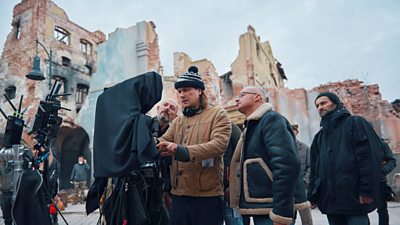
I’d worked with Paul Spriggs before on The A Word and I wanted him for the job from the off, because he has an extraordinary understanding of character and how that’s reflected through design. Paul constantly surprises and astounds. Adam, Paul and myself talked a lot about capturing Warsaw before the war, as it was one of the most beautiful European cities. Now we think of Warsaw post-war but that helps the story because we see this beautiful city destroyed. Paul would put buildings up in front of rubble so that even when the buildings had gone, they were both in the same location so you felt invested in it visually. There’s no way you felt cheated.
Each city, be it Manchester, Paris, Berlin and Warsaw, had a slightly different, colour palette and design. There’s a series of almost subliminal visual clues that are bedded in. One of the huge challenges of the drama is that the audiences retain in their head each family and where we are, so when we go from one story to another we’re not disorientated and lost. Paul built a landscape that allows us to do that, a kind of shorthand that we immediately recognise which city we are in.
The scripts you’ve written include some of those most iconic moments of the war. What level of research did you do?
I thought I knew a bit about the war but it turns out I knew nothing at all. The great thing about the research for the show was that it came from three different directions. Richard Overy, who is a renowned historian and head of history at Exeter University, provided an overview for us. He writes a lot of the Imperial War Museum material and is a great writer on the Second World War in his own right. I also had a researcher working alongside me who really understood how the fictionalised version might work and we would talk separately to the Imperial War Museum. It was about narrowing down the abundance of material that was there and finding alleyways and places that I didn’t know about. Then it was finding stories, finding the little details that humanise it.
What inspired the details we see in the battle of River Plate, in both story and design?
When I was reading about the Battle of River Plate, a captain wrote that they went down to the engine room and the only thing that had survived was the ship’s canary. The men had all died but the canary had survived and laid an egg during the battle. I immediately thought there’s something about the absurdity of that which I wanted to capture, so I created a story that began and ended with this canary.
If you look at war movies that feature sea battles, they’re notoriously difficult to make with any great degree of tension, as battleships don’t move at speed. I thought if we can stay in the bowels of the ship rather than being on deck, that’s what would terrify me. Being under the waterline or under the deck and not knowing what’s going on is horrifying. It was a diary of a gunner who described that below deck you don’t know if you’re winning or losing. The main things he wrote about were being given double rations and eating biscuits all the way through the battle. There’s a humanity and a joy to that detail that you can embrace as you start to understand the character.
I wanted to tell a morality tale about a man who falls out with his best friend before the battle and never gets a chance to make it up. If this day is your last, how do you behave to another human being? The sea battle has genuine tension and genuine tragedy.
Why is diversity so important for this story?
At the heart of Nazism is a belief in racial superiority. It seemed odd to me that you wouldn’t then want to make a war drama that was in some way a celebration of diversity, because this war was won by a multi-racial international alliance. It wasn’t just won by white men and it wasn’t just won, however much we like to believe it, by plucky Britain. So why wouldn’t you try and do something new?
On a personal level my grandmother, who was white, and my auntie Anna, who was Afro-Caribbean, were a mixed race variety act called Two Shades, performing in 1930s Manchester. Creating the characters of Lois and Connie was partly a desire to celebrate them and they became a starting point for telling hidden stories of diversity. During the war Two Shades had huge success because a lot of entertainers had been posted overseas and their story seemed an organic and natural place to start.
Why did you feel the need to bring the psychological effects of warfare to the front in this story?
During my research I read a book about the history of psychiatric treatment of soldiers. The opening page on the chapter of Dunkirk described this lorry-load of traumatised men, which included three Englishmen, two Irishmen and three Senegalese, who were serving in the French army. I wondered what that must be like, and how we could tell that story. That excited me and I hope it would excite an audience, too.
Describe the Paris you wanted to depict and why you chose to tell this story through the eyes of a gay couple?
Pre-war Paris became a haven, especially for black American jazz musicians and for gay men. The bohemian scene in Paris was deeply attractive and people flocked to it for its liberal, slightly more open values compared with the rest of Europe. Then the Nazis rolled in. What do you do? Do you stay and resist or do you run for your life? Drama is all about creating complications for the character and I’ve not seen that story told before. We are hopefully now at a time where we can tell a story about two gay men living during the Second World War that is not sublimated into Brief Encounter.
What was it about the female characters that you wanted to resonate with the audience?
I always try and create a range of female characters who are allowed the same characteristics as my male characters, whether that be pleasant or unpleasant, strong or weak, flawed or not, deluded or not. The joy of writing something set in a particular time period is that the restrictions are more overtly placed on women, with the assumptions about what women can and can’t do.
With Robina, I was very interested in creating a woman who is on the surface, powerful, upper-middle class, has money and a nice house but who is nevertheless locked into a particular role. Psychologically, I wanted to show this is a woman who is either so afraid of love that she can’t express it or has never felt love and can’t express it. I gave her awful things to say but still framed her language wittily. Lesley Manville, from the first day, understood the character and where Robina was coming from. She totally got it and delved right into the pain underneath it all.
Describe the character you created in Nancy.
Nancy is the American war journalist, played by Helen Hunt. I found it amazing how many female war correspondents there were in the Second World War. I wanted to write about a woman who had experienced a severe trauma in her past and as a result had built a shell of wit and one-liners around her. But she also has a purpose, which is to guide us through the story and because she is a journalist, she can go anywhere. She also understands that the power she has is completely dependent on being indulged, either by a political master, a censor or by her boss at home. The power she has, she has to earn, but is only granted to her by men.
Tell us about Harry's two key love interests.
The two younger women who feature, Lois a young Mancunian factory worker and nightclub singer, and Kasia, a young Polish waitress, are both versions of the women I met in the diaries I read. Who, like all young people, are interested in dancing and love and have, in Lois’s case, political ideals, some sense of there being a bigger world out there and not quite knowing how to take the next step into it. World War II in particular gave women that opportunity.
What does Jonah Hauer-King bring to the lead role of Harry?
Harry is the only character with whom most of the other characters intersect, so he’s the one that guides us through this narrative, especially in the first three hours. His story is about the first year of the war, ending on the beaches of Dunkirk, the loss of idealistic innocence and realisation that this isn’t going to be as straightforward as we all thought.
Jonah brings that sense of privilege, but a young man who is sensitive enough to be struggling with his privilege. He brings an immense vulnerability and I like that combination of somebody who looks like they should be a lot cockier than they are. Harry is full of good intentions and that’s what gets him in the messes he gets into, because those good intentions aren’t always the thing that’s needed in the moment. He also carries with him a fairly heavy family history. What Jonah has done over the seven hours is marked the change in Harry. He goes from being a fairly callow young man into somebody traumatised, who then finds himself.
What was the inspiration for the Rossler storyline?
When dramatizing a German family, the thing I was keenest to address is what do we do when we’re faced with a situation that we feel we can’t change. I wanted to write about an ordinary German family that are neither resisting Nazism nor colluding with Nazism. They’re a normal German family living under a Nazi government, under fascism. There is a stereotype that either all Germans were Nazis, or if you weren’t a Nazi, why weren’t you part of the resistance. I thought how often do we resist in any society? It’s easier to keep your head down and hope it will pass.
Tell us about the challenges facing the Rosslers.
I wanted the family to be vulnerable in some way. I read a lot about the euthanasia programme that the Nazis put into place. It started about ten months before the war. Initially, it was directed at adults with long-term mental health problems and severe disabilities. It extended fairly quickly to the monitoring of newborns and children with disabilities. Essentially it was a dry run for the holocaust. Everything they put in place became part of the template for how they then directed the selective murder of Jewish people. The Rossler’s daughter has epilepsy, so the vulnerability of that family is enormous, which was an even bigger reason to keep their heads down and conceal everything they can.
When the casting process was taking place, what was your vision for the characters you created and what were you looking for in the actors?
We were incredibly lucky to get Helen Hunt, Lesley Manville and Sean Bean, but the majority of this cast were going to be actors who aren’t yet established, which was exciting. What we wanted from the performance was no awareness that we’re in a historical drama; they are young people living in a world and trying to break their way out, which happens to be 1930s Poland or happens to be 1940s Manchester. We wanted to create the same exuberance in a family whether they’re Mancunian or Polish and show the same family tensions and jokes.
I wanted them to have a vitality that was not reverential. I want audiences to watch it as though they are watching a contemporary drama. Having read some of the wartime diaries, young people then thought and behaved like young people do now. The humanity of that generation should be celebrated and that includes making bad decisions and having flaws. That seems to me a more honest and genuine celebration than actually seeing them through a sepia lens as some saintly otherness.
Do you have any personal stories of your family from the war?
My father was one of four brothers and they all fought in the Second World War. He was shot by a Japanese sniper and my grandmother received a telegram saying he was missing in action and presumed dead. Some time later he turned up alive on the doorstep. Being a Salford mother, the first thing she said was, "Oh, Eric, you do need a haircut". That’s as much grief and trauma as she showed. Incredibly all four brothers survived.
Did your father talk openly about his experiences?
Like most of the men of that generation he never really talked about it, and I don’t think he considered it an act of bravery. When my dad was in his late 60s one of his old RAF Regiment got in touch and he wanted very little to do with it. He didn’t want to go back there. He was in China post-war helping with reconstruction, with refugees and helping get food stocks to people who were starving. That seemed to be the one thing he did talk about.
How did this project actually come about?
Damien (Timmer) and myself are obsessed with The World At War documentary, the definitive World War II documentary voiced by Laurence Olivier that went out in the 1970s. Damien wondered if it would be possible to make a drama in that style, because what the original documentary did was tell the war from multiple perspectives. The spark was thinking about those tiny moments of humanity at the very heart of the war.
There was a Pathé newsreel after the Battle of River Plate when they interviewed the British soldiers who had been held captive in the German ship that the British were firing at to try and sink. The British sailors who’d been held captive knew that they would die if the British won the battle, yet they still wanted the British to win. They were just ordinary fellas saying the Germans were great chaps, they gave us all cigarettes and they looked after us. There was something so incredible about the complicated humanity in that. Also I have to say, Deutschland 83 was a big inspiration. How do we look at a period we think we know and freshen it and add vitality? That was the spark that ignited the flame of the idea.
Why do you think this show will appeal to an international audience now?
I hope the show appeals to an international audience because it tells a story from many national perspectives. In television terms, audiences are far more familiar with watching subtitled shows from other countries; it's an international phenomenon that we no longer just want to watch domestic product. It also feels like a time to watch a drama about a world where disparate countries with different needs united nevertheless, to oppose a cult of hatred. To tell stories within that about how people from different backgrounds and different parts of the world, crossed paths with each other, and discovered that they weren’t that different.
Pictured: Director Thomas Napper Director Adam Smith Production Crew
Character Descriptions
NANCY CAMPBELL
Played by Helen Hunt
American broadcaster and journalist NANCY CAMPBELL is addicted to war. She can’t stay away. It isn’t just the adrenalin, but the puzzle of war - the puzzle of human nature – she craves. NANCY, in Warsaw in 1939, crosses the border to Germany and spends the first eighteen months of the war in Berlin as part of the overseas press corps. Her ability to befriend her German neighbours as well as army officers sees NANCY report those stories at the very forefront of the Nazi regime; some they are happy to have broadcast to the world, while others, they are determined to keep hidden. No surprise then, that NANCY is driven by getting those forbidden stories out of Berlin - at huge personal risk.
ROBINA CHASE
Played by Lesley Manville
When her son HARRY, finds himself on the wrong side of the law protesting against Oswald Mosley, ROBINA CHASE despairs, only slightly comforted in the knowledge he is soon to travel to Warsaw for a job as a translator. After HARRY’S father died in the most tragic of circumstances, ROBINA was left to raise HARRY alone. She has done so with the sole aim of making him a man of great social standing, but so far, HARRY is proving only to disappoint. His love for two different women - both, in ROBINA's eyes, highly unsuitable - has far reaching consequences, and her frustration is exacerbated when HARRY returns prematurely from Poland, following the Nazi invasion, with a Polish refugee in tow. ROBINA - despite her will and better judgement - finds herself with a house guest she had never expected. Against the odds, the war is set to change this cold and austere woman, as much as it will HARRY.
DOUGLAS BENNETT
Played by Sean Bean
DOUGLAS BENNETT is a pacifist who was mustard-gassed in the First World War. He watches as his son and daughter go off to war, despite the fact that he is a pacifist. With both children away, he finds solace in unlikely friendships; with HARRY CHASE’s mother, ROBINA, and the young Polish refugee she has reluctantly taken into her home. DOUGLAS’s worst fear looks set to become reality when his son TOM finds himself aboard HMS Exeter, a ship that eventually faces German ship the Graf Spee in one of the first major battles of the war. Desperate for news of TOM, the uncertainty of his son’s wellbeing and the haunting horrors of his own experience of battle look set to overwhelm him, until unexpected news from his daughter LOIS gives him renewed hope for the future.
HARRY CHASE
Played by Jonah Hauer-King
HARRY CHASE is a young Englishman with a flair for languages, deceit and heartbreak. A talented translator, HARRY is in Warsaw Woking for the British embassy. Caught in an explosive love triangle between his Mancunian girlfriend LOIS BENNETT, and local Warsaw girl KASIA TOMASZESKI, when war breaks out, HARRY has choices to make, fast. With KASIA's life in danger, he knows that there is one place she would be safe: Manchester. But how will he explain this to LOIS, and, what's more, to his mother? Funny, handsome and clever, life has been easy for HARRY so far – but war changes this forever. An idealist, a rebel, perhaps HARRY always just needed a cause – and the cause is the war. The series will take him all the way from Warsaw to Dunkirk, as he learns to lead, to fight, and to find out what he truly believes in.
LOIS BENNETT
Played by Julia Brown
LOIS BENNETT is a Mancunian factory worker. At home she is the lone girl in a family of men with the responsibility of looking after her fragile father and a wayward brother. Despite opposition from his snobbish mother, LOIS is in love with HARRY. HARRY betrays her with KASIA whom he meets in Warsaw. His betrayal seems to simultaneously break her heart and open her mind. Later, she will reflect that it was as though love blocked out the rest of the world; once he had gone, she could finally see what she was missing. A talented singer, LOIS and her musical partner, CONNIE KNIGHT are determined to make their own contribution to the war effort. LOIS finds her place – and adventure – in the form of ENSA, the War’s Entertainment Corps, and heads off to perform for the troops in Northern France.
TOM BENNETT
Played by Ewan Mitchell
On the pull or on the make, TOM BENNETT brings nothing but trouble to sister LOIS and his father, DOUGLAS. With the police having caught up with him after his latest swindle, TOM avoids prison only by vowing to join the forces, when all the while he intends to dodge action altogether, as a conscientious objector. By the end of episode two, however, TOM has joined the Navy, and is about to face a personal and a military battle of equal, epic proportion.
KASIA TOMASZESKI
Played by Zofia Wichłacz
KASIA starts the war as a waitress in one of Warsaw’s many bars and cafés, already in a passionate love affair with the young English translator, HARRY CHASE, unaware that he already has a girl at home. Her father STEFAN and brother GRZEGORZ depart for Danzig to defend against the imminent German invasion, leaving KASIA with mother, MARIA and younger brother, JAN, at home in the city. Within days of the war beginning, KASIA’s family has each faced the cruel reality of this brutal conflict, and KASIA is faced with terrible choices between protecting her family and her own safety and freedom. KASIA joins the Polish resistance and her war becomes one of subterfuge, excruciating danger and constant fear of betrayal.
GRZEGORZ TOMASZESKI
Played by Mateusz Więcławek
GRZEGORZ TOMASZESKI is not built for battle. A naïve and loving teenager, he wants only to prove himself to his father. Entirely unprepared for the horror that awaits, GRZEGORZ heads to Danzig with STEFAN to defend the city at the outbreak of war, only to face tragedy before the day is out. Like his sister KASIA, life is set only to get tougher for GRZEGORZ, and the devastating battle at Danzig is just the beginning of his wartime anguish. He makes firm friends with KONRAD, a brave man more suited to the challenges conflict brings, and together they eventually flee Poland and make their way through Europe, in the hope their lives can be spared, as so many of their fellow countrymen brutally lose theirs.
WEBSTER O’CONNOR
Played by Brian J. Smith
When we discover WEBSTER in September 1939, he is working in the increasingly busy corridors of the American hospital of Paris. When France is threatened and occupied, despite the efforts of his aunt NANCY, WEBSTER stays in Paris and he fights. At first as a surgeon in a neutral hospital, and then a surgeon in a neutral hospital under Nazi occupation, WEBSTER finds himself fighting on all fronts; for his own identity and freedom, for his lover ALBERT’s freedom, and for those patients who, as of May 1940, are prisoners of war. With the help of friend HENRIETTE, a local French nurse, they begin a system of smuggling patients out of the hospital and beyond, all beneath Nazi noses.
ALBERT FALLOU
Played by Parker Sawyers
Jazz musician ALBERT FALLOU is deeply in love with American doctor WEBSTER O’CONNOR. When the Germans invade, ALBERT grows worried for his and WEBSTER’s safety, and for his own freedom as a Parisian of west-African heritage. When WEBSTER and his colleague HENRIETTE trial their plan to smuggle patients out of the hospital, ALBERT is keen to leave too, and turns to WEBSTER for help. WEBSTER is keen for them to stay put. Before long, however, ALBERT’s fears become their reality, and he is interned in a camp just outside Paris, where he defies their racial profiling by forming a classical orchestra of inmates.
STAN RADDINGS
Played by Blake Harrison
HARRY’s sergeant, STAN RADDINGS, is a working-class southerner with an enormous heart, sometimes concealed behind an unwittingly tactless exterior. A brilliant soldier, STAN is a committed, knowledgeable and loyal sergeant, and when, in their early days of battle, HARRY becomes overwhelmed by the task before him, STAN steps up to set him, and their unit, back on the right path.
HENRIETTE GUILBERT
Played by Eugénie Derouand
HENRIETTE is a nurse at the American hospital in Paris and WEBSTER’s closest ally there. She is a brilliant nurse and they’ve grown close over time. HENRIETTE, as well as being a little in love with WEBSTER is also hiding a more important secret. When war breaks out, and Paris falls to the Nazis, HENRIETTE conceals her Jewish heritage, working with WEBSTER to smuggle French prisoners of war out of the hospital under the noses of the Nazi authorities.