An interview with Lesley Manville
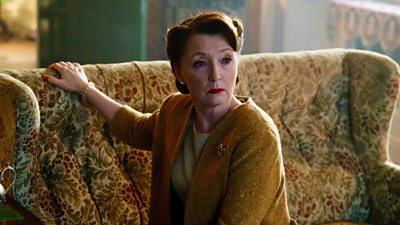
Lesley Manville plays Robina Chase in World On Fire.
Published: 24 September 2019
I love the way the story dips in and out of all these different lives. Yes of course there are the central characters, but it’s a real cocktail of stories about how this epic and tragic event affected different people in different parts of the world.
What is it about Robina Chase that attracted you to the part?
Robina is an upper middle-class woman who is widowed and is the epitome of the very posh end of Manchester. Her son Harry is her only child and he goes off to war - Robina’s story revolves around that. Harry’s father, we learn, committed suicide some time ago and she lives in a large country pile that’s a bit cold and soulless. I was drawn to play that class of woman because it’s not something I’ve had to do often before.
How do we see her evolve throughout the drama?
There is something quite frozen about Robina at the beginning of the series and then you get to see this woman who melts a bit and comes to some level of understanding about herself and how she’s conducted her life. The fact that Robina is quite emotionally repressed and finds anything to do with love and being tactile quite a challenge says a lot about where she has come from. It’s partly to do with her background, partly the class she belongs to and partly her upbringing and the time period. She’s quite a closed door and nothing gets in - in fact you get the impression that nothing much has ever got in. In that respect she’s quite an interesting person to get your acting chops around.
How did you react when you first read the script?
The first thing you look at when considering any part is the writing and if the writing and narrative are strong then it becomes a much easier decision to say yes and this script is wonderful. It’s beautifully written by Pete Bowker and the characters are all very specifically observed. I love the way the story dipped in and out of all these different lives. Yes of course there are the central characters, but it’s a real cocktail of stories about how this epic and tragic event affected different people in different parts of the world. It looks at what the war did to peoples’ lives on a big scale, on a very small scale and on a very personal scale. What it does to love, relationships and families.
How are we first introduced to Robina in the story?
In the story we first meet Robina in her mansion, lonely, on her own. Harry has gone off to war and you get the impression that she’s not been the greatest mother in the world. It’s not that she’s an evil woman in any way, it’s just a muscle in her that she doesn’t quite know how to flex; how to be this person who gives warmth and love.
Harry comes back with Jan, a young Polish child, for her to take care of. She’s aghast - why on earth he would think she has any qualifications to look after a strange child who doesn’t speak her language is beyond her. Jan becomes a sort of challenge for her, and it's what I like about the way Peter’s written Robina: you can write her off as selfish, privileged with a blinkered view of the world - someone who only thinks upper class people are important - working-class people don’t really exist in her world - but she has a great sense of humour and is quite wicked and dry, which I liked a lot about her. The journey for her is that she discovers how to be a mother.
How does her relationship grow with Jan?
In the 21st century that we live in families are not necessarily made up of biological members. Families now are about embracing children that are not your own; grandchildren that are not your own, but that was obviously not the case in the 1930s and 40s.
However, Robina actually embraces this young boy and very slowly finds herself attached to him. A whole set of feelings that she didn’t know she was capable of start to emerge and it’s very touching. You see the strange relationship she has with her own son, where, by her own admission, she’s been a terrible mother, but they have something that binds them together. They have a humour and archness with each other and sometimes that’s all it takes. Of course it’s not everything and it’s not nearly enough but it’s what binds them. I do love the way you see this woman who has been so bad at being a mother all her life begin to, through maturity, the war, loneliness, whatever find somewhere in her heart where she can open up a bit and give something to this foreign child.
What does Robina make of Harry’s choices in women?
Robina thinks Harry’s choice in women is appalling, especially when you know her expectations for him are that he will marry an upper middle-class girl who knows which knives and forks to use; knows how to dress, knows how to speak properly and will be a credit to her husband.
Being in love doesn’t really matter to Robina. If he could only meet somebody who was presentable and could keep up the ridiculous game that she’s played all her life she would be reasonably pleased with that. She’s embarrassed about the manner of her husband’s death. To Robina it’s shameful and embarrassing and a good marriage for Harry would go some way to eradicating Robina’s embarrassment. However, with two women on the go, one a polish waitress (Kasia) and the other a cabaret singer (Lois), it is looking increasingly unlikely that her wish will come true.
Describe Robina’s relationship with Lois’ dad Douglas?
Robina’s relationship with Douglas is at first a necessity because of the relationship between Harry and Douglas’ daughter, Lois. She thinks she can handle Douglas easily because he is a bus driver, but he disarms her with his candour and honesty. Given everything that’s happening in Robina’s world she actually opens up to Douglas and realises that he’s an intelligent man. She can see he has a tenderness and warmth that she envies in some way so we see this unusual friendship begin to develop.
Apart from when she’s with Harry we never see Robina with her own people, so it was quite tricky to get that right because there were no other upper-class characters to bounce off. But then one of the directors (Andy Wilson) gave me a great note which is that Robina is naturally upper-class because it’s in her DNA, so she would never think about how should she behave with a bus driver - she would just be Robina.
What was it like to work with Eryk, who plays the little refugee boy Jan?
Eryk is quite an exceptional person, and not just as an actor but as a charming young man. He’s full of warmth and life and love and understanding and compassion. One of my early scenes with him was when she starts to see quite how vulnerable he is, how young he is and how far away from home he is. Eryk played it so brilliantly and I found him very easy to work with. It was also very easy for me to take what I felt about him as a young man and convert that to Robina’s growing sense of compassion and love for Jan.
Eryk’s instincts are quite exceptional for a young actor and there’s not a lot that you have to tell him, he understands it instinctively and you cannot teach that. You could send a child to drama school every Saturday school for ten years and they could learn all the techniques, but you could never teach a child that. He has an inherent understanding and he can tap into his heart and feelings and relay them to the actor he’s working with.
How does war change her?
Robina’s perspective of the war is from a very cosy and safe position really. I mean obviously nobody was safe, but she is relatively cosy and safe. You could say she is experiencing the war through Jan, and strangely, she seems to care more about him than the fact her son is on the front line. You will see him arriving back and she’s there, waiting with a polite kiss on the cheek if anything, but there’s no kind of charged emotion at the thought of her child returning from war. Somewhere deep inside those feelings are there, it’s just that it was such a repressed time for her class.
Character Descriptions
NANCY CAMPBELL
Played by Helen Hunt
American broadcaster and journalist NANCY CAMPBELL is addicted to war. She can’t stay away. It isn’t just the adrenalin, but the puzzle of war - the puzzle of human nature – she craves. NANCY, in Warsaw in 1939, crosses the border to Germany and spends the first eighteen months of the war in Berlin as part of the overseas press corps. Her ability to befriend her German neighbours as well as army officers sees NANCY report those stories at the very forefront of the Nazi regime; some they are happy to have broadcast to the world, while others, they are determined to keep hidden. No surprise then, that NANCY is driven by getting those forbidden stories out of Berlin - at huge personal risk.
ROBINA CHASE
Played by Lesley Manville
When her son HARRY, finds himself on the wrong side of the law protesting against Oswald Mosley, ROBINA CHASE despairs, only slightly comforted in the knowledge he is soon to travel to Warsaw for a job as a translator. After HARRY’S father died in the most tragic of circumstances, ROBINA was left to raise HARRY alone. She has done so with the sole aim of making him a man of great social standing, but so far, HARRY is proving only to disappoint. His love for two different women - both, in ROBINA's eyes, highly unsuitable - has far reaching consequences, and her frustration is exacerbated when HARRY returns prematurely from Poland, following the Nazi invasion, with a Polish refugee in tow. ROBINA - despite her will and better judgement - finds herself with a house guest she had never expected. Against the odds, the war is set to change this cold and austere woman, as much as it will HARRY.
DOUGLAS BENNETT
Played by Sean Bean
DOUGLAS BENNETT is a pacifist who was mustard-gassed in the First World War. He watches as his son and daughter go off to war, despite the fact that he is a pacifist. With both children away, he finds solace in unlikely friendships; with HARRY CHASE’s mother, ROBINA, and the young Polish refugee she has reluctantly taken into her home. DOUGLAS’s worst fear looks set to become reality when his son TOM finds himself aboard HMS Exeter, a ship that eventually faces German ship the Graf Spee in one of the first major battles of the war. Desperate for news of TOM, the uncertainty of his son’s wellbeing and the haunting horrors of his own experience of battle look set to overwhelm him, until unexpected news from his daughter LOIS gives him renewed hope for the future.
HARRY CHASE
Played by Jonah Hauer-King
HARRY CHASE is a young Englishman with a flair for languages, deceit and heartbreak. A talented translator, HARRY is in Warsaw Woking for the British embassy. Caught in an explosive love triangle between his Mancunian girlfriend LOIS BENNETT, and local Warsaw girl KASIA TOMASZESKI, when war breaks out, HARRY has choices to make, fast. With KASIA's life in danger, he knows that there is one place she would be safe: Manchester. But how will he explain this to LOIS, and, what's more, to his mother? Funny, handsome and clever, life has been easy for HARRY so far – but war changes this forever. An idealist, a rebel, perhaps HARRY always just needed a cause – and the cause is the war. The series will take him all the way from Warsaw to Dunkirk, as he learns to lead, to fight, and to find out what he truly believes in.
LOIS BENNETT
Played by Julia Brown
LOIS BENNETT is a Mancunian factory worker. At home she is the lone girl in a family of men with the responsibility of looking after her fragile father and a wayward brother. Despite opposition from his snobbish mother, LOIS is in love with HARRY. HARRY betrays her with KASIA whom he meets in Warsaw. His betrayal seems to simultaneously break her heart and open her mind. Later, she will reflect that it was as though love blocked out the rest of the world; once he had gone, she could finally see what she was missing. A talented singer, LOIS and her musical partner, CONNIE KNIGHT are determined to make their own contribution to the war effort. LOIS finds her place – and adventure – in the form of ENSA, the War’s Entertainment Corps, and heads off to perform for the troops in Northern France.
TOM BENNETT
Played by Ewan Mitchell
On the pull or on the make, TOM BENNETT brings nothing but trouble to sister LOIS and his father, DOUGLAS. With the police having caught up with him after his latest swindle, TOM avoids prison only by vowing to join the forces, when all the while he intends to dodge action altogether, as a conscientious objector. By the end of episode two, however, TOM has joined the Navy, and is about to face a personal and a military battle of equal, epic proportion.
KASIA TOMASZESKI
Played by Zofia Wichłacz
KASIA starts the war as a waitress in one of Warsaw’s many bars and cafés, already in a passionate love affair with the young English translator, HARRY CHASE, unaware that he already has a girl at home. Her father STEFAN and brother GRZEGORZ depart for Danzig to defend against the imminent German invasion, leaving KASIA with mother, MARIA and younger brother, JAN, at home in the city. Within days of the war beginning, KASIA’s family has each faced the cruel reality of this brutal conflict, and KASIA is faced with terrible choices between protecting her family and her own safety and freedom. KASIA joins the Polish resistance and her war becomes one of subterfuge, excruciating danger and constant fear of betrayal.
GRZEGORZ TOMASZESKI
Played by Mateusz Więcławek
GRZEGORZ TOMASZESKI is not built for battle. A naïve and loving teenager, he wants only to prove himself to his father. Entirely unprepared for the horror that awaits, GRZEGORZ heads to Danzig with STEFAN to defend the city at the outbreak of war, only to face tragedy before the day is out. Like his sister KASIA, life is set only to get tougher for GRZEGORZ, and the devastating battle at Danzig is just the beginning of his wartime anguish. He makes firm friends with KONRAD, a brave man more suited to the challenges conflict brings, and together they eventually flee Poland and make their way through Europe, in the hope their lives can be spared, as so many of their fellow countrymen brutally lose theirs.
WEBSTER O’CONNOR
Played by Brian J. Smith
When we discover WEBSTER in September 1939, he is working in the increasingly busy corridors of the American hospital of Paris. When France is threatened and occupied, despite the efforts of his aunt NANCY, WEBSTER stays in Paris and he fights. At first as a surgeon in a neutral hospital, and then a surgeon in a neutral hospital under Nazi occupation, WEBSTER finds himself fighting on all fronts; for his own identity and freedom, for his lover ALBERT’s freedom, and for those patients who, as of May 1940, are prisoners of war. With the help of friend HENRIETTE, a local French nurse, they begin a system of smuggling patients out of the hospital and beyond, all beneath Nazi noses.
ALBERT FALLOU
Played by Parker Sawyers
Jazz musician ALBERT FALLOU is deeply in love with American doctor WEBSTER O’CONNOR. When the Germans invade, ALBERT grows worried for his and WEBSTER’s safety, and for his own freedom as a Parisian of west-African heritage. When WEBSTER and his colleague HENRIETTE trial their plan to smuggle patients out of the hospital, ALBERT is keen to leave too, and turns to WEBSTER for help. WEBSTER is keen for them to stay put. Before long, however, ALBERT’s fears become their reality, and he is interned in a camp just outside Paris, where he defies their racial profiling by forming a classical orchestra of inmates.
STAN RADDINGS
Played by Blake Harrison
HARRY’s sergeant, STAN RADDINGS, is a working-class southerner with an enormous heart, sometimes concealed behind an unwittingly tactless exterior. A brilliant soldier, STAN is a committed, knowledgeable and loyal sergeant, and when, in their early days of battle, HARRY becomes overwhelmed by the task before him, STAN steps up to set him, and their unit, back on the right path.
HENRIETTE GUILBERT
Played by Eugénie Derouand
HENRIETTE is a nurse at the American hospital in Paris and WEBSTER’s closest ally there. She is a brilliant nurse and they’ve grown close over time. HENRIETTE, as well as being a little in love with WEBSTER is also hiding a more important secret. When war breaks out, and Paris falls to the Nazis, HENRIETTE conceals her Jewish heritage, working with WEBSTER to smuggle French prisoners of war out of the hospital under the noses of the Nazi authorities.