An interview with Jonah Hauer-King
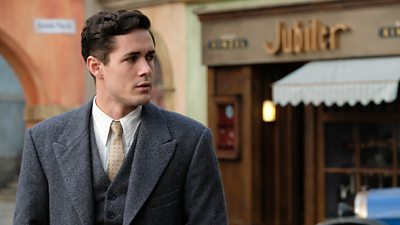
Jonah Hauer-King plays Harry Chase in World On Fire.
Published: 24 September 2019
There’s action. There are battle sequences. It’s on a huge scale, but it’s grounded in the intimacy of human relationships in a way I don't think you often see in tv drama
What was it particularly about Harry that you were drawn to and wanted to play?
I was drawn to Harry because of the depths that he has in him. He’s a very complex character. I don’t think he’s an archetypal hero at all, and that’s one of the best things about Pete’s writing - he stays away from stereotypes and predictability. Harry’s someone with a huge amount of humanity and compassion but with a lot of flaws as well. People aren’t perfect, they have light and shade. Reading the scripts, I felt like Harry goes on such a journey where he learns and grows so much. For an actor, any character who has a huge arc and some kind of transformation is really attractive.
Where do we find Harry at the start of the series?
We meet him whilst he’s still in Manchester, then we fast-forward to Warsaw in 1939 where he’s working as a translator. We learn that he has a first love back home, but since being in Warsaw he has fallen in love with someone else. It’s quite difficult for Harry because he’s full of love and compassion, but is also quite impulsive and reckless. He’s also incredibly emotionally intelligent and very sensitive.
He suffered quite a significant amount of emotional trauma growing up and that’s had a huge effect on him. He’s not scared of showing how he feels, but he acts so impulsively and doesn’t think about the consequences. That’s one of the biggest things that he learns over the course of the series, of learning to not be so self-centred all the time. His biggest mistake is not being open and honest and upfront with the people he loves the most.
With Harry being based in Warsaw, do you think he feels a little more freedom than others because he’s away from home?
What the war gives Harry is a sense of purpose. He can be quite tough on himself, and especially as we go through the series, he starts to feel as though he isn’t behaving well. That he’s hurting people and causing people pain. The war, strangely for him, gives him an escape because it gives him some meaning and some purpose. I don’t think it in any way glamourises the war for him at all, but he does feel like has real direction.
How did you research this role? Did you have any family history to draw on?
I did a lot of research, and there’s also so much in the script. During filming there was Armistice Day, which was incredibly moving. We were on set and we had a two-minute silence. It was a reality check, remembering those who have actually experienced times like those we were filming. We’re trying to create a story and create art about it, but it’s so important to be grounded in the reality of what happened in both the First World War and the Second World War and, indeed, any war of our time.
I’ve always felt quite connected to the Second World War because my grandparents are Polish Jews who fled to America in the 1930s, which is where my mum grew up. War is so unsettling and there’s so much upheaval. Because of that I’ve always been really fascinated in how war affects one’s identity.
How has it been filming those war sequences?
When you’re telling a story about a very difficult time that many of us can’t imagine, first of all you have a duty to try to honour as much as you can - and that’s through research. Then when you actually come to do it on the day, it’s extraordinary how moving it feels and how powerful it is.
You’re filming these scenes in a safe environment where someone calls cut at the end of a scene. Yet you do still have these moments of feeling scared and moved - it’s chilling and alarming and it affects you. It was important to keep remembering that - aside from the fact that we’re doing it to entertain and to tell a moving and interesting story, it’s a story based on reality. It was important to respect and honour it.
Can you describe the look and style of the show? Do you feel its giving audiences a new perspective on the war?
The style of this whole series is very intimate and close. That starts with Pete’s writing. One of the things that really makes a period piece work is when it feels real and when it feels as though these are people that you understand, can connect with and have things in common with. It continued with Adam, our director who built the world, Suzie, our DOP for the look of the drama, and all the way through to our costumes and make up. All the decisions feel as though they’ve been made to tell this story truthfully but also to make it feel current and to make it feel real to our time, because many things about this war are all too relevant and should feel too close to the bone.
What makes this different from other Second World War dramas?
This is definitely a Second World War piece that is focused on the characters and how the war really affects them. There’s action. There are battle sequences. It’s on a huge scale, but it’s grounded in the intimacy of human relationships and the characters and what they are going through and how they’re feeling in a way that I don’t think you see that often in television drama. There is a huge degree of intimacy in the way that it’s been shot, with cameras on the shoulder and not tripods, often very close to the action, with lots of close ups. Every detail is planned - for example actors not wearing much make-up because we don’t want it to feel polished. It shouldn’t feel clinical or diluted. It should feel real.
Were there any particular scenes that stood out or you really enjoyed?
We shot a wonderful scene that was all about establishing the world of Warsaw and Harry and Kasia’s relationship. It is an important scene because we had to show the joy, the happiness and vibrancy of these cities, especially Warsaw, before the war. It’s about showing young love, of joy and being carefree and showing a romance that could exist now just as it could have in 1939.
Filming this scene was one of my favourite days. It was just a lot of fun. We spent the morning cycling around this little town that we used to depict Warsaw. Zofia was sitting on a bike whilst I cycled around. She was the trooper because she had to manoeuvre herself, which didn’t look that comfortable, but she made it look like she was having the best time ever. Then we had a lot of dancing to do which was great. We did an hour or two of rehearsal the day before with the dance teacher and learned some moves - the Rusty Dusty and the Drunken Sailor. It felt amazing. It’s so important to show those moments at a time in history that was very dark and difficult.
There is a great international cast on this. Did that help in any way?
It’s amazing how international the cast is. We have people from the UK, America, Poland, Czech Republic, all over, which is so exciting because that’s also true to the war. It was so international, and it’s important that we’re telling the stories not of one country but of many.
What was it like to work with Zofia in particular?
Working with Zofia was brilliant. She’s so kind and funny and was a real ally and friend throughout all of it. When you go away on location and you’re away for a while, it can be unsettling at times. But when you have a crew and a cast and someone like Zofia to work with all day it makes it much easier, because you feel like you have a community and a home there. Zofia’s brilliant on and off screen. She’s an amazing actor and amazing person, so I’m very lucky to work with her.
Can you tell us about Harry and Lois’s relationship?
Lois is Harry’s first love. We sat down with Pete (Bowker), our writer, and talked a lot about it and how that relationship might have started. They’re both liberal and progressive and quite political, and we thought that they probably met at a march of some kind and really connected over that. Like in a lot of the writing throughout the series, a big part of their relationship is humour. They make fun of each other which is so important in any relationship, but I think forms the basis or at least a large part of theirs.
Harry feels very close and connected to her, because they’ve shared a lot. They’ve both lost a parent. And so, as the series unfolds and he falls in love with Kasia, he feels a genuine regret and hurt about the way things have played out. His feelings for Kasia are so real and yet his feelings for Lois are as well.
How is Harry’s relationship with Nancy?
Harry’s relationship with Nancy is one of my favourites. Nancy is an American war correspondent living in Warsaw at the same time as Harry. Harry loves Nancy. He’s so impressed by her. He’s impressed by how strong she is, how smart she is, how she doesn’t take anyone’s grief and she calls them out. She is very principled. He looks up to her so much. When she gives him advice, he listens.
He’s also scared of Nancy because Harry is scared sometimes of being vulnerable, and Nancy makes him feel vulnerable because she sees him. She understands him. She knows about his life and about Kasia. She also knows about Lois and I think she sees through him in a healthy way. Despite appreciating that, I think it also freaks him out a bit. They’re a funny pair, especially because, like with a lot of Pete’s writing, there’s a lot of humour there and she makes fun of him and puts him down. He tries to stand up to her and fails. It’s a fun, sparky relationship.
How was it filming with Helen Hunt?
It’s stating the obvious, but when you’re working with someone as experienced and as brilliant as Helen is, you really can tell. You almost would take it for granted coming on to set that they’re going to be incredible. Then actually, you get into the scene with them, and they give you so much and they’re so alive. She’s amazing, truly, and just a massive pleasure, massive honour to work with her. The same goes for Lesley Manville. It’s a real privilege to be able to get to work with people like her. That is the lovely thing about this show - there’s a lot of young energy and there’s a lot of very experienced energy as well, and the two go really nicely hand in hand.
Is there anything that Pete Bowker has said that has stuck with you through filming? Any specific notes?
The thing that stuck with me from my conversations with Pete and with Adam our director was making sure I didn’t feel a sense of trying to make Harry the hero. When someone has as much humanity and goodness in them, it’s easy to try and justify and make excuses for their actions. It’s very predictable that, as an actor, you fight your corner and you want your character to be a good person.
Harry is a good person, but he’s not a hero, he’s flawed like everyone is. So our conversations were partly about making sure there was no character vanity and just telling the story truthfully, because in the long run it’s a much more interesting story to tell. You watch him grow and you watch him change, and it gives him a journey. The main focus was on trying to play the story truthfully and not worry about the things that Harry was doing wrong and just focus on who he is.
Was there anything in the small detail of telling this story?
The Second World War is mostly about little triumphs and little battles that were won by people - soldiers and civilians alike. In any war movie, there’s a tendency to focus on the great actions of people running around fields and shooting down planes. That’s only partly why the war was won. What’s so special about this is it really delves into what it might have been like for all different kinds of people in the war, with small acts of kindness and small acts of companionship but also small acts of defiance.
Without giving too much away, I think Harry’s real moment of starting to find himself occurs at Dunkirk, but it’s not about shooting lots of enemy soldiers. It’s about actually just helping a small group of soldiers who he looks after and feels protective of and compassionate towards. That is the moment in his journey which is the real switch for him. It’s an act of leadership and of kindness.
Character Descriptions
NANCY CAMPBELL
Played by Helen Hunt
American broadcaster and journalist NANCY CAMPBELL is addicted to war. She can’t stay away. It isn’t just the adrenalin, but the puzzle of war - the puzzle of human nature – she craves. NANCY, in Warsaw in 1939, crosses the border to Germany and spends the first eighteen months of the war in Berlin as part of the overseas press corps. Her ability to befriend her German neighbours as well as army officers sees NANCY report those stories at the very forefront of the Nazi regime; some they are happy to have broadcast to the world, while others, they are determined to keep hidden. No surprise then, that NANCY is driven by getting those forbidden stories out of Berlin - at huge personal risk.
ROBINA CHASE
Played by Lesley Manville
When her son HARRY, finds himself on the wrong side of the law protesting against Oswald Mosley, ROBINA CHASE despairs, only slightly comforted in the knowledge he is soon to travel to Warsaw for a job as a translator. After HARRY’S father died in the most tragic of circumstances, ROBINA was left to raise HARRY alone. She has done so with the sole aim of making him a man of great social standing, but so far, HARRY is proving only to disappoint. His love for two different women - both, in ROBINA's eyes, highly unsuitable - has far reaching consequences, and her frustration is exacerbated when HARRY returns prematurely from Poland, following the Nazi invasion, with a Polish refugee in tow. ROBINA - despite her will and better judgement - finds herself with a house guest she had never expected. Against the odds, the war is set to change this cold and austere woman, as much as it will HARRY.
DOUGLAS BENNETT
Played by Sean Bean
DOUGLAS BENNETT is a pacifist who was mustard-gassed in the First World War. He watches as his son and daughter go off to war, despite the fact that he is a pacifist. With both children away, he finds solace in unlikely friendships; with HARRY CHASE’s mother, ROBINA, and the young Polish refugee she has reluctantly taken into her home. DOUGLAS’s worst fear looks set to become reality when his son TOM finds himself aboard HMS Exeter, a ship that eventually faces German ship the Graf Spee in one of the first major battles of the war. Desperate for news of TOM, the uncertainty of his son’s wellbeing and the haunting horrors of his own experience of battle look set to overwhelm him, until unexpected news from his daughter LOIS gives him renewed hope for the future.
HARRY CHASE
Played by Jonah Hauer-King
HARRY CHASE is a young Englishman with a flair for languages, deceit and heartbreak. A talented translator, HARRY is in Warsaw Woking for the British embassy. Caught in an explosive love triangle between his Mancunian girlfriend LOIS BENNETT, and local Warsaw girl KASIA TOMASZESKI, when war breaks out, HARRY has choices to make, fast. With KASIA's life in danger, he knows that there is one place she would be safe: Manchester. But how will he explain this to LOIS, and, what's more, to his mother? Funny, handsome and clever, life has been easy for HARRY so far – but war changes this forever. An idealist, a rebel, perhaps HARRY always just needed a cause – and the cause is the war. The series will take him all the way from Warsaw to Dunkirk, as he learns to lead, to fight, and to find out what he truly believes in.
LOIS BENNETT
Played by Julia Brown
LOIS BENNETT is a Mancunian factory worker. At home she is the lone girl in a family of men with the responsibility of looking after her fragile father and a wayward brother. Despite opposition from his snobbish mother, LOIS is in love with HARRY. HARRY betrays her with KASIA whom he meets in Warsaw. His betrayal seems to simultaneously break her heart and open her mind. Later, she will reflect that it was as though love blocked out the rest of the world; once he had gone, she could finally see what she was missing. A talented singer, LOIS and her musical partner, CONNIE KNIGHT are determined to make their own contribution to the war effort. LOIS finds her place – and adventure – in the form of ENSA, the War’s Entertainment Corps, and heads off to perform for the troops in Northern France.
TOM BENNETT
Played by Ewan Mitchell
On the pull or on the make, TOM BENNETT brings nothing but trouble to sister LOIS and his father, DOUGLAS. With the police having caught up with him after his latest swindle, TOM avoids prison only by vowing to join the forces, when all the while he intends to dodge action altogether, as a conscientious objector. By the end of episode two, however, TOM has joined the Navy, and is about to face a personal and a military battle of equal, epic proportion.
KASIA TOMASZESKI
Played by Zofia Wichłacz
KASIA starts the war as a waitress in one of Warsaw’s many bars and cafés, already in a passionate love affair with the young English translator, HARRY CHASE, unaware that he already has a girl at home. Her father STEFAN and brother GRZEGORZ depart for Danzig to defend against the imminent German invasion, leaving KASIA with mother, MARIA and younger brother, JAN, at home in the city. Within days of the war beginning, KASIA’s family has each faced the cruel reality of this brutal conflict, and KASIA is faced with terrible choices between protecting her family and her own safety and freedom. KASIA joins the Polish resistance and her war becomes one of subterfuge, excruciating danger and constant fear of betrayal.
GRZEGORZ TOMASZESKI
Played by Mateusz Więcławek
GRZEGORZ TOMASZESKI is not built for battle. A naïve and loving teenager, he wants only to prove himself to his father. Entirely unprepared for the horror that awaits, GRZEGORZ heads to Danzig with STEFAN to defend the city at the outbreak of war, only to face tragedy before the day is out. Like his sister KASIA, life is set only to get tougher for GRZEGORZ, and the devastating battle at Danzig is just the beginning of his wartime anguish. He makes firm friends with KONRAD, a brave man more suited to the challenges conflict brings, and together they eventually flee Poland and make their way through Europe, in the hope their lives can be spared, as so many of their fellow countrymen brutally lose theirs.
WEBSTER O’CONNOR
Played by Brian J. Smith
When we discover WEBSTER in September 1939, he is working in the increasingly busy corridors of the American hospital of Paris. When France is threatened and occupied, despite the efforts of his aunt NANCY, WEBSTER stays in Paris and he fights. At first as a surgeon in a neutral hospital, and then a surgeon in a neutral hospital under Nazi occupation, WEBSTER finds himself fighting on all fronts; for his own identity and freedom, for his lover ALBERT’s freedom, and for those patients who, as of May 1940, are prisoners of war. With the help of friend HENRIETTE, a local French nurse, they begin a system of smuggling patients out of the hospital and beyond, all beneath Nazi noses.
ALBERT FALLOU
Played by Parker Sawyers
Jazz musician ALBERT FALLOU is deeply in love with American doctor WEBSTER O’CONNOR. When the Germans invade, ALBERT grows worried for his and WEBSTER’s safety, and for his own freedom as a Parisian of west-African heritage. When WEBSTER and his colleague HENRIETTE trial their plan to smuggle patients out of the hospital, ALBERT is keen to leave too, and turns to WEBSTER for help. WEBSTER is keen for them to stay put. Before long, however, ALBERT’s fears become their reality, and he is interned in a camp just outside Paris, where he defies their racial profiling by forming a classical orchestra of inmates.
STAN RADDINGS
Played by Blake Harrison
HARRY’s sergeant, STAN RADDINGS, is a working-class southerner with an enormous heart, sometimes concealed behind an unwittingly tactless exterior. A brilliant soldier, STAN is a committed, knowledgeable and loyal sergeant, and when, in their early days of battle, HARRY becomes overwhelmed by the task before him, STAN steps up to set him, and their unit, back on the right path.
HENRIETTE GUILBERT
Played by Eugénie Derouand
HENRIETTE is a nurse at the American hospital in Paris and WEBSTER’s closest ally there. She is a brilliant nurse and they’ve grown close over time. HENRIETTE, as well as being a little in love with WEBSTER is also hiding a more important secret. When war breaks out, and Paris falls to the Nazis, HENRIETTE conceals her Jewish heritage, working with WEBSTER to smuggle French prisoners of war out of the hospital under the noses of the Nazi authorities.