An Interview with Colin Wratten
Producer
Published: 12 December 2016
To tell an Agatha Christie story that had such a dark heart was really appealing. We were very fortunate when Julian Jarrold agreed to direct the show and I think what drew me to the project also drew him, which was the slightly subverted expectation that people may have of Agatha Christie. This isn’t what people will expect, it is a dark story and as always there is a very satisfying twist at the end.
What initially caught your interest in the production?
What first drew me to the project was Sarah Phelps’ writing. I have had the good fortune of working with Sarah a number of times before and I find the way that she has brought a new take on Agatha Christie really refreshing. To tell an Agatha Christie story that had such a dark heart was really appealing. We were very fortunate when Julian Jarrold agreed to direct the show and I think what drew me to the project also drew him, which was the slightly subverted expectation that people may have of Agatha Christie. This isn’t what people will expect, it is a dark story and as always there is a very satisfying twist at the end.
Did you enjoy the casting process?
Karen Lindsay-Stewart, our casting director, was able to suggest some amazing people for the show and the cast that we pulled together is an embarrassment of riches. Toby Jones is incredible and we were thrilled when he agreed to come on board, as we were with Andrea Riseborough and Kim Cattrall. Monica Dolan, David Haig, Billy Howle, the list goes on and on. A really, really top-notch list of actors who I hope the audience will really warm to, (or not as it may be…).
Have you read Agatha Christie before?
Most people in the United Kingdom grow up with Agatha Christie as part of their DNA. That was another reason why coming on board to do this show was so appealing. It combines a very successful author in Christie and a writer of Sarah Phelps’ calibre with a story that has a completely dark heart at its centre – what you end up with is something completely different. There is very much a film noir feel to this production and I think the audience will be surprised and find it very satisfying. It is not necessarily what you would expect from an Agatha Christie story.
Why did you decide to take The Witness for the Prosecution to Liverpool?
Rather bizarrely wherever a programme is set it’s often not the best place to shoot it. So, this story is set in 1920s London but it’s actually very difficult to shoot 1920s London in London.
In a lot of period shows you have to end up going slightly further afield to get the buildings that haven’t been updated or modernised. In London most period buildings have been upgraded and for us, the appeal is areas where the aesthetic and the charm of the older buildings still exist. Liverpool is the perfect example for us because it still has the red bricks similar to those in London. There are very few places outside of London that you can film as London and Liverpool is one of those places. Liverpool has a great film office that actively promotes filming in the area and there is also a Lord Mayor’s proclamation that helps with the logistics of filming on the street and in the area.
What have been the main production challenges?
There are quite a few production challenges associated with The Witness for the Prosecution, most notably the courtroom. We had one hundred supporting artists as well as fourteen of our regular cast taking part in the courtroom scenes. All of this required coverage; coverage of the jury, coverage of the judge, the solicitors as well as all the dialogue that is being spoken by the characters and the narrative. That requires lot of
planning from our director Julian Jarrold to ensure that we come away at the end of the shoot with a complete story having been told in a dramatic way.
It’s a big set piece and will be a real centrepiece for the show. It takes an awful lot of preparation for costume and make-up to service one hundred supporting artists. We need to get extra marquees and of course they all need to have their costumes fitted in advance of the day. Any period piece needs to ensure all supporting artists have the right hair cut, the right facial hair, costume, etc. The challenges of the courtroom days were getting about 110 to 115 people through the costume, hair and make-up process and on set ready for when the camera’s ready to turnover.
Can you tell us about filming the theatre scenes at the Winter Gardens in Morecambe?
The character of Romaine is in a theatre review, it’s a vaudeville show and very low-end. The challenge was to find a theatre that has its original features and had not been modernised or upgraded. The Winter Gardens in Morecambe is a beautiful, beautiful theatre that has played host to performers such as Morecambe and Wise and it has a real rich heritage that you sense the moment you walk through the door. It served our
purposes perfectly.
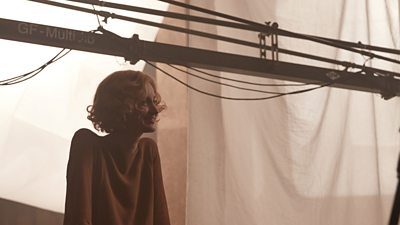
Sarah Phelps has written these wonderful directions within the script to ensure you see from the wings that the production is fairly low-rent. People have come out of a period of extraordinary hardship and these shows were just a little bit of light relief. We see the bright exterior from the audience’s point of view and the views are also seeing the wings with the creaking scenery, the dancers feet covered in blisters, the shoes that are old and cracked and the threadbare costumes. That’s a big challenge for every department from production design, costume and of course the director to portray that in a different way.
Alice Mayhew
Played by Hayley Carmichael
Stifled by years of repressed emotion, Alice has as much verve and vigor as the grey meals she makes Mayhew for dinner. Haunted by the memory of her son who died at war, her few, precious moments of happiness are spent in his bedroom, left perfectly intact since the moment he left.