An Interview with Andrea Riseborough
Playing Romaine Heilger
Published: 12 December 2016
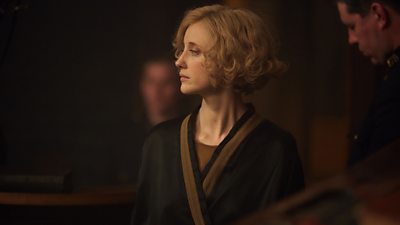
Leonard and Romaine are each other’s strength, not just to exist together as ghosts of the First World War, but they provide for the other the strength to live a full life. Their relationship is twisted and broken and brutal but there is a great deal of love.
What is Romaine’s story?
My character Romaine is a child of the First World War. She’s Austrian-born but grew up in Liege. I imagine that her parents would have had simple jobs and she was really broken by the War. I have a whole story in my head of what might have happened to her during the War that we don’t see on screen.
Did you get any specific input from Sarah Phelps to help with your development of the character?
I think the bare bones of the story were cleverly fleshed out by Sarah Phelps. She did this by setting the story against the backdrop of the First World War and it really helps you understand the motivation behind what all the different characters do. So whilst it is an Agatha Christie story, Sarah Phelps has managed to give it texture in a way that is quite profound. What Sarah has achieved is really beautiful.
Were you familiar with Agatha Christie’s work before coming to this production?
Of course! We all grew up aware of Agatha Christie; there is no writer more prolific than her in England. I love the different incarnations of Poirot and I loved Peter Ustinov’s portrayal of him. David Suchet’s Poirot was very charming and, when I’m away in the US, those series’ remind me of being in Britain and being British on a Sunday night.
What was it about the character of Romaine that drew you to her?
She is broken and it was her brokenness, tenacity and innocence that drew me in. I see Romaine as a serial, fragile, fairy-like, pastel-coloured nymph. I believe that her wounds are so all-consuming that she’s lost any sense of perspective in order to become completely self-sufficient. Perhaps there is a sense of being amoral when survival is the only aim. Leonard and Romaine are each other’s strength, not just to exist together as ghosts of the First World War, but they provide for the other the strength to live a full life. Their relationship is twisted and broken and brutal but there is a great deal of love.
The shadow of the First World War runs very deep in this drama?
Yes it does and that’s testament to Sarah’s writing. Sarah has put the story into context. I haven’t lived through a war myself but I think everyone who lives on this planet has experienced the ripple effects of conflict in some way or another. Both of my grandfathers fought in the Second World War and my great-grandfather died at the Somme in the First World War. I never truly believed that the War just finished and everyone was happy-clappy, brought out the bunting and felt everything was okay again. That’s definitely not my impression of the fall-out of war. Maybe that’s because my schoolteachers put the fear of God into me about war or maybe it’s because I had the great fortune to be born in a time that we are quite truthful about the fall out of war. My grandparents were deeply affected by war and it was obvious that the men who fought were horribly affected, as were the women who remained at home.
Would you say that Sarah Phelps’ script explores the darkness of the effects of war?
Sarah examines the sense of hopelessness these characters would have felt, they saw things that they could never un-see and through her scripts, Sarah expertly reminds us about the fragility and stupidity of it all. The characters of Romaine, Leonard and Mayhew have gone through serious trauma and in those times they have no help.
What underlies Romaine’s relationship with Leonard?
Romaine is terrified and the control she exerts over Leonard is all motivated by her fear of losing him. She just keeps him, like most things, at bay. That’s her great power and it’s how she’s gotten by. I really get the sense, from what Sarah Phelps has written, that is because
of what she endured during the First World War.
Biography
Andrea’s most recent credits include Netflix’s critically acclaimed drama series Bloodline and miniseries National Treasure for Channel 4. Ms. Riseborough shared with her fellow actors from Birdman the Screen Actors Guild Award for Outstanding Performance by a Cast in a Motion Picture. The film won four Academy Awards including Best Picture.
She starred for six months at the National Theatre, in Burn, Enda Walsh’s Chatroom, and Mark Ravenhill’s Citizenship, all directed by Anna Mackmin. She was honored with the Ian Charleson Award for her performance in Peter Hall’s RSC staging of Measure for Measure.
Ms. Riseborough starred as Margaret Thatcher in the telefilm Margaret Thatcher – The Long Walk to Finchley, directed by Niall McCormick, for which she received a BAFTA Award nomination; starred in the short film Love You More, directed by Sam Taylor-Johnson; starred in Avie Luthra’s independent feature Mad Sad & Bad; and played the lead role in the miniseries The Devil’s Whore. On stage, she starred in Dorota Maslowska’s A Couple of Poor, Polish-Speaking Romanians, at The Soho Theatre; and in the Donmar Warehouse production of Ivanov, opposite Kenneth Branagh and Tom Hiddleston. She made her U.S. stage debut in Alexi Kaye Campbell’s The Pride, directed by Joe Mantello. Among her feature films are Mark Romanek’s Never Let Me Go; Nigel Cole’s Made in Dagenham; Rowan Joffe’s Brighton Rock; Madonna’s W.E., as Wallis Simpson; Amit Gupta’s Resistance, with her Nocturnal Animals costar Michael Sheen; Henry Alex Rubin’s Disconnect; Joseph Kosinski’s Oblivion, opposite Tom Cruise; Eran Creevy’s Welcome to the Punch; Corinna McFarlane’s The Silent Storm; the Duffer Brothers’ Hidden; currently in post-production, Jonathan Dayton and Valerie Faris’ Battle of the Sexes; and James Marsh’s Shadow Dancer, opposite Clive Owen, for which Ms. Riseborough won the British Independent Film Award (BIFA), the Evening Standard British Film Award, and the London Critics’ Circle Film Award for Best Actress.