An Interview with Billy Howle
Playing Leonard Vole
Published: 12 December 2016
It’s that curiosity, that idea that when you watch something, particularly if it’s a mystery with unanswered questions, it’s in our nature to carry on asking questions and work it out in a forensic way to put the pieces together. I think that’s why people enjoy puzzles; it’s all part of the same thing.
Can you tell us about your character?
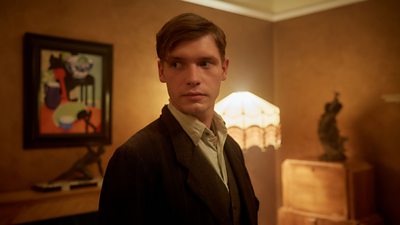
Leonard Vole is a young, ex-soldier who fought in the First World War. Leonard met Romaine in combat during that time. He comes home from action and, I think like lots of guys his age, found the promises the Government made to people returning from the First World War weren’t necessarily honoured. They thought they would come home as heroes and that Britain would be this land of opportunity and of course the reality was very different.
There wasn’t a lot of employment and young men were coming home from awful trauma, so finding a job and sticking to it became increasingly difficult. It’s a very interesting time period, particularly for young men who fought in the First World War. There’s an air of
desperation about Leonard, desperation and need, needing or wanting, a kind of hunger that hasn’t been sated yet.
How do you feel about the period? Is it a time you would have chosen to live in?
It’s an incredibly interesting period in our history. Everyone thinks of the roaring twenties and associates it with decadence and flappers, female sexual liberation, the freedom of women to express themselves, the beginning of feminism. But it was also a time of huge, huge change. The inter-war years witnessed a lot of change; society’s mentality was changing, the class system was shifting, the idea of servitude was changing and the idea of the British Empire was becoming something else entirely. It was a very exciting time.
Did you enjoy wearing the 1920s costumes?
The 1920s was also a really interesting time for fashion. For me, I tend to enjoy wearing any period costume. I love how fashion and clothing has changed and evolved through time. The men’s suits, and especially the slightly more expensive ones, are very beautiful.
Do the costumes inform your performance?
It’s an interesting question because it’s a question of what your character would choose to wear. As an actor, it is these sorts of small decisions, like how you wear your clothes, that force you into the mind of the character. Would Leonard wear his jacket open? What colours would Leonard be drawn to? What personal items are available to a man in Leonard’s situation? These small things and attention to detail is where you start to find things out about the person and the role you’re portraying. So I’d say yes, clothes are incredibly important.
Were you familiar with previous Christie adaptations before this role?
Absolutely! As a kid I spent a lot of time with my grandparents. My maternal grandmother would sit, before binge watching existed, and watch Poirot until the cows came home. You couldn’t pull her away from it. I remember watching the Ingrid Bergman film, Murder on the Orient Express (1974), and as a kid having that morbid curiosity about the intrigue and mystery. I think it is something that became fascinating to me. I caught the bug and became interested (or morbidly curious) in murder stories and the darker facets of our shared human existence.
Why do you think Agatha Christie remains so popular to this day?
Agatha Christie writes as a social historian. She comments on the society around her in her stories; she documents things and brings them to life in an entirely normal way in a way that a history book can’t. It’s these stories, the people and the way they interact with each other that really informs you about the social history of that time. That’s what’s fascinating about Agatha Christie. She has documented such a wide scope of time and strata of society. I think that is what people find interesting because, in some way, you’ll be able to relate to one or more of the characters. And it’s that idea that we are natural sleuths and detectives anyway. It’s that curiosity, that idea that when you watch something, particularly if it’s a mystery with unanswered questions, it’s in our nature to carry on asking questions and work it out in a forensic way to put the pieces together. I think that’s why people enjoy puzzles; it’s all part of the same thing. Being engaged with something as though it’s a game, as though
it’s something that you need to solve whilst also being entertaining is a really wonderful thing.
What were the biggest challenges in this production?
Every new day was a challenge in itself, that’s why I love it and why I love what I do, because I’m always learning. I think if you stop learning there’s not much point and so I always hope to be challenged. That’s the beauty of this job.
Biography
Billy Howle is perhaps best known for playing the role of James in the eight-part crime drama Glue and will next be seen in The Seagull, starring alongside Saoirse Ronan and Annette Benning. Billy will also star in The Sense Of An Ending alongside Michelle Dockery, Charlotte Rampling, Jim Broadbent and Emily Mortimer.
Billy studied acting at the Bristol Old Vic Theatre School. Billy appeared as Joseph in Channel 4’s historical drama New Worlds in 2014, as well as the guest role of Billy Shearwood in the fourth season of ITV’s Vera. Last year, Billy was also seen in the BBC television film Cider
With Rosie, a semi-autobiographical coming-of-age story set in the Cotswolds during and immediately after the First World War. In 2015 Billy completed a run in the New York transfer of the Olivier Award winning production of Ghosts.
Most recently, Billy starred in Long Day’s Journey Into Night at the Bristol Old Vic theatre, alongside Jeremy Irons and Olivier award
winner Lesley Manville. Billy received high praise for his role with The Times commenting that “Billy Howle is exceptional as Edmund”. Billy was featured in Prada’s latest video for their Spring/Summer 2016 Menswear campaign.