An Interview with Monica Dolan
Playing Janet McIntyre
Published: 12 December 2016
The magic of Agatha Christie and her plots is that you’re always being led in different directions and you keep thinking that you’ve got the case cracked and then it’s a wonderful feeling when it turns and it’s somebody else.
Describe the character of Janet McIntyre?
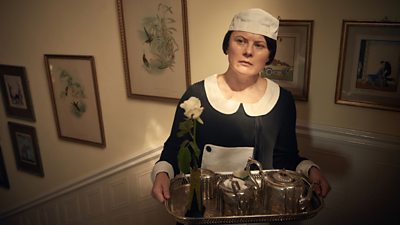
Janet McIntyre is Emily French’s servant. She is her ladies maid and essentially her housemaid. Chances are that Janet would have been with Emily since the age of about twelve, so there is a lot of history there and to an extent, Janet feels somewhat owned by Emily. In the script, one of the characters says that "servants are rabidly possessive over their masters and mistresses" and I think that is how Janet comes across.
Did you discuss the character and how she developed with the writer and director?
Yes, we did delve into the backstory of the relationship between Janet and Emily and how that relationship would have become more intense and co-dependent since Emily’s husband died. One of the things that we found really useful in the development of the characters was that both Kim Cattrall and I had watched a very disturbing movie called The Servant (1963), starring James Fox and Dirk Bogarde. That film was set much later than our drama but it did reflect that blurring of the lines between mistress and servant. It is quite appropriate because during the time that we are setting our drama, there was a big economic downturn and perhaps many women post war didn’t want to be servants. That made me think that there is something special about Janet that makes her want to be a servant and remain in service.
People from other walks of work-life were forming unions and that wasn’t easy for servants to do since they were located in different households making it hard for them to unite. So it wasn’t a very attractive job any more, particularly after everything that women had experienced during the war.
Is Janet typical of the period that The Witness for the Prosecution is set?
The war years were an interesting time for women who were experiencing camaraderie working in places like munitions factories. The old ways of coming from the lower classes and being a servant was beginning to break down. The work was incredibly hard, the mornings were early let alone the sheer lack of labour-saving technology that we take for granted now. The standard of cleanliness required in these houses was high and the
servants living quarters were extremely uncomfortable; sometimes they would share a bed with other servants or at least share a room. What is particularly interesting with Janet is that she is the only servant to Mrs French and that is very unusual during this period. I wondered what Janet had done with all the other servants.
How important is the costume in forming the character?
We have had some very interesting conversations and research into creating the character through her clothes. A woman of Janet’s class in this period would not have many clothes.
We tried to delineate that Mrs French would have provided this uniform and Mrs French is a very fashionable modern lady. Janet’s uniform reflects Emily French’s household and as such is more fashionable and reflective of the time though it is likely not something that Janet is one hundred per cent comfortable wearing. Janet’s personal clothes would have been more dated; they’d have been from before 1923 and very much not the style that Mrs French is dressed in. Janet is a religious lady so vanity is something that is a bargain with Mrs French rather than something that comes from her character. It is as interesting as it is limiting as a servant in what you can express through your uniform because the whole idea
is that you were meant to be invisible.
Does the period hair and make-up help you get into the character and period?
In many ways it is the discussion about the hair and makeup that helps you with the character rather than the actual putting it on. We had to look for something that wasn’t so modern that Janet would look really ground-breaking, but couldn’t be so old-fashioned that it didn’t sit with being Mrs French’s servant. The earlier hairstyles actually make me look a little bit softer so we went with a slightly more severe hairstyle that was appropriate to the time but also harked back to an earlier time.
Had you come across The Witness for the Prosecution before?
I have watched the film and the feeling the film gave me was very dramatic. There is a moment where everything turns around and that sense of achievement you have as an audience member where something lands and you’re reminded that it’s moments like these that Agatha Christie is really good at.
Were you aware of other works by Agatha Christie?
When I was much younger I read a lot of Agatha Christie’s novels and was quite obsessed with Death on the Nile, in fact I remember acting out one of the parts in front of my friends at school. I also had the pleasure of being in After the Funeral (2006), which was a Poriot and is one of my favourite jobs to date. The thing about Agatha Christie and The Witness for the Prosecution is that it is very plot driven and to work on an Agatha Christie project always means an ensemble cast. There is the killer or killers, the suspects and the red herrings; everyone has something to contribute to the whole piece and the stories are always really cracking.
Why do you think that Agatha Christie’s stories continue to entertain?
The stories that Agatha Christie crafted are still immensely popular today because of the driven plot and all the twists and turns that keep you guessing. I think what Sarah Phelps has done with this script adaptation is certainly refreshing for an audience today. The magic of Agatha Christie and her plots is that you’re always being led in different directions and you keep thinking that you’ve got the case cracked and then it’s a wonderful feeling when it turns and it’s somebody else. Sarah Phelps has, in her own way, reinvented the story with both And Then there Were None and with The Witness for the Prosecution.
Because Christie’s stories are set in the early 20th Century there is a danger of adaptations becoming about manners and period detail and what Sarah has managed to do is to unearth the animal drives beneath the matter, which makes it very interesting to play. Sarah and I actually worked together a number of years ago at the Royal Shakespeare Company and she was my dresser. I remember that time very fondly and we get on very well.
How has life been on set?
Filming went very well and I really enjoy working with Julian Jarrold. He is really calm and has a mischievous quality that helps you keep playing. I really enjoyed working with Kim Cattrall, very much. Kim has a youthful outlook on life but very sophisticated ideas and views and is an incredibly interesting person to work with. Billy Howle and I have worked together previously and we had to be very careful not to laugh too much on set when we get together. I particularly enjoyed the courtroom scenes because everyone was there in the one room and I really, really like courtroom drama. You get people together in a courtroom drama that would never meet in normal life. Some characters just don’t know how to behave in a court and the dynamic is really interesting. I love the tension in these scenes.
Biography
Monica studied drama at the Guildhall School in London, graduating in 1991 and soon afterwards went into television. A supremely versatile character actress she has tended to specialize in stunning portrayals of the darker side of life, as real-life stalker Maria Marchese in U Be Dead, demure but deadly Miss Gilchrist in the superior Poirot adaptation After the Funeral and, particularly, as serial killer Rosemary West in Appropriate Adult for which she, along with fellow Guildhall graduate Dominic West, deservedly received a BAFTA award. Therefore it was rather a surprise when she was not the killer in an episode of Midsomer Murders though she sort of made up for it playing twin sisters, one nice, one less so, in Call the Midwife.
On stage she has not let the villainous side down as Regan in King Lear with Ian McKellen and an unusual version of Macbeth, set in Africa, with her Lady Macbeth the only white protagonist. In 2014 despite a lighter role in the TV sitcom W1A she was back to being enjoyably horrid as George Mackay's bigoted mother in the film Pride.