Interview with co-writers Ian Hislop and Nick Newman
The co-writers Ian Hislop and Nick Newman talk about writing the Wipers Times together.
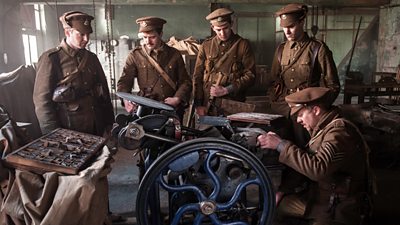
I think what you’ll get as the audience is the authentic voice of the trenches. This is what they wrote, not in 1930, not after 10 years when they’ve been thinking about it. This is what they wrote during the war to keep themselves going."
IH: This is a story of a comic newspaper, which was produced in the trenches during the First World War, by members of the British Army.
NN: It’s a real treat to come onto set, it’s like a grand day out, just to see this little world you have created suddenly spring to life. It’s always a pleasure.
IH: We tend to come on set early on and then get barred by the director, so then we go home again. We flew into Northern Ireland and arrived in France, in 1916. What they’ve done with the location is extraordinary.
NN: The two main characters are Fred Roberts, the editor, and Jack Pearson, the sub editor, of the trench newspaper, the Wipers Times. Our heart is with them always because they sort of reminded us of us; we’ve written together for 30 years or so and their relationship is similar ours.
IH: They were two men trying to be desperately funny. We’re doing it in Soho most of the time and they were doing it in the worst possible circumstances. They were incredible. To think that in the middle of it all they were sitting there writing jokes and then printing them up, under fire, is just amazing.
NN: Ian had done a radio documentary about the Wipers Times many years ago and he showed me the paper. But when we got talking about it, it was partly the collaboration and the way these two men worked together that intrigued us. So that was part of the springboard for our fascination with these stories; we imagined it was a bit how we work together.
IH: And it’s the story about a satirical newspaper produced in 1916. We both work on a satirical newspaper now. The truth is that theirs was funnier and much harder to do.
NN: We have always written together, we produced revues at school, then went on to university together and we have ended up writing professionally with one another.
IH: We don’t have any other friends.
NN: We are married basically, although we do have other wives…
IH: …elsewhere
NN: We’ve been very lucky because we’ve got the original facsimile of the original Wipers Times in their entirety. Also we’ve got a memoir that Fred Roberts wrote long after the war. Everything in the story is true: there’s a meeting with Churchill, there are spies, there’s all kinds of detail, which was all absolutely true.
IH: If you watch the film and you think we’ve made it up, we won’t have, it’ll be true. Roberts’ life is extraordinary and he wins the Military Cross in the middle of the War for gallantry, just after producing a magazine at the Battle of the Somme.
NN: There’s a moment in the paper where he says in the footer of one of the editions of the paper, ‘have you ever tried correcting galley proofs under fire? You should try it.’ It is that extraordinary bravery that we’re trying to get across in this story.
NN: I imagine viewers might be expecting to see a tragic tale of lives lost in a futile war, and we’ve had a lot of films like that and some of them are very, very good. But this is another side to this story of the First World War, and I think it’s a particularly British thing that we tend to laugh in adversity and this is about the triumph of the human spirit in adversity. It shows how a group of men managed to survive the First World War, by trying to make as light of it as possible. There are some very subversive jokes, there are some satirical jokes and there are some very silly jokes. It resonates with us a lot and hopefully the audience will be genuinely surprised how this body of men reacted to the horrors of the First World War.
IH: I think what you’ll get as the audience is the authentic voice of the trenches. This is what they wrote, not in 1930, not after 10 years when they’ve been thinking about it. This is what they wrote during the war to keep themselves going.
NN: The project has been about 10 years in the creation, from the first time Ian discovered the original Wipers Times manuscript. Since then we’ve written many, many drafts and treatments.
IH: Yes, I made a documentary about it and thought 'that’s not enough really, it’s worth more than that'.
NN: We eventually came to the conclusion that we should write it as a play. So we started researching it and suddenly BBC Two came to us and said they had read our treatment and we would like to do it and the next thing we’ve written a script and here we are. The speed has been very quick since we finished the first draft. So the message is don’t give up! You get a lot of rejection. Everybody gets rejected all the time, the best writers in the world.
IH: Not us!
NN: There’s bitterness and heartache and pain all along the way, but if you stick at it and if you’ve got a story to tell you’ll have a chance.
