Interview with Steve Backshall
Steve Backshall discusses the live event of summer 2015 - Wild Alaska Live.
Published: 18 July 2017
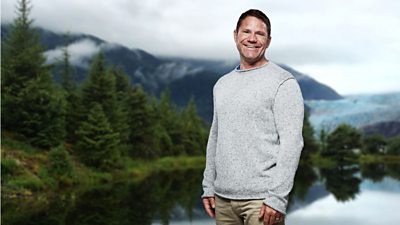
What makes Wild Alaska Live special? That there’s nowhere to hide. It’s happening there and in that moment - it’s authentic and genuine actuality
What do you think will make Wild Alaska Live special?
There’s nowhere to hide, it’s happening there and in that moment; it’s authentic and genuine actuality. People are used to seeing natural history programmes that have been filmed over many years which are concentrated, focused visions of natural history. Our programme is the natural world in real time, as it happens.
And the way people consume media is different to how it was 10 years ago - appointment-to-view tv is even rarer. In that same hour, over the other side of the world, something incredible is happening. It can be a communal experience, especially for families. That’s the kind of feedback we had from Big Blue Live, people thanked us for that opportunity. It’s the difference between watching a football or rugby match live, not knowing what the results are going to be, or watching the highlights later on.
How did you think that feedback changes making a television programme like this?
My job has changed so much over recent years because of social media. You can now watch a programme and see how the audience respond to certain moments and it was overwhelming to see how people responded to Big Blue Live. There was a sense of immediacy that people hadn’t seen for a long time. People were really switched on to it, especially the positive conservation message. That’s a great opportunity for this kind of programme.
What’s your brief for Wild Alaska Live?
It’s massive, with lots of different animals and locations - it's probably the most challenging thing I’ve ever done! It’s the most ambitious for sure, as we are going to be trying to do things never done before - abseiling down into the inside of a glacier, a place where no one knows what we will find, this has never been done live!
We’re going to try to film humpbacks feeding co-operatively, and orcas live. Liz is going to try to film wolves live. It’s down to the ambition of the team that we’re attempting these sort of feats.
Where do these story ideas come from?
Most of the stories I’m doing on Alaska are all mine, and I’ve spent a lot of time in Alaska filming before and it’s an area I know well. These are things I’ve had in my sights for a long time and that bring a lot of excitement, but also they are also my idea if they go wrong!
Can you tell us a bit more about Alaska itself?
If you ask most wildlife film-makers or biologists what the greatest wildlife spectacle on Earth is, they’ll say wildebeest migration or the Great Barrier Reef - but to me it’s in Alaska is the summer.
There’s no focus of wildlife on the planet that matches it. Bubblenet humpacks and bears catching salmon as they leap up waterfalls is absolutely unparalleled, and all happening with such reliability that we can do it live. There are very few places where you can say that.
More than anything there is the sense of scale: you can fly for hours and hours of Alaska and you look down and all you’ll see is forests, lakes and snow-capped mountains, with no sign whatsoever of human beings. There are national parks the size of countries where people just never go. There are so many different environments - from arctic tundras to snowy slopes to mountains that exceed 6,000 metres in height - and so much of it is untrammelled by human feet.
What can you not travel without?
Superglue, because it has so many different applications - from sticking together clothing to sealing blisters and cuts, scabs and scars!
What are your tips for survival?
- It has a variable climate which can plummet down to zero, or it can soar high to the high 20s, so you need an array of clothing kit to be comfortable in many different conditions.
- Bug spray. There are 27 different kinds of mosquito in Alaska and they seem to be able to bite through anything!
- A knowledge of bears, because they are an omnipresent concern - they can small food from 20 miles away so you need to be careful of how you store and prepare food. You also need to be careful how you move through the environment, and if you do encounter one you need to be strong, calm and confident. You need to let them know you are there and the chances of a negative encounter are slim.
From BBC One and the makers of Big Blue Live, the Bafta award-winning live event of summer 2015, comes an even bigger and even wilder event - Wild Alaska Live.
This July, viewers will be taken on a live adventure as the crew broadcasts from across the vast wildernesses of Alaska, to see some of the world’s most captivating animals in one of the greatest natural spectacles in the world - the Alaskan summer feast.
Steve Backshall, Matt Baker and Liz Bonnin will be broadcasting here live at the most crucial time of year for Alaskan wildlife - the annual salmon run. Three hundred million salmon arrive for one of the most spectacular animal migrations on the planet. It triggers a remarkable summer feast that showcases some of Alaska’s most captivating animals: black bears, brown bears, Kodiak bears, orca, salmon sharks and wolves. They are joined by humpback whales, beavers, walrus, moose and many others, all gathering for a summer feast like no other.
Made by BBC Studios’ Natural History Unit and co-produced by PBS, Wild Alaska Live, a major three-part live television event, will be a thrilling celebration of one of the biggest conservation success stories on the planet.
Alaska has some of the biggest areas of protected wild open spaces left on Earth. Most of the USA’s brown bears are in Alaska, there are more wolves here than almost anywhere else in the world and there are strong orca populations. Every animal we will encounter is part of this inspirational story.
EM