Interview with Liz Bonnin
Liz Bonnin discusses the live event of summer 2015 - Wild Alaska Live.
Published: 18 July 2017
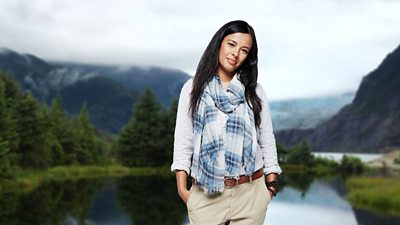
My biggest challenge is to convey how it feels like to be this live and this remote, while pointing out what that bear is doing and the subtleties of its behaviours
Where are you going to be based in Alaska?
I’m going to be based in Katmai National Park, 800 miles away from the hub and 300 miles away from the nearest road. It's the most remote place I’ll ever have camped. I’ll be looking at how the brown bears and the wolves come together, as the salmon run plays out.
What makes doing natural history programming live so special?
Bringing wildlife to a new audience is always a challenge - you have to be able to tell the story and bring the characters of individual animals to life, and to get a sense of the place. But doing that live as well as everything else is a little terrifying. But we love that in television!
It’s why we’re back for more after Big Blue Live, and the team has raised the bar in a way we didn’t think would be possible. It's on an epic scale and more remote that Monetary Bay ever was. But I can’t wait - it’s more thrilling than terrifying.
You’re quite experienced at live TV now...
I’ve filmed in a lot of wild places now, many of which have been fantastic, remote and a little bit daunting, and I’ve camped in many places, but this is a completely different scale. The logistics of the whole set-up and doing an outside broadcast is a completely different ball game.
Just when you think you’ve been somewhere challenging, Alaska comes up! I never thought I’d be doing this as a job so sometimes I do have an 'out of body' experience. This is the best team, not only for wildlife filming, but live productions too.
What do you think will make Wild Alaska Live so special?
What made Big Blue Live special, and what will make this so special again, is that we are bringing these spectacles and extraordinary events - where the wildlife is having a massive party, where different animals are coming together - to the audience, live.
It’s different to a pre-record, there’s a different quality to it - it's the closest thing to bringing the audience away with us. My biggest challenge is to convey how it feels like to be this live and this remote at the same time, while pointing out what that bear is doing and the subtleties of its behaviours.
What can’t you travel without?
My notebook! I’m lucky that I have diaries on film of the things I have done, but it’s the little moments and the experiential stuff which you might forget without writing it down. It’s such a privilege that I want to remember the special moments, as well as the films we make.
What are your tips for surviving in the wild?
- Listening to your guide
- Don’t get complacent.
- Respect the bear’s home - it’s their patch!
From BBC One and the makers of Big Blue Live, the Bafta award-winning live event of summer 2015, comes an even bigger and even wilder event - Wild Alaska Live.
This July, viewers will be taken on a live adventure as the crew broadcasts from across the vast wildernesses of Alaska, to see some of the world’s most captivating animals in one of the greatest natural spectacles in the world - the Alaskan summer feast.
Steve Backshall, Matt Baker and Liz Bonnin will be broadcasting here live at the most crucial time of year for Alaskan wildlife - the annual salmon run. Three hundred million salmon arrive for one of the most spectacular animal migrations on the planet. It triggers a remarkable summer feast that showcases some of Alaska’s most captivating animals: black bears, brown bears, Kodiak bears, orca, salmon sharks and wolves. They are joined by humpback whales, beavers, walrus, moose and many others, all gathering for a summer feast like no other.
Made by BBC Studios’ Natural History Unit and co-produced by PBS, Wild Alaska Live, a major three-part live television event, will be a thrilling celebration of one of the biggest conservation success stories on the planet.
Alaska has some of the biggest areas of protected wild open spaces left on Earth. Most of the USA’s brown bears are in Alaska, there are more wolves here than almost anywhere else in the world and there are strong orca populations. Every animal we will encounter is part of this inspirational story.
EM