Key Animals
Meet the animals
Published: 18 July 2017
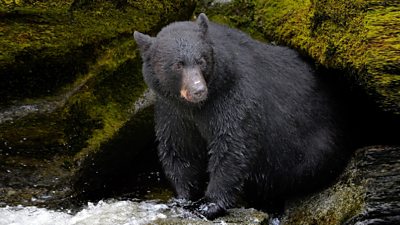
Black bears
Black bears are so adaptable that they are counted as the most successful bear in the United States. Their awesome strength and curved claws make them expert climbers, and despite weighing in at 250 kilos they can scamper up a 30-metre tree in 30 seconds flat to reach food - or retrieve a wayward bear cub!
Since emerging from hibernation in May our black bears have been seeking out an existence in the mountains of the Tongass Forest. Now they are making their way down to the meadows - around the base of Mendenhall Glacier - with their cubs, to await the arrival of the salmon. We’ll be asking why this feast is so important to black bear families and how this winter has been for them.
Pictured: black bear fishing for salmon, Tongass National Forest, Alaska
Brown Bears
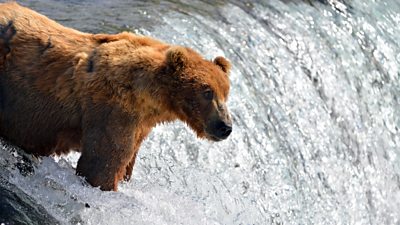
Brown Bears
The brown bear is one of the largest land predators on the planet. They’re found all over the northern hemisphere, but by far the biggest are right here in Alaska.
Hibernating for six months of the bitter winter, they lose a quarter of their body weight and emerge starving. The bears in Katmai National Park have been on a pilgrimage, travelling hundreds of miles to reach the remote bay where our team is waiting for them. Gathering together as they await the salmon, the bears socialise and feed on grasses and clams at the river’s edge.
There may be as many as 30 bears here, many with cubs, but these solitary top predators are not used to company, so the next few days will be a real test of patience and strategy as they jostle for position on the banks of the river.
Wolves
Wolves are the ultimate wilderness icon. These predators thrive in the harshest environments. In winter, their ultra-thick coats allow them to withstand temperatures as low as minus 50 degrees Celsius. Working in packs they chase down caribou and elk at speeds of up to 40 miles per hour, with deep snow helping them to overwhelm prey much bigger than themselves.
In summer, when they have no snow to help them bring down large prey, these adaptable predators switch to salmon. In Katmai National Park the team hopes to glimpse a wolf that has joined the feast and will ask what this summer has in store for this most charismatic of Alaskan predators.
Eagles
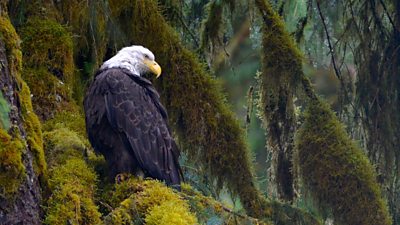
Bald eagles are America’s great wildlife success story. Due to the use of DDT as a pesticide, eagles, along with many raptors, were near extinction 40 years ago. But banning of the DDT by the federal government and habitat protection afforded by the Endangered Species Act have not only brought this American symbol back from the brink, but seen them thrive. There are thought to be as many as 10,000 bald eagles in the Tongass forest - the largest concentration in the world.
We’ll follow a pair of expectant parents as they keep their eggs warm and their nest tidy in the winter, hatch their chicks in spring, and keep them fed up and ready to fly by summer.
Pictured: Bald Eagle
Beavers
Beavers are perhaps the hardest working animals on the planet - these toothy rodents are capable of architectural feats any human engineer would be proud of. Four oversized front teeth grow continuously throughout their lives, making them capable of carving through 15cms of hard wood in just one night. These felled trees are perfect building materials and the beaver’s favourite food.
The beavers at the base in Tongass National Forest have sculpted the landscape, creating a dam that the salmon have to jump on their journey upstream - but also a pool where the salmon rest and recoup their energy. The beavers’ network of waterways are frozen for up to eight months of the year, so right now the race is on to make the most of the summer thaw, stockpiling food, rearing their kits and making essential repairs to their lodges and dams.
Orca
Bears and wolves might be waiting for salmon to arrive in the rivers and creeks, but before they run this gauntlet the salmon first have to deal with the wolves of the sea - orca. These highly intelligent predators work together in family groups and hunt everything from seals and salmon to sharks. Orca use a complex system of clicks and whistles to locate their prey and also to communicate with one another - each family has a different accent and researchers are able to use this and the shape of their fins to tell them apart. We’ll be catching up with orca as they join the feast, and discover how the families are faring this year.
Humpback whales
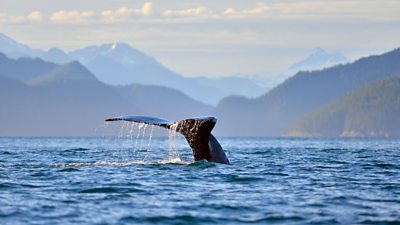
Humpback whales
At 18 metres, these ocean giants are longer than a double decker bus, with each flipper reaching five metres long. A massive tail fluke propels them through the water or even heaves their 35-ton bulk up into the air. This huge bulk needs a huge amount of food. Humpback whales make the longest migration of any mammal and they have travelled tens of thousands of miles to reach their summer feeding grounds in Alaska.
When they arrive, they’ll need to eat 1.5 tons of food a day to make up for the four months of starvation on their epic migration, and they exhibit a unique form of hunting seen only in Alaskan waters. Working in teams, they’ll form rings of bubbles, netting fish and force them to the surface. It’s the greatest feeding spectacle on Earth, and we’re hoping to bring it to BBC One viewers live from the icy waters around Juneau.
Salmon
Salmon are arguably the most important animal in the whole of Alaska. Presently, they’re embarking on one of the largest animal migrations on the planet - 300 million are poised to undertake the biggest inland invasion of any marine creature. They have 12,000 Alaskan rivers to choose from, yet every single salmon knows exactly which one it came from.
As they move into the rivers of their birth their bodies will go through an extraordinary metamorphosis: their skin transforms from silver to crimson red, their bones into a powerful hooked jaw, and their internal chemistry changes to cope with the freshwater. By mid summer the waterways will be choked with salmon and their arrival underpins the entire Alaskan feast. Everything from bears to wolves to eagles or even humans owe their very existence here to this phenomenal fish.
Salmon shark
The rich bounty of Alaska’s summer draws in a mass of exciting wildlife. But there’s one fearsome predator that you wouldn’t expect to find here. They’ve travelled all the way from California to prowl the cold waters and claim their stake in the feast. They’re a relative of the mighty great white shark and named after their favourite food… it’s the salmon shark ('herring shark' in Russian), and they’re not exactly the runt of the family, growing up to 10 feet long.
The salmon shark has the amazing ability to keep its body temperature well above that of the surrounding cold water of the North Pacific, and has the highest body temperature of any shark. This allows them to keep their swimming muscles and organs warm, so that they can still hunt effectively.
Marmot
As the largest member of the squirrel family, marmots are usually associated with the mountain tops. But in the Tongass Forest, with its steep slopes down to the sea, some marmots have adapted a beach lifestyle. Warm, moist, spring weather occurs earlier down by the sea and vegetation is growing weeks before it would in the alpine meadows. We’ll watch as our family of marmots frolic by the shore, play and feed up on this lush bounty.
Walrus
Walruses, whose Latin name translates as 'tooth-walking sea horse', are a summer spectacle for Alaska. Most of the Alaskan population of walrus are far out on the pack ice in the Chukchi Sea, but groups of several thousand males have taken to coming inland to bask on rocky shores.
These social giants will snooze and grumble and occasionally squabble for the choice locations on the shore, not unlike the rest of the world’s beach-goers.
Porcupine
The porcupines of the Tongass Forest could prove to be our nemesis. These inquisitive rodents will chew through anything and can be incredibly destructive. At Mendenhall Glacier Visitor Centre they will roll up thick matting then chew off the rubber underneath. We’ll be keeping an eye out for these prickly customers in case they get up to any mischief - hopefully they won’t be chewing through our camera cables…
Moose
Think Alaskan animals and nearly everyone will think of these comical looking creatures. They might look cartoonish with their drooping noses and gangling legs, but moose are one of the most dangerous animals in Alaska. We’ll be investigating how the human residents of Alaska manage to live peacefully alongside this rather short-tempered inhabitant.