Waiting For The Out cast and creators discuss the drama that 'looks just as much at what goes on for those outside prison walls as well as prisoners inside of them'
Adapted from Andy West’s memoir The Life Inside, the drama follows a philosopher who begins teaching a class of men in prison
Waiting For The Out is an original six-part series adapted from Andy West’s acclaimed memoir The Life Inside, from the multi-award-winning writer Dennis Kelly.
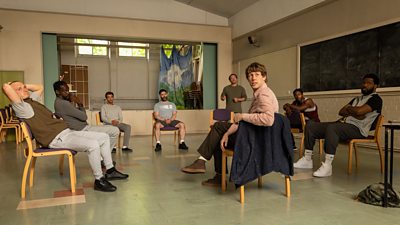
BAFTA nominated Josh Finan leads the cast as Dan, a philosopher who begins teaching a class of men in prison. Each week, Dan leads discussions about dominance, freedom, luck and other topics that have troubled philosophers for thousands of years – topics that gain a new meaning when seen through the prisoners’ eyes - both igniting passions and creating tension.
Through his work, Dan begins to dig deeper into his own past – growing up with a father (Alex Kearns) who ended up in prison, as did his brother Lee (Stephen Wight) and uncle Frank (Phil Daniels). Dan took a different path, but his time working in a prison begins to make him worry, obsessively, that he belongs behind bars just like his father.
As Dan’s personal crisis deepens, his actions begin to threaten both his own future, and his family’s.
Dennis Kelly (Writer and Executive Producer)
How did this project come about for you?
Jane Featherstone at SISTER sent me Andy’s book, The Life Inside, and it came at a time where it felt to me that there was a lot of talk about masculinity, and the extremes of that conversation felt polarising at times. Somewhere in the middle is this whole swathe of blokes just getting on with being blokes and I was interested in talking about that when Andy’s book came in.
The book is mostly set in male prisons and is about him and his relationships with family members that have been in prison, including to some extent his dad who was also incarcerated. There's something in the way that Andy communicates that really pulled me into the book. I love the fact that he's still teaching these classes now and when this show goes out, he’ll probably be going to teach in prison somewhere the next morning.
How did you approach adapting Andy’s memoir?
There are lot of moments in Andy’s memoir that naturally focus on a bunch of blokes in a room talking and whilst that isn’t very dramatic for television, I really didn't want to turn this into a high action prison drama. Those dramas are out there already and they're brilliant, but that tone didn't feel true to this and I was mindful of the fact that there was a real human being - Andy - at the heart of the story, so I checked in with Andy throughout as we made any changes and he was amazing.
As a writer, where did you feel the need to diverge from Andy’s memoir?
There are differences between how we read a book and how we watch a TV series. For example, in Andy's book, there’s a fantastic device throughout where he talks about the executioner in his head and the executioner is a psychological enemy for him, a feeling that something or someone is out to get him. Of course, for television we can’t remake that ‘executioner’ device in the same way so, my idea was to bring that idea to life by making Andy's father the executioner. Whilst the series is adapted from Andy’s memoir and recollections, Andy and Dan don’t feel the same way about their father and that leads to different things happening as a consequence.
Would you say those creative decisions are why Dan doesn’t share the same name as Andy?
Exactly right. Some of the things that happen in the series are different from what Andy has experienced or would do. Andy is a well put together human being who is supportive of the people around him, but that doesn’t make compelling television, so with Andy’s blessing, we took the things that he had gone through and stretched them out or exacerbated them so that there are more consequences for Dan that push the series forward.
Dan’s a catastrophe and his compulsions make him become dangerous to the people around him, not because he's a bad person but because he hasn't dealt with the things from his past. That’s ultimately why this is a fictionalised story, it’s not true and so we’ve not labelled it as such.
I also deliberately stayed away from knowing anything more about the peripheral characters. For example, Dan and Lee both share the same dad, but in real life, Dan and his brother have different dads. I didn't ask Andy any questions about his family members either because I wanted them to be fictionalised people as opposed to being based on his real relationships and memories.
Where do we find Dan at the start of the series?
Dan has a new job in a prison teaching philosophy, and his brother Lee is very perturbed by this as their dad went to prison, Lee has spent a lot of time in prison himself, and their uncle Frank has been inside too. Dan is at a point in his life where he takes this job because he needs to face unresolved issues with his past. It's a drastic thing for him to do, but there's a part of him that feels like he's destined to be in prison.
We’ve talked about the idea of this executioner and Dan feels like he's destined to become a person that is incarcerated because that's in his DNA. He’s trying to work out whether he is like his dad or someone else entirely and he's a bit of a mess really. He doesn't look like it though, he's very, very functional.
Would you agree that Dan feels like he doesn't quite belong anywhere?
I think that’s true. Dan is from a family that is very different to him and I thought that contradiction was really interesting. For me, I’m from a working-class background, but my job isn’t one that feels accessible for working class people and so I think these contradictions about where we belong live within a lot of us and we don't know how to resolve them. What we end up doing is labelling ourselves with “I'm this, I'm that” or desperately trying to prove what we are or aren’t. You often hear people talk about imposter syndrome and I don’t know who doesn’t feel like that at some point in their lives.
We can’t talk about Dan’s family without discussing uncle Frank!
Of course, Uncle Frank is an old school east-end professional criminal. If you have read Andy’s memoir, you get the feeling uncle Frank could almost have sprung out of a gangster film. However, there’s kindness to Frank – which doesn’t diminish the things he’s done – but he’s the polar opposite in a criminal sense to Dan’s father who is a brooding and dangerous presence.
We went beyond what's in Andy's book and decided to give Frank a job pushing trolleys in a supermarket - there’s this chap telling wild stories about his prison life and he’s now pushing trolleys! I think it’s important that we see him thrive in that world though. And instead of telling stories about criminals he’s now telling stories about the events in the supermarket carpark.
How did you approach the philosophical discussions in a way that felt both authentic but also accessible?
The conversations in Andy's books are an amalgamation of memories from different classes, and I was mostly led by those or by watching Andy’s classes myself. For example with the tale of the frog and the scorpion, I actually saw Andy do that lesson and it played out exactly the way it did in his book – most of the prisoners felt it was the frog’s fault, “the frog’s an idiot”, but there tends to be one that argues “no it’s the scorpion’s fault, you can’t have a world without kindness, you’ve got to believe in kindness”. So, there was lots of dialogue I had in mind already from the book and from being in Andy’s classes that I could bring into this world, and I think that naturally makes it accessible.
How are those philosophical discussions reframed by the fact that they're happening in prison?
They're much more acute; if you and I have a philosophical discussion about freedom or luck, those things remain philosophical because we are physically free and we talk about freedom as a concept of being free in your mind and asking, “are we really free?”. But when the door is locked every time you walk through it, freedom becomes very acute and so do ideas of the lucky world vs the just world when you’re speaking to people who are serving a sentence.
The other thing I noticed through visiting prisons and attending classes with Andy, is that when we go home at the end of the day, we talk about our world, our work, our lives. When you’re in prison, prison is your world and it becomes all you talk about, and when you do talk about something else, everything comes back to prison. Even when talking about philosophy, such as the ship of Theseus and asking "when every part of it is replaced, is it the same ship?” sooner or later it comes back to prison because it leads people to ask themselves how much they have changed and ask “am I the same person that got put inside?”. Prison makes those conversations feel so alive in a non-academic way.
Amongst the darker themes the series explores, there are funny and light-hearted moments. How important was humour to you when you were writing?
It was really important. We were really lucky in having Jeanette (Nordahl) and Ben (Palmer) as our directors as they understood it needed both humour and drama and that the humour had to sneak up on you. Jeanette set up the look and feel with the first three episodes - she’s such a funny person and she understood that humour straight away, plus Ben of course has a history with the comedy genre.
I mean, this isn’t a comedy, but if you read Andy’s book there are moments that are really laugh out loud funny and there are moments that are really dark. These people are in prison for doing things that have hurt people and there’s a lot of pain written through the book, but with all pain there are moments of levity, and those things need to live together.
Andy West (Author and Executive Producer)
What’s the development process from page to screen been like with Dennis and the team at SISTER?
What I have always liked about the team at SISTER was their vision for the show, which felt very much in keeping with the spirit of the book and I got the impression that the team would keep hold of the humour and moral complexity of my work. The process of working with Dennis has been really rewarding, one thing I really appreciate about his skill and experience is that sometimes I can get quite stuck with the material as it’s so rooted in my own experiences and things that have happened to me, so I find Dennis brings a really dynamic energy that gives such life to that world.
How much of yourself do you see in Dan?
I like to think of us as connected but different and that’s because with book adaptations, changes are made for the purposes of dramatization. I could see that Dan needed to have a life of his own and gave my blessing to that and was excited to see where Dennis and the team would take him. I also needed to distinguish that he isn’t me – so the name change is a healthy differentiation.
Personally, I have found it useful to make a distinction between the lie and then the lie that tells the truth, for example, I don’t share Dan’s desire to have children anytime soon, but Dan craving that sense of connection and being confused about whether he could hack it as a father is very truthful to myself. So, even in the fictional parts of Dan, I can still connect to him.
What has it been like for you seeing your memoir brought to life on set?
This process has felt so powerful as really the book is charting isolation – the isolation of being in prison or the isolation you feel because your relatives are in prison. A lot of the people encountered in my book are in that state of isolation and loneliness, and then I’ve come onto a set and seen so many people breathing so much humanity into that. It’s been the exact opposite of the isolated feeling the book charts.
How do your family feel about your memoir, and what did they think when you told them it was being adapted to screen?
I'm really lucky. My mum, brother and my other close family members have been really supportive and have trusted me and Dennis. Not all writers are given that sense of permission. We've tried to capture the essence of their lives with both honesty and care, but we've also fictionalised their story for TV. They have seen some of the footage about how they are depicted and they've responded to it really warmly. My sister-in-law, who is a former prison officer, saw my cameo and said, ‘We’d take the mickey out of you if you walked into the office with hair like that.’ The family are proud of me, but they also like to keep my feet on the ground.
Tell us about being on set for scenes filmed in locations that have a personal connection for you?
When I was six, I went to visit my brother in HMP Gloucester on Christmas Eve and I wrote about that experience in my book. We actually filmed that scene in the very same room at HMP Gloucester, so fact and fiction are sometimes doing the tango together. When I visited my brother in prison as a kid my mum told me that he was working in a factory, only this factory had bars on the windows and people were in handcuffs. That’s a very common story – what do you tell your child? Do you tell them the truth? Retrospectively I’ve reinterpreted my mum lying to me as a message to me as her telling me “This is not a place where you belong, your dad, your uncle, your brother are here but this is not for you, this won’t be your life”.
Being in this world again now feels like the life I came from and the life I’ve had are integrated and intertwined through this project.
What impact do you think your philosophy classes have on the prisoners you work with?
You can't underestimate the value of getting out of your cell for a couple of hours. Prison populations have more than doubled since I saw my brother when I was a child, and a lot of prison regimes see people locked up for 23 hours a day, so being out of your cell is great.
We are asking questions about responsibility, character, forgiveness and shame and often people in prison are grappling with those questions or in a crisis trying to search for an answer. They’re warehoused in these institutions and there isn’t really a chance to reflect morally or existentially, so I think coming into a space where that opportunity exists is really valued. I think what philosophy does in a prison setting is make things less black and white; it gives everyone back their humanity and the right to be complex in a way that your prison number or uniform denies.
What do you think will surprise viewers about Waiting For The Out?
I love prison dramas like Oz or The Night Of, but they’re often very square jawed and serious, hyperbolically masculine series with a lot of action. The truth is that prison is incredibly boring and filled with people trying to pass the time. Putting that onto screen is understandably challenging, but I hope that what we have done here is produce something more reflective and fragile. Waiting For The Out is about prison, but it’s about prison as experienced intimately by being in prison or by loving someone in prison and it’s that intimacy sets the series apart.
Why is this story an important one to tell?
When I speak about working in prison, people often talk to me about Thirteenth or The Shawshank Redemption or a prison that is not in this country and so I’m really pleased that we are making a series that feels much closer to home. I think philosophy is a really great way of having complex conversations and we meet prisoners in the series who have done very harmful things and have also had harmful things done to them – they're trying to make sense to that and there’s not an easy answer, but there is hopefully a sincere and humane way having a conversation about these issues. The series should give people the space to sit with the moral complexity of life and I think we are often denied that through the pace of social media and the news cycle.
You’ve even had your own cameo – tell us about that!
I play the prison officer that takes Dan from the prison gates to his classroom on his first day, which felt like a nice handing over and passing on of the artistic baton from author to actor!
Josh Finan (Dan)
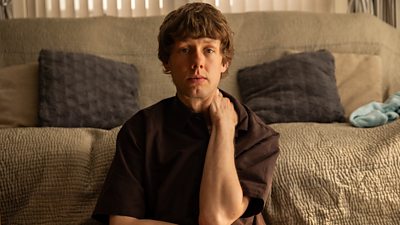
What was your first reaction when you read the script for Waiting For The Out?
I was drawn in straight away when I saw that Dennis (Kelly) and Jeanette (Nordahl) were both involved in the series. I’ve worked with Jeanette previously and have also been a long-term admirer of Dennis Kelly’s work. When I was at university, I did a student production of one of Dennis’ plays, DNA, and I really fell in love with it, so I went into reading the script with high expectations. As I was reading, I remember feeling like I was in a world that I hadn’t seen before – getting a glimpse into the lives of those inside that we might think we know and understand but exploding our perceptions.
Dan himself is a really complex man going through a lot. So, my takeaway was that I felt I’d be devastated if I didn’t get the job!
I understand you accompanied Andy to one of his philosophy classes in a prison. Was that experience useful for getting into Dan’s shoes?
That day was invaluable to the work I was doing prior to filming. I felt that very clearly that there was a big grain of truth within the scripts as there’s a lot written about the chaos of the prison and the sounds and feeling of the place. Plus of course there’s the rigmarole of handing in your phone at security, getting patted down, fob access for entry...
The crux of the first episode is how Dan feels during his first day of work, so for me as I was walking through the prison with Andy, I was really trying to think about how it felt. The whole process of entering a prison for the first time is stressful as it’s sensory overload, and I really wanted to try and use that and capture that feeling for work.
Where do we find Dan at the start of this series?
Dan was brought up in a family where the male figures – namely his dad, uncle and brother – have been incarcerated at various points as he is growing up, and Dan has not seen his dad since. Dan’s mum then re-married and Dan was brought up from around the age of nine to ten in a fairly middle-class environment with his mum and stepdad, and crucially he doesn’t go down the route his family members did. I don’t believe Dan would be able to articulate this himself, but I think he has a feeling of survivor's guilt, as though he is somehow responsible for the continued wellbeing of his brother, for example.
I think Dan is also running from the idea that somehow inside himself he is inherently a bad person. His new job complicates his life and day to day relationships and - without revealing too much - his new job teaching in a prison exacerbates those tensions and opens up a lot of unanswered questions for Dan that he finds inescapable.
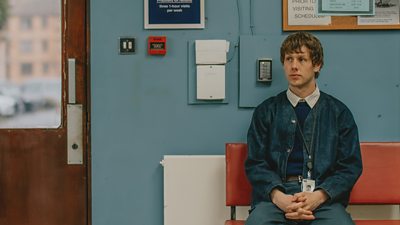
What do you think is motivating Dan’s decision to teach in a prison?
There are a few theories that are floated by characters within the series surrounding Dan’s choice to work in a prison, for example we see someone at a dinner party proposing that Dan is in some way to ‘save’ these figures in his life – such as his father - retroactively. It’s probably a little true, but my personal opinion maybe is that Dan loves people and seeing brains tick and fizzle. The prisoners he teaches are looking for a way out of their own mind and that offers Dan the opportunity to find fulfilment in his work that he simply can’t find elsewhere.
A lot of the series was filmed in Liverpool, near to where you grew up. How was that for you?
I love Liverpool so much and I got to spend time with my family at the weekend. I knew some of the crew from previous jobs and that community feeling is so nice to have at work. My family also got the chance to have small cameos in the series as well. Every time I do a job they jokingly ask “can we be in it?” so I actually asked this time and they were SAs for the Christening towards the end of the series. When my sister heard my mum and dad were going to be in it, she got severe fomo and travelled up to join us for the day too!
What makes the series stand out, to you?
The series looks at the long shadow that is cast over the lives of those that are impacted by the prison system and the incarceration of their loved ones. I think whilst it shows great hope - and you’ll see moments where Dan and his family are falling about laughing like any other family - there's a sense that for families whose lives become intertwined with prisons, the experience with that institution stays with you. Personally, I don’t think I’ve seen a drama that looks just as much – if not more – at what goes on for those outside of the prison walls as well as prisoners inside of them.
Stephen Wight (Lee)
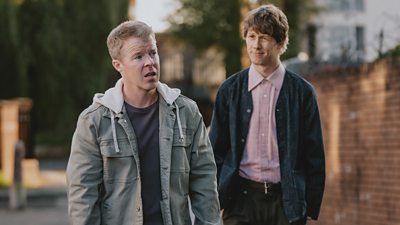
What were your first impressions of Lee when reading the scripts and what drew you to him?
I thought that Dennis had nailed the vulnerability that comes with being a recovering addict. When I read the scripts, I was constantly questioning whether Lee would relapse and I thought that the stakes were so high for him as a character, not just from the literal point of view of what is happening at this point in his life with him being a new father and the pressure that comes with that, but the tension that comes with his brother searching for their estranged father. I was reading the scripts with a sense of trepidation and anxiety for Lee.
How did Dennis’ writing resonate with you?
Dennis, as with all his writing, makes everyone unique and individual. As in life. I think with every character in this series, there are stereotypes as to how you could approach them. Lee could be so archetypal in terms of the man you could portray him as, and for me coming from a working-class background, I really loved that Lee wasn’t all those things. Yes, Lee is an ex-addict who had a rough upbringing and did time in prison, these are aspects of his character but ultimately don't define him. However, they are labels we so quickly put on people.
All the characters and prisoners felt very humanised, not demonised, and that’s not to say that we can’t feel negative emotions towards people that have done very bad things, but we are in a world where we are very quick to disassociate empathy with people who have really struggled through life and behaved badly within their environments, and that can feel quite reductive.
Where do we find Lee at the start of Waiting For The Out?
We find Lee in the midst of the joy and tiredness of becoming a new father. He and his wife have just had a little boy, and Lee is in that new baby bubble. I don’t have children myself, but speaking to friends who do, I understand that people have a real fear about being a “good parent”. Within the context of the series, Lee has that pressure, which is amplified by his brother searching for their dad, who Lee most definitely doesn’t see as a role model. There’s a real joy in this new chapter for Lee, but a seesaw tension that this could tip the other way at any moment for him.
How does that personal milestone of becoming a dad affect Lee’s relationship with Dan?
It really ups the stakes for them both as brothers. If Lee hadn’t have become a father and Dan revealed he was searching for his dad, I think there would be a great deal of conflict between them because the man that Lee knows to be their father is very different from the man Dan wants to discover.
You can see from an objective point of view why Dan wants to find his father, but Lee is being both protective of Dan as his older brother, but also being a new father himself all he is thinking is “I just want to do a better job than my dad did for me”. Dan is - unintentionally - poking that fear and unearthing all of that for Lee. Lee is not just working on himself as a recovering addict but also working through how he feels about their father now that he’s a dad himself. The complexity and fear and anxiety that Dan’s search heaps on Lee is hard for Dan to comprehend, so there’s a lot of tension between them.
What do you think might surprise viewers of Waiting For The Out?
There’s a scene later on in this series with Phil Daniels, who plays Dan and Lee’s uncle Frank, and he’s waxing lyrical and telling stories of his life inside that really lilts a different colour to what people might perceive prison life to be, as it illustrates a sense of community inside that place. I think the series is ultimately about that community and a sense of belonging. Dan himself feels lost and removed from his family, because he doesn’t know how he fits into the community of his loved ones and he’s trying to find his own identity. I think in a fractured world where we are quick to label people or put people into different boxes, it feels fresh to explore what brings people together.
Everyone says don’t work with animals and babies… naturally, in Waiting For The Out, you had a lot of scenes with babies!
I did, but you know the babies were amazingly well-behaved. One of the babies was called Maverick, I think he was named after the character in Top Gun so hopefully he has a great acting career ahead of him! You have to go with whatever the babies are doing – they become number one on the call sheet as you can’t direct a baby, you’ve got to let them be the star. To have a real baby when you’re acting as a new – and anxious - father was brilliant though, and that makes it quite natural to respond and react to what the actual baby is doing.
Samantha Spiro (Dan’s Mum)
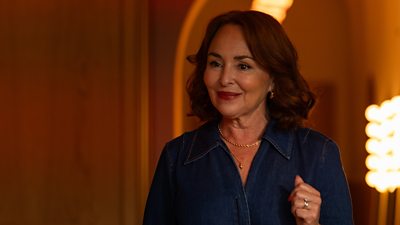
What was your first impression of Waiting For The Out?
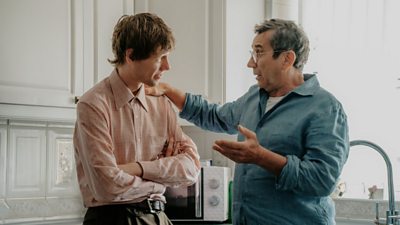
When I was auditioning, I was sent a couple of scenes between Dan and Dan’s mum. They were the scenes that take place in Dan’s mum’s kitchen, where Dan is trying to find out more about himself. When I first read those scenes, I didn’t have the larger context of the scripts but through solely reading those moments it felt like there was an awful lot going on between Dan and his mother. The scenes themselves also felt theatrical in a way – kind of like a little play between a mother and her son, in which he is trying desperately to find out who he is, whilst his mum feels very provoked by that.
What drew you to the role initially?
I realised the series was written by Dennis Kelly and I’m a huge fan of his, mostly from his theatre work having enjoyed Matilda The Musical, Taking Care of Baby, Girls and Boys, but also going back to his Television work like Pulling, which I went up for many years ago. Dennis writes brilliantly for women and a lot of the time when I give advice to students wanting to get into drama school, they’re using his speeches for auditions as his work is so profound. When I received those two scenes he had written, I felt really emotionally connected to the character and was immediately intrigued about the relationship between mother and son. His writing drew me in straight away.
Tell us about who Dan’s mum is and what she’s been through when we meet her in the series?
Waiting For The Out flashes back in time and Flora (Spencer-Longhurst) plays Dan’s mum when Dan was a little boy in flashback scenes, which are really there to represent Dan trying to piece his childhood together. We learn that throughout Dan’s childhood, his mum has been constantly trying to protect her son as he is the most important thing to her. That motivation carries through to the scenes where I take over as Dan’s mum in the present day. Flora and I would watch each other’s scenes back throughout production so that we had a through line of who she is.
How has the incarceration of Dan’s father and brother affected that mother and son bond?
I think Dan’s mum is carrying a lot of the guilt - she’s always tried to look after him and she feels like he’s escaped that inherited cycle of crime and incarceration. She’s full of hope for Dan and wants to protect him from all that family history, but she really carries a feeling of guilt and responsibility for putting him in a vulnerable position throughout his childhood. That said, I also think she’s a character that represents hope because she has removed herself from that cycle by trying to improve her life. We get the feeling the relationship she has been in in recent years was healthy and she’s been with a good man.
What’s it been like working alongside Josh?
Although you never have a huge amount of time to rehearse when it comes to telly, we took the time to rehearse as if this were a play as the scenes were so well written. Josh loves working on the detail and he’s so sparky, alive and open to things feeling improvised so we have had a lot of fun.
What moments stand out in your mind from filming?
I didn’t read the book at the time as Dan’s mum is not a factual representation of Andy’s mum, but when we were filming I asked Andy about his family when he was on set the day that we filmed Lee’s son’s christening. We were trying to create a family that had known each other their whole lives and it really did feel like a family in those moments. I remember Andy saying how surreal it was to watch as those scenes really did feel like they reflected his family when they were at their best. Speaking of family, when we filmed the christening, Josh’s actual mum was one of the SAs on that day and she’s standing directly behind me in those scenes! That was a moment where real-life was merging with the series – if anything adds to a set feeling like a family, it’s having real family there!
What do you think might surprise viewers about the series?
Waiting For The Out is all about finding humanity and of course Dan’s family represent that. Whilst some of the series takes place in a prison, it’s not what you’d typically consider a prison drama - the characters within the prison are really taken on personal journeys through the philosophical conversations that they have and Dan is included within that. Revisiting that childhood trauma is ultimately this young man’s journey of trying to discover more about himself.
Phil Daniels (Uncle Frank)
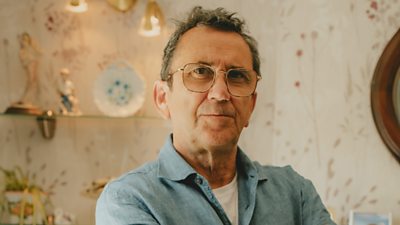
Tell us about Frank
Frank is Dan’s uncle – he is a thief and has spent the majority of his life in prison. He’s grown up on the inside so he’s quite institutionalised. When we meet Frank in the series, he’s just been released and he’s never had much of a life outside. He moves back in with his lovely mum when he gets out, and most of his story is focused on reminiscing about his time in prison. He’s got a love for it and now he’s out, he can’t really comprehend the modern world he finds.
What drew you to Frank as a character?
It was mainly that he was an older man who has become lost during his time inside prison. When Frank gets out, he gets a job stacking trollies in a local supermarket and he tells Dan that he doesn’t understand the health and safety checks and paperwork that you have to consider in this day and age. Frank is a man who isn’t able to get to grips with his new reality in this modern world and that was interesting to me as I think it's something that happens to a lot of older people, but usually in relation to technology and keeping up with the latest gadgets and computers. For Frank, his reality of the unknown is on a much larger scale as he hasn’t really experienced a lot of the real world at all. Leaving prison is unsettling; it makes him feel really behind and uncertain about what life on the outside has in store for him.
What is Frank’s relationship like with Dan and what does he think of Dan’s new job?
I think now that he’s out of prison himself, Frank wants to care for his nephew, especially given Dan’s dad hasn’t been there for him over the years. Whilst Dan wants to find his dad, Frank warns Dan that he isn’t someone you should get involved with.
Frank is really proud of Dan ‘escaping’ the system and so he can’t understand why Dan would voluntarily go there. However, Frank does represent the history of the family in a way and he embodies that legacy of incarceration for Dan. Prior to Dan finding a different way of life, the family destiny seemed to be prison and I think Frank’s release alongside the new job really highlight that to Dan and pushes the questions he has about himself to the surface.
What do you think makes Waiting For The Out an important story to tell right now?
The series draws upon the real-life experience of going into prisons and speaking to prisoners from Andy’s memoir. Dan’s classes and conversations with the prisoners we see in the series explore their own personal philosophies. Prisons aren't environments where people can move forward as you’re physically stuck in the same place. But I think the philosophy discussions help the prisoners feel they can move forward mentally, which feels important when we think about prisons and rehabilitation.
Francis Lovehall (Dris)
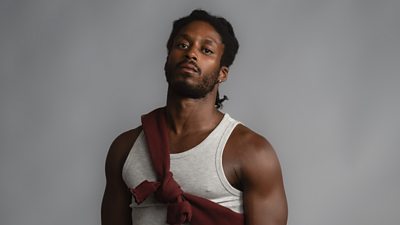
What drew you to Waiting For The Out and is there a specific scene with Dris that really spoke to you?
I wanted to confront what I see in so many men that are my peers and interrogate why they make certain decisions and if they regret those decisions. Serving time is an interesting concept as it’s meant to be a period of reflection on what you’ve done, but if you don’t regret what you’ve done, where do you go from there?
Dris encapsulates someone who isn’t necessarily regretful, he is just accepting of what the consequences to his actions are. If I was to choose a scene or a moment that spoke to me, it would be when Dris tells Dan that he is just “waiting for the out” as that encapsulates Dris – his mind isn’t where he physically is, he’s just biding his time to get out.
Why is Dris behind bars?
Dris is in prison on a GBH charge for aggravated assault. I think he sees his time inside as a ‘mishap’ – he was in a situation where he felt like he needed to protect himself and he saw red. I don’t think that makes Dris a horrible person, I think he made a decision that he now has to live with. On the outside, Dris is loved by his family and he is also really successful at what he does, so he has things to look forward to when he leaves.
I think Dris is one of the few characters we see behind bars not searching for anything. He wants what is his – his freedom – and that’s where his mind is at.
Is there a moment in Dris’ journey that has really stayed with you?
I thought that Dris’ reading the hungry caterpillar from prison for his son on the outside would be the most emotional moment, but actually, it was the aftermath of the hungry caterpillar bedtime story for me as Dris has just read this bedtime story to his son, but there’s so much distance between them. Dris also read that story because he’s failed to fulfil his promise and be there for his son - the story is meant to take up the space that Dris physically can’t until he gets to come home. At the end of the scene, our Director Ben (Palmer) wanted to see what the reading meant to Dris and that was the most challenging as it’s about revealing something deeply personal, which in this space, prison, you wouldn’t expect any inmates to typically reveal.
This isn’t a space where vulnerability thrives and there’s a real conflict in Dris not wanting to break down.
What relationships are most crucial in Dris’ life?
It's the relationship between Dris and his family – his son and his missus – that he values most. Dris understands that the relationships in prison are fleeting, because when he gets released, his life will move on and those that are left in prison still have their lives on pause. Dris is very aware of that and him maintaining a relationship with his missus and his son are most important - he’s always looking outside to that future life with them.
What do Dan’s philosophy classes mean to Dris?
When Dan goes into prison and asks all these questions to the group of prisoners, he only exists within that safe space and as a viewer, you’re seeing the prisoners in that safe space, which is set within a space that’s very unsafe and hypermasculine.
The classroom allows for vulnerability and learning, and it’s about those men – including Dris - really considering where they are in life. Often when I’ve watched dramas set in prison, there are lots of stereotypes of the people that exist there and typically there’s a lot of bullies. I feel like Waiting For The Out steps away from that and simply looks at this group of men as human beings. As soon as you look at them purely as prisoners, a hierarchy has formed. This series, and Dan’s philosophy classes, really centre around these men's lives and offer time to reflect on how they feel about themselves and their lived experiences.
How would you sum up Dris’ personal philosophy?
Dris is brazen, loud and very inquisitive. He looks for the fun and mystery in everything he does, and you can see that when he’s in Dan’s philosophy classes – they really open his mind. I think he navigates spaces with love and with a care that I don’t think most people would have if they were to find themselves in his situation.
Thinking of some of the themes within the series, do you think life is more about luck or choices?
I don’t believe in luck, personally. I feel it’s a word that tries to capture perseverance and determination and it's reductive to that experience of trying to get what you want – it negates the experience of all the times you weren’t ‘lucky’ and those are all moments you grow as a person and reflect on what hasn’t gone right. There are times in the past where I put the responsibility of achieving something outside of myself and that never leads to success – I’ve learnt to take responsibility for my own work and my own life, which has got me to where I am. You’re relinquishing your control and autonomy over your own life by putting the responsibility onto something like ‘luck’.
Ric Renton (Wallace and Writer for Episode 5)
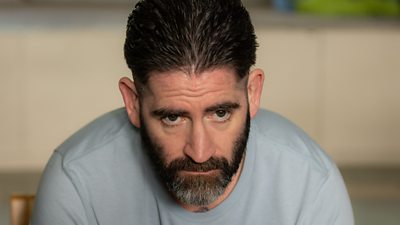
What drew you to Waiting For The Out?
I mean… it’s SISTER and Dennis Kelly, isn’t it? Add Andy’s book into the mix and I’d be posturing as profoundly arrogant to say that wasn’t more than enough! Look, I loved the book. I love Andy’s writing. I’d read The Life Inside twice as preparation, which I can say eclipses all the prep I never did in school and I loved it.
As an ex-con, I’m fast to sniff out inauthentic prison work and the way Andy wrote, he captured the world magnificently. Something I really enjoyed and continue to enjoy as me and Andy are still in touch, is talking about how different our experiences and perspectives are. Obviously, we come at this from diametrically opposing sides, but we can have a proper laugh about so many things we’ve experienced.
The canyon of difference between prisons in the North and South has long fascinated me, so while it didn’t surprise me to hear the lads down South were getting philosophy lessons while back home we got A Cat In The Hat, I found it fascinating to think about seeing a group of lads that are instinctively very reactionary, perhaps perceived to not have a high degree of critical thinking and put them in a room where they can be gently provoked and challenged. I also loved their answers - truly only answers you could get from fellas serving time. A proper unique perspective.
How did you approach playing Wallace?
I first got acquainted with Wallace when I was reading Andy’s book. When I read Wallace in the book I thought ‘I want a crack at playing him’. All the characters are fantastic in their own way, but I felt an affinity with Wallace. He was stoic and didn’t seem to care about being the most popular fella on the landings, you know? I had a lot of experiences being that guy, which rarely resulted in an immediate net positive but I’m glad I did, for lots of reasons, not least of all it meant, I hope, that I could bring an authenticity to Wallace. I think in prison, me and Wallace lived quite similarly, and so he really felt like an extension of who I was back then.
How would you describe Wallace and his time inside?
Delusional. Which is another thing I identify with. Wallace was delusional in a way that serves him. He clung to this idea of his daughter, this hope he holds that they’ll do all these things together when he gets out. He still thinks of her as a little lass when in reality she’s grown up, but he needs that delusion and hope because the last thing you ever want to feel in prison is hopeless, I can tell you that for nothing. Everyone needs hope in prison because when you lose hope, you can head down a path you might not come back from. That’s why when Zach calls Wallace out on his delusion in front of everyone he feels so exposed because it helps to have subscribers to your hope.
It's also a lonely place for Wallace, in all of Dan’s lessons Wallace doesn’t even look at anybody until that confrontation with Zach. He has no real relationships, he is very isolated, even in lockdowns when he gets the opportunity to go outside, he elects to stay in his pad and read a book.
Has Waiting For The Out made you reflect differently on your own time inside?
Actually, maybe. If anything, I’m grateful if that’s what I needed to go through to get to where I am, maybe. A moment I think about a lot is when I was slung in solitary confinement and a guard offered me a Bible; I didn’t react too kindly. But, I could kiss the version of me who did this now, I called back after the guard as he was leaving and said ‘any chance of a dictionary?’ He walked away and I thought that was the end of that. A few hours later, the food hatch opens, and a dictionary comes skidding across the floor. I sat in solitary for a few weeks reading the dictionary and got up to M before I was released back into the general population and finished it back in my pad. I can’t help but wonder where I would be today if I didn’t do that. As Steve Jobs said, ‘you can’t connect the dots looking forward; you can only connect them looking backwards’. It’s so true.
Writing and performing in Waiting For The Out has hands down been one of the greatest experiences of my life. I’m not endorsing doing time, but for my personal journey I wouldn’t take my time back as it’s got me here today, I wouldn’t have written or auditioned in the same way.
Follow for more
Latest from the Media Centre
All newsSearch by Tag:
- Tagged with DramaDrama
- Tagged with Media PackMedia Pack
- Tagged with Latest NewsLatest News
