Versailles - Creators' introduction
Introduction to new BBC Two Versailles by the programmes creators, Simon Mirren and David Wolstencroft.
Published: 9 May 2016
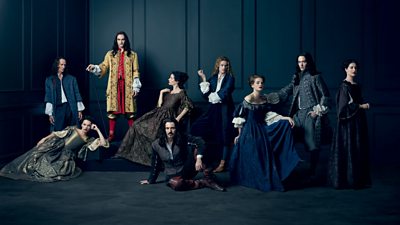
Versailles was the Apple of its day, the world’s first truly global brand.
What are two UK writers doing writing a show in English about a French king? The answer is very simple: Apple. The world knows what Steve Jobs did by building Apple into a force around the globe, but few know that without Louis XIV and Versailles, none of what we are witnessing today would be possible.
Versailles was the Apple of its day, the world’s first truly global brand. Great stories are a global language and there are few greater or more all-encompassing than the story of Versailles.
The Chateau de Versailles and the court of Louis XIV are part of the unshakeable bedrock of French history. For a moment, we admit, we were more than a little nervous of committing to the project, since we knew all too well what the French might think of seeing their historical legacy outlined in Anglo-Saxon idioms.
But then we did something that is very useful in most circumstances. We stepped back, gained a little context, and remembered that Louis’ grandmother was a Medici, that his queen, Marie-Therese, was Spanish, that his sister-in-law, Henriette, was an English princess. That’s when it hit us: The story of Versailles isn’t just a French story or even a European story, it is universal.
For many of us, the first stories we were ever told featured a king in a castle in the middle of a forest. For us, Versailles, while rooted deeply in French patrimonie, is a universal tale of the need for power and the need for control.
When we approached the story of a young monarch centralising his power, we knew it was also the story of a young man attempting to conquer his demons and grasp some form of control over his life. We felt it would be intoxicating to see him battle these forces and succeed. We are, all of us, trying to build something, after all.
Reading the history books it is easy to assume that Louis’ absolute power was wielded the moment he became King, that this was his birth right, ordained by the chronicles. In our opinion, this is far from the truth. His central transformation from a figurehead into a CEO is a fascinating study in what psychologists might call 'ruthless dominance', a project of sheer force of will that was forever poised on the brink of failure.
Louis is still at this stage, one year after the death of his beloved but controlling mother, a man plagued by insecurity and flux in stormy and unsettled times. There was no telling which way his destiny would go. It was entirely up to him to seize his destiny from the ministers who had controlled him throughout his regency. In doing this, in many ways, he was moving from childhood to adulthood.
Our first season sees his coming of age of a monarch. As writers we have had many years of experience working on shows that have featured criminal psychopathology and other disorders of the brain. Thus we always saw the architecture of this show as inextricably linked to the architecture of Louis’ young mind - ambitious, traumatised, paranoid, borderline sociopathic and even psychopathic at times.
The palace of Versailles is, in many ways, a map of the mind of a monarch. The establishment of Versailles as a centre of power away from the past, in Paris, was a masterstroke of realpolitik, as innovative, intelligent, modern and provocative as Louis XIV himself. What Louis created was not just a palace. It was a great cornerstone of culture, fashion, cuisine, as well as the secret police.
But it wasn’t just Louis who held our attention. His brother Monsieur, Philippe Duc d’Orléans, seemed to us an extraordinary and uniquely modern character hiding in plain sight. He won us over completely. We’d simply never seen a character like him before, an openly gay warrior, a champion of the arts, a huge influencer of taste and fashion, in thrall to his lover (the manipulative Chevalier de Lorraine); a man who was forever in the shadow of his older brother.
Louis’ enmity with his brother remains front and centre to our drama. Monsieur is a vast contradiction of willing passivity, bottled rage and, like his brother, sexual appetite. Between them sits Henriette d’Angleterre, the sister of an English king, one of the beauties of the age, Monsieur’s wife and, we postulate, Louis’ lover. This was a triangle we wanted to explore for 100 episodes! Enraged by his brother’s affair with his wife, he nevertheless continues his own homosexual affair with the Chevalier de Lorraine, and attempts to maintain control over Henriette through multiple pregnancies and psychosexual abuse.
History is told by the winners and the majority of the stories that remain have been controlled in some way. What pressures lie behind them? In whose interest were they written? What we know of history is merely the tip of the iceberg. We wanted to write a redacted history of Versailles, the iceberg under the water… and the intrigues have only just begun.
Simon Mirren is a British writer and producer. He started his writing career with the 1999 movie G:MT - Greenwich Mean Time. He then worked as a television writer on numerous hit British series, such as Waking the Dead, on which he was also producer. He played a key role in the first two series of Spooks (Bafta for Best Drama Series in 2003), on which he was responsible for the research which gave the show its authenticity. He created and produced the miniseries Deep Blue for Channel 4 and in 2003, he moved to Hollywood where he worked as a writer for the series Without A Trace. He then joined the writing team of Third Watch, before working for six years on the series Criminal Minds, of which he became showrunner. He is also showrunner for the series The Sector, produced by Scott Free (the production banner of Ridley and the late Tony Scott) for cinemax.
David Wolstencroft is a multi-award-winning British writer and producer. Born in Honolulu, Hawaii, he grew up in Edinburgh and studied at Cambridge, where he won the Edward Spearing Prize for history. His first work for television was the series Psychos (original idea and writer), which was nominated at the Baftas and earned him the Network Newcomer Award from the Royal Television Society. He then wrote the spy series Spooks for BBC One, which won several Baftas, and on which he met Simon Mirren. In 2013, the series The Escape Artist starring David Tennant was aired on BBC One and earned Wolstencroft a nomination for a Bafta Scotland award for his writing. Wolstencroft also wrote the screenplay for Shooting Dogs, the feature film directed by Michael Caton-Jones starring John Hurt and Hugh Dancy, which won the Grand Prix at the Heartland International Film Festival in 2006.