Oliver Refson and Lilah Vandenburgh
The series is written by Oliver Refson and Lilah Vandenburgh, and directed by Oliver Refson, with music videos by Lilah Vandenburgh.
Published: 27 December 2016
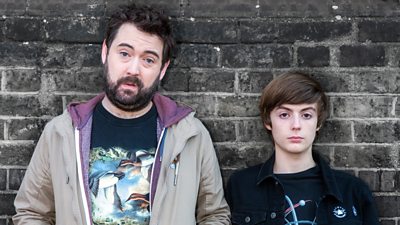
In every series, one of the themes is always growing up, and unlike a lot of material we see about man-child type guys, we’re hoping the audience feels Andy actually is changing. As Errol ages, they’ve grown up together.
Describe Uncle.
O: It is a buddy comedy with a nephew and Uncle but with dramatic tones running through it so all the comedy is grounded in as much reality as possible. Melancomedy is the way we describe it – and there’s the musical element as well, which is a big part of the show.
Originally, the pilot was supposed to be about an actor, but when Nick came on board, we changed it to suit him better, which I think served the show better from a storytelling standpoint as well. Nick, Elliot and other cast members are all musicians or singers, so the show organically ended up being very musically based.
L: We write it and Nick writes all the songs for it. It’s a buddy comedy, with an odd-couple vibe as we have the classic duo of a character who’s very uptight paired with one that’s more of a chaotic man-baby. What makes it different and special to us is their chemistry and the musical alchemy they bring to it.
Uncle has never shied away from the big issues – what are you tackling in series three?
L: In every series, one of the themes is always growing up, and unlike a lot of material we see about man-child type guys, we’re hoping the audience feels Andy actually is changing. As Errol ages, they’ve grown up together. Each series, we’ve also talked about different types of addiction. When we started the series, Sam is a recovering addict. Now she’s turned her life around – and while we’ve tackled Andy’s addictions in a comedy way in the past, we’re actually addressing them in a more dramatic way this series.
O: We try to make sure that there are eventually consequences to Andy’s behaviour and it’s not just hanging in the air. So he has to look at his own issues, whether they be love or drug related. We’re also tackling pregnancy - for more than one character - death and fatherhood. With Uncle, we’re trying to make characters more well-rounded than the way they come in. So Errol is much more than just a neurotic nerd, he’s growing out of it a little in fact and trying to expand himself as a person. And Andy isn’t just a booze-hound and a naughty uncle, he’s a vulnerable and complex human being and other people in his environment are calling him out and challenging him to be better.
This is the final chapter for Uncle - what are the big changes we’ve seen in Andy and Errol?
L: Andy gets a glimpse of real success. It’s not exactly as he’s dreamed, but it’s an opportunity to get paid - he gets hooked up by a big label as a writer/producer for a boyband. He’s also working on whether he can have meaningful friendships with women outside of sexual relationships. In series two, he was told that he can’t be friends with women and the love of his life got away. Oli and I always say what we hope for Andy is for what he needs, not what he wants.
O: At the beginning, Andy was about to commit suicide because he couldn’t get the girl that he wanted. He needs someone to validate or complete him constantly. And his friendship with Errol is a little bit the temporary salve over that wound. But Andy will have to face this eventually.
Another big change for series three is that all our main characters are living together under one roof. Bruce is trying at being a step-father figure for Errol and they are figuring out how their relationship works. Errol’s journey is also about becoming a hormonal teenager– he actually has a line about hoping he’d fall on the “asexual spectrum” so he wouldn’t have to deal with the fact his interest in girls is distracting him from his education.
How tricky is it to achieve the show’s balance of comedy with dramatic moments?
O: We are conscious of the balance, but the actors are just very good at doing the transitions through the tones. There are definite moments of high-key comedy and then moments of pure drama, which has always been what we’re interested in doing. It’s a big hodge-podge, but we have faith in the actors and we are lucky to have performers that know how to handle it.
L:. The more dramatic the drama is, the funnier the relief. We wanted to have high peaks and low valleys rather than a flat emotional state. It’s nice to be able to watch the performers run the gamut of emotions – from dark, heavy monologues, physical comedy, and the musical comedy. But it’s intentional, we’re aiming for that.
What are your favourite moments from the show?
L: My favourite moments are the two-handers between Andy and Errol. Like in series one on the park bench and Andy’s trying to explain how to pick up women and in series two in the corner shop when he kind of does part two of that lesson. I like any time Uncle Andy tries to teach Errol a life lesson and they get to banter, because their chemistry is amazing. In this series, they get to do a lot of musical stuff together too, not just videos but scenes, getting to sing and play together. And Elliot’s a great guitarist now and we finally get to show that off a bit.
O: I like when there are scenes, which doesn’t happen often, where we have Nick, Daisy and Elliot together, because the three have great chemistry. In series three, there’s a really nice brother-sister conversation about their parents which happens when Andy walks in when Sam is on the loo. You don’t see that kind of thing often, but it’s real.
This is the last series of Uncle - why have you decided three is the magic number?
From the beginning of Uncle, we've wanted to tell the story of a man-child's coming of age. We had an end point in mind but you never know how these things will go. We're really excited with how Andy's evolved as a character, and Nick Helm's continually nuanced, funny, moving performance is a huge part of that. He's a pleasure to write for, and brings a deep pathos to Andy that makes you root for him to get his life together, even at his worst. And the fact Elliot Speller-Gillott has matured so quickly encouraged us to think on our feet and keep the buddy dynamic lively between Errol and Andy as they've both grown up.
But we were really keen to move this story along, not get mired in repetition, and keep the characters growing and changing. One of the exciting aspects of planning an ending is getting to let the story wrap up naturally, rather than hitting the reset button each series. This kept it fresh and exciting for us as writers, and hopefully for the audience too.
Three series felt like the right amount to get this story told properly. And as writers, we felt leaving on an elegant note was the right way to go out. By the series finale, Andy and the gang have been on quite the journey, and we hope audiences will be pleased with how the story ends. Ultimately, it felt like the right time.

