Interview with Dan Sefton
Interview with Dan Sefton, writer and creator of Trust Me
Published: 26 July 2017
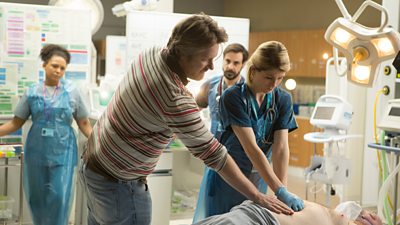
For me there’s a delicious irony in the idea that the imposter doctor is better than the real thing, both clinically and with patients.
What inspired you to write Trust Me?
I’d always been fascinated by imposters and what motivates them. Most are men, doing it for status and ego. Women tend to have different reasons. I was also interested in what would happen to someone who did a bad thing for the ‘right’ reasons. Would it slowly change them as lie followed lie? Also, what happens when you’ve managed to fool everyone and then you meet the love of your life when you are living those lies? Is it really possibly to have a ‘life’ as an imposter or are you doomed to be alone? Be careful what you wish for...
How much of your own experiences fed into the story or the characters?
As a doctor I’ve encountered imposters in real life - there was actually one in the department where I worked. Often they are well liked and competent! I’ve also met qualified doctors who are frankly dangerous. For me there’s a delicious irony in the idea that the imposter doctor is better than the real thing, both clinically and with patients.
What are some of the challenges that you faced during the writing process?
Medically the action scenes are chosen to be the things that scare or disturb me as a doctor. So they may not be the most obvious choices but they are real. I’ve experienced many disturbing moments in the last 20 years and wanted to expose the characters and audience to scenes that show them what it’s really like. It’s a very hard and difficult job for both doctors and nurses and the cost is high. Hopefully by putting that on screen, the general public will have a more nuanced understanding of what their ‘heroes’ go through and also how they act when things go wrong.
The writing has been easy as the support from both Red and the BBC - not to pull any punches - has always been there. Throughout the process we have all found the confidence to be even bolder, with both the morally ambiguous characters and the subject matter. I think it has paid off. Certainly everything I hoped for has been realised on screen, thanks also to brilliant acting, direction and design.
Tell us about the medical training given to the cast
We spent a day or two running the kind of training that real doctors get. It was important to get them used to handling the equipment so it looked totally natural. Little things, like how to wear a stethoscope around your neck like a ‘real’ doctor - and how possessive doctors are of their ’tubes’. I’m a life support instructor so I could use the real life training equipment. Everyone seemed to get into it - especially Jodie. On set, the patient transfers, equipment etc were real and the entire cast got really good at doing it all - so much so that they could probably now pass for real doctors and nurses! If you meet a doctor who looks like Jodie Whittaker then check her GMC certificate!
How realistic is this drama?
I feel it’s as realistic as it’s possible to get. Nothing in the story is fudged or faked. This is how it feels. The details are all there. The set was built from the ground up and it’s indistinguishable from a real ED (emergency department). Scenes in the medical conference in episode two are part of medical life that is rarely seen. So this is a show that really gets under the skin of doctors, how they really think, act and talk.
How different is this to Good Karma Hospital?
Very different. Almost deliberately another side of medicine. Also this is a psychological thriller in the Hitchcock tradition set in the NHS, not a ‘medical show’.
What are you hoping audiences will take away from the series?
Many things. The series pushes the audience to identify with an anti-heroine. For me this is a modern US TV drama idea that British TV has been slower to adopt. I think it’s a challenging premise and told in a way that makes you think about exactly what you need from a doctor: are you really better off with a drug-using Oxbridge graduate, or an imposter who is compassionate, smart and hardworking? Maybe we should look again at who we select for these jobs... medicine is not an intellectual subject and often the wrong people go into it for the wrong reasons.
I’d also like people to see just how tough it is for doctors, nurses, paramedics and other professions like the police and fire service to have to deal with the aftermath of accidents, illness, violence and death. It’s a tough job and it takes a heavy toll on the people who do it. Watching a child die at 2am on a Saturday night is a reality for these people, when most of us are tucked up in bed. Yet many members of the public are vindictive when it comes to punishing honest mistakes made in the heat of the moment.
Although it’s not political, people may also see why the NHS is struggling to retain staff, so much so that a bad but punctual doctor or a good imposter is never asked too many questions. It is in this kind of environment, where temporary staff make up the majority of a shift, where safety can be compromised, no matter how many positive appraisals they may have received.
Above all I hope it’s an entertaining, disturbing drama series that ends in a satisfying and unexpected way.
Pictured: Dan Sefton on set with Jodie Whittaker
Character biographies
Cath Hardacre/Dr. Ally Sutton (Jodie Whittaker)
Everything about Cath says that she is honest, hardworking and uncompromising. In a well intentioned meeting with the hospital board Cath loses her job - and with that the means to provide for her daughter. In a moment of desperation, Cath steals her best friend’s identity and applies for a job in Edinburgh, adopting the persona Dr. Ally Sutton. As Ally, she becomes a trusted member of the emergency department and against her better judgement falls for her colleague, Dr Andy Brenner.
Dr. Andy Brenner (Emun Elliott)
Andy is a consultant in the emergency department, a doctor whose professional and charming manner puts even the most nervous patient at ease. Tired of playing second fiddle to his career, Andy’s ex-wife ended their marriage, taking their children with her. To his surprise, Andy soon finds himself falling for Ally, who is his intellectual counterpart. She represents the light at the end of the tunnel after his painful separation and he finally feels he’s getting his life back on track after the acrimonious split from his ex-wife. But Andy doesn't know Ally as well as he thinks he does...
Dr. Brigitte McAdams (Sharon Small)
If anyone is going to survive the sinking ship of the emergency department, it is Brigitte. She is the clinical lead in the department but she considers it a poisoned chalice of endless paperwork. Openly admitting that she is only in the profession to keep her daughters in private school, Brigitte has fallen out of love with treating patients and lacks confidence when she must take care of a serious medical case. Brigitte’s slightly bonkers approach towards medicine means that her team rally around her when they sense that she is losing her nerve.
Karl (Blake Harrison)
Karl was on the path to making something of his life, but it all came crashing down after he lost his job. With his contract severed and his debt increasing, Karl found himself in the throes of alcohol addiction. His relationship with Cath suffered as a result and they separated shortly afterwards. Since then, Karl has been in a constant cycle in and out of alcohol rehabilitation. When Cath moves to Edinburgh, it gives him the push to change his life for the better. Karl realises how much he misses his daughter Molly being present in his life and vows to do all that he can to be closer to her. But will Karl’s good behaviour be rewarded with the family reunion he longs for?