Gwendoline Christie plays Miranda
Gwendoline Christie plays Miranda in Top Of The Lake: China Girl
Published: 13 July 2017
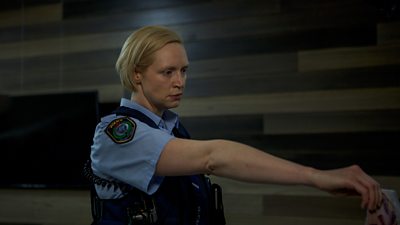
To build someone multifaceted, a character who is conflicted, complex, who doesn't make sense and behaves in ways that are illogical, gauche, unreasonable, impulsive, strange - that was so delightful to do that.
Character descriptions
Who is Miranda Hilmarson?
She's a police constable who has been in the Sydney police force for two years, and in that time she's formed a relationship with Adrian Butler, who is her boss. And who is also married, which creates quite a complex situation. There is a lot of friction between the men and the women in the workplace, and Miranda doesn't have so many friends. So when she hears that detective Robin Griffin, the super detective, is arriving at their police station, she makes a beeline for her. Adrian knows Robin; they have a long-standing history together. And Adrian arranged for Miranda to start to work with Robin.
Miranda is very enthusiastic person. She's unbridled, and she can get a little bit carried away sometimes. And she's very excited by the prospect of working with Robin. And she really wants Robin to be her friend, which proves challenging.
What did it mean to you to work with Jane Campion?
I saw An Angel At My Table when I was 12. I was captivated by the story of this outsider and what she went through. The story was beautiful, bizarre and complex and human, I couldn't stop thinking about it. So when I knew that The Piano was coming out I was really excited. There was something about her vision that spoke to me in a way that films previously hadn't. The film had a sensuality to it, it explored a different kind of world and looked at human emotion in a different way. It was obviously very beautiful, but it was dark, it was funny.
I wanted to work with Jane from then. When I was at drama school I used to go home and watch The Piano regularly - it was a part of my world, and it helped me to see the world in a different way. I realised I was not just looking at a story through the eyes of a great artist but I was looking at the story through the eyes of a female director.
That wasn't something I'd had a huge amount of experience of, and, in that 15 year-old state, when your body’s changing, everything’s changing, it was reassuring to me that there was the scope for a new way of looking at the world. A way of that spoke to me as a woman, that said something about the experience of what it is to be female in a way that wasn't a protest, wasn't a statement, it just existed. And it existed in a state of beauty, complexity, and extreme depth. I found it profound. It shaped the way I view the world and the way that I want to work.
I was, naturally, incredibly excited when I found out that that Jane Campion was doing a television series. I watched it and I fell in love with it; I thought Elisabeth Moss was ravishingly brilliant, and everyone was so real. And humour, incredible humour. I wondered how Jane might tackle that world, but she did it in a way that I could never have imagined, with a new pair of eyes that illuminated human existence to me in yet another new way.
I really wanted to be a part of it, I so hoped that that might happen. And so I contacted Jane and a miracle happened. She sent me back a very nice message. And then about six months later I got a phone call from her saying that after she read my letter she started dreaming about me and she’d written a part for me in her new series. It was extraordinary.
What were some of the biggest challenges for you playing Miranda?
There are lots of confronting issues in this story. It's a very original examination of womanhood. In my work I've explored characters who are considered, traditionally, to be more masculine, and it's interesting for me to move that journey on and explore those aspects of womanhood that are considered to be conventional. That's what fascinated me about the project - outside of it being with someone as brilliant as Jane - that we were looking at something anew.
Miranda has just two worlds that she inhabits: the world of the cops, which is her job and to some degree her life; and her life outside of that, which is with Adrian. So Miranda’s world outside of the police force is very limited. She's in this relationship Adrian, who is her boss, who has a wife and a child. It's a very conflicted situation. She doesn't see very much of him at all.
When we get a peek into her apartment we start to see this world that she's painted very cheerfully, but there's a lot of loneliness there. And you can see in her work environment that there isn't a lot of love between her and the other cops. She has to deal with a lot of misogyny and quite narrow ideas around her in terms of how she should be accepted in the world. She deals with that by just getting on with her job, and she's ambitious. She wants to be promoted, she wants to be a detective, she has a keen mind. She's come to policing a little bit later but she loves her job and she loves Adrian too.
Miranda wants Adrian to step into her world and for them to form a new life together, but he's still mainly contained in his pre-existing world, which is a world of responsibility and emotional dependency, and Miranda deals with Adrian’s absence, not very well. She's very emotional, someone that enjoys attention, and feels upset when she's not really receiving any. That can take many different forms and she can start looking for attention in new ways.
To build someone multifaceted, a character who is conflicted, complex, who doesn't make sense and behaves in ways that are illogical, gauche, unreasonable, impulsive, strange - that was so delightful to do that. And working in incredible detail too, just working on the costume and being able to have that input of why, why does she wear this at this point? Why does she stand in that way? Where does she keep her accoutrements, why does she keep them there? Every single element had a justification. That was thrilling to me.
How was the experience of working with Elisabeth Moss?
Lizzie is a sensational person. I knew she was a sensational actress, but I didn't know I'd be equally bowled over by her incredible personality and her discipline and her dedication and her imagination and creativity. And her absolutely wonderful, wicked sense of humour. I have so enjoyed every moment that I have worked with her and I have a much-treasured friend too now.
What excited you the most about the story of Top Of The Lake season 2?
It’s incredibly well written and carries you, intrigues you and hooks into you; it gets its claws into you and you want to know and find out why. You can read it again and again and it keeps revealing different layers of humanity and story and questions.
This is a unique exploration into a subject that doesn't get enormous amount of airtime in TV shows - what it is to be a woman. What it is to be a woman at many ages, whether you're a teenager like Mary, or you're in your mid-30s like Miranda and Robin. If you're older, like Julia, it really looks at what it is to be a woman, a mother, a sister, a wife. What those things mean. And what it means to the person whose experiencing them, what that challenge is, what that journey is. How it unfolds, manifests, how difficult or repellent or joyous it might be.
That to me is a new and exciting story - to look at the different ways we can parent. It's also just absolutely the most darkly hilarious thing I've ever read!