David Dencik plays Puss
David Dencik plays Puss in Top Of The Lake: China Girl.
Published: 13 July 2017
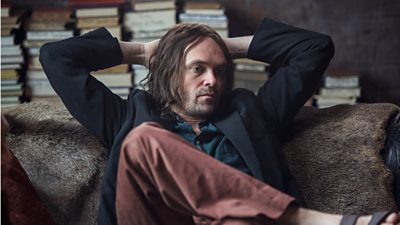
The fact that Puss is a free spirit, Mary is very attracted to that. But he's a dangerous person for her too, he has ideas about feminism and female liberation that are not coherent with anybody else’s...
Tell us about the character you play.
Puss is a European person who landed somehow in Sydney many years ago. He is very much influenced by his European heritage, at least in the way I see it, and I think the way Jane sees it too. He’s dating Robin Griffin’s daughter, that's how he fits in in a dramatic sense, but he's a very complicated character, very contradictory.
I read in the script when he's first introduced, it says something about his long hair. Which adds a European style to his manner, so I took that to my heart. Then it says after that, 'He has the look on his face, that of an arrogant man who has just been insulted', For no obvious reason, because he had not been insulted in that particular scene. And I thought that was key to the way to act it, that he is in a way offended by society. He's like a confused academic, a rebel without a cause in the true sense because he doesn't even know what he's rebelling against.
He's anti-establishment. He's anti the western world in a sense. In 1989, when the wall came down, he seems to have been a teenager at that point. He has been raised in East Germany, in communist Europe. And somehow, it's a bit unclear, he's ended up in Sydney. He's actually a bit stolen from a character in a Dostoyevsky book called The Possessed, a guy called Stavrogin. So I read the entire book because Jane Campion told me that it was a source of inspiration. And when I came down here it turns out she didn't even finish the book, and it’s a really thick book!
But it was a good fun reading it. Dostoyevsky calls him a nihilist. He has no particular beliefs; he just wants to destroy whatever’s around him, the values of people around him. Puss, it turns out, is married to a lady that we actually get to know, but they don't seem to have any particular good relationship. He lives in his attic. And the apartment underneath is used as a brothel. So that's how he makes his money, he's a landlord.
It’s very hard to connect the dots when it comes to Puss. He's irrational and he does weird things. He bites somebody on the nose. It's a kind of a Tourette’s situation for him. He's very apologetic afterwards; he just couldn't stop himself. He completely trashes a daughter-father dance - he insists on making everyone feel bad somehow. It's very uncomfortable to be around him. He's not a guy who makes people feel safe.
What attracted you to this role?
Working with Jane Campion was a major attraction. I had not seen Top Of The Lake when I was contacted, so I saw it all in one. And then I read the first four episodes of Top Of The Lake: China Girl they sent to me, and I was just mesmerised by the writing. It was so not your average, TV series. I think it’s very gutsy to actually write a character like Puss.
The dialogue is irrational and strange and it was really quirky in a very good sense, and it appealed greatly to my taste, and to what I enjoy in acting. And these scenes, long scenes, you know, of many pages, where I would read it and I would go, “what?” It just blew my mind. So those things were two very good reasons to come all the way to Sydney and I've been in and out three times now.
Is Puss a modern-day Svengali?
I'm not sure what Svengali means, I stumbled upon that word previously, but I think that question would interesting to ask Mary actually, because she's very much in love with Puss. And Puss is very much in love with Mary too in a certain sense, but it's a more platonic way. That's also where it differs from your mainstream TV drama. It's not an erotic love affair they have, well, not particularly anyway.
This TV series doesn't dwell on the intimacy between Mary and Puss. Mary is a teenager and she is rebelling against her parents, as many teenagers do. And she has the backstory of being adopted. So somehow they identify with each other; Puss says that his mother was raped, he was the result of a rape. As is Mary. So they have points in their own destinies that actually link together, where they identify with each other.
And the fact that in a way Puss is a free spirit, he does what he wants to do and what pleases him, she's very attracted to that. But then he's a dangerous person for Mary too, he has ideas about feminism and about female liberation that are not coherent with anybody else’s, the fact that he pushes her into prostitution in a nutshell.
He is deliberately provocative towards Mary’s parents rather than trying to befriend them.
Oh yeah, most definitely. I think even without the prostitution, I think he would have been in conflict with her parents. The first scene that they have together very early on in episode one, he asks the father for the daughter’s hand in marriage, which is completely unnecessary, because who does that today? And furthermore, one month down the road she will be 18 and she can legally marry. He's just rubbing it in somehow, there's this element of sadism in him.
But still, he has interesting political perspectives on certain issues taking place in the world today. He is in a way a Robin Hood person for a group of people; he actually wants to take from the rich and give to the poor, and he does so. He doesn't look good doing it, but he does stuff that we should commend him for.
How was it working with Jane Campion?
Great fun! It's very nice to act for her and to be in a process with her. She's very open and very accessible. She's a real human being. You know, early on you start showing pictures of your family and this and that, you know, getting very close. A couple of days prior to my departure I got an email saying “Do you swim?” And I said, “Yeah, I swim”. Cause Jane would like to take you to the beach. So a couple of hours after my arrival, I was picked up just down the road from here and taken to the beach to swim around with Jane.
We would speak about this and that, about the political situation, and we would speak about the character, the fact that she has cast her own daughter as my girlfriend, what that means and why that was a choice that she had made. The day after the beach thing, we had a dinner with Ari, the other director. I feel it's very quaint to work here in Australia and it resembles a bit the work that I do back in Scandinavia - in Denmark or Sweden.
How close-knit were the cast and crew on this shoot?
It's much more contained, like a family. These scenes that we do, they call upon the actor to expose themselves. So when you do that you also expose yourself privately to the entire team and people and it's a question of trust and confidence to do that. It's a beautiful process. If you can commit to it and go through with it, and look each other in the eyes and, and be serious about it and still have fun you know, it feels very real.
What were the most interesting scenes for you to film?
Many of the scenes have been real highlights. I think the father-daughter dance was good fun. There were 200-300 extras, and me just being the monkey around everybody just acting weirdly. And the scene at the beach of course where we have all the nudists walking around, that's in a way memorable just for that single reason. And the scene where I bite Elisabeth’s nose, which is in a way much more intimate than giving her a kiss. We wanted it to look real, so there was a stunt element in it and we rehearsed that quite a bit.
Character descriptions
Robin Griffin (Elisabeth Moss)
Detective Robin Griffin has eturned to Sydney to rebuild her life. Broken and fragile, she is convinced that her work will restore her but is haunted by the daughter she gave up at birth. Robin’s search to discover ‘China Girl’s’ identity takes her into the city’s dark recesses and also deep into the secrets of her own heart. As she gets to know Mary and grapples with the push and pull of this new relationship, her fears grow about the danger Mary may be in, but her hopes also rise about the possibility of a new kind of love.
Mary Edwards (Alice Englert)
Mary was adopted by Julia and Pyke when she was two days old. A beloved only child, she wrote to Robin when she was 12, hoping for a reply, but one never came and for years she has struggled with this rejection. Now a mercurial 17 year-old who is determined to chart her own path, Mary is swept up in a thrilling relationship with a much older man, Alexander, whom she plans to marry.
Julia Edwards (Nicole Kidman)
Julia is Mary’s adoptive mother. A secondary school teacher, her fierce, controlling love for her daughter has put them on a collision course, intensified by the fact that Julia has recently fallen in love with a woman and moved out of the family home. As she and Pyke disentangle their lives, Julia is struggling to figure out how to hold on to a difficult teenage daughter who seems to hate her.
Miranda Hilmarson (Gwendoline Christie)
Miranda is an eager new recruit in the Sydney Police force and a fan of Robin’s, whose reputation proceeds her. She is thrilled to be partnered with Robin but can’t seem to get anything right and her open-hearted directness clashes with Robin’s self-contained distance. As the investigation unfolds their partnership surprises both women, and Miranda becomes a forceful catalyst in pushing Robin to face her demons.
Alexander Braun - Puss (David Dencik)
A former academic from East Germany in his early 40s, the charming, charismatic Puss sees himself as a Robin Hood engaged in a provocative life of authentic class warfare. He is generous and kindly to the girls in the brothel he lives above, but as Mary forges a friendship with Robin, the depths of his emotional sadism begin to show.
Pyke Edwards (Ewen Leslie)
Pyke is a successful lawyer and Mary’s adoptive father. A man of integrity and courage, he is calmly working through the separation with Julia, determined to do whatever it takes to keep his daughter close.