Interview with Rita Tushingham, Sheila Atim and Kathy Kiera Clarke
Interview with Rita Tushingham, Sheila Atim and Kathy Kiera Clarke, who play the witches Bella, Thyrza Grey and Sybil Stamford respectively.
Published: 29 January 2020
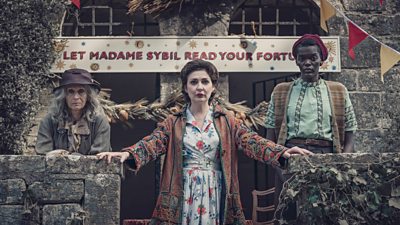
What drew me to the script? Characters that have something inexplicable about them always intrigue me. Witches were naturally a good start.
Pictured L-R: Bella (Rita Tushingham - RT), Sybil Stamfordis (Kathy Kiera Clarke - KKC), Thyrza Grey (Sheila Atim - SA)
Can you describe the story of The Pale Horse?
KKC: There are a series of deaths, which may or may not be murders and which may or may not have a perpetrator or perpetrators.
RT: In terms of the three witches, we are the web that draws all the characters in throughout the story.
Sarah has deliberately steered clear of stereotypical witches. What do you love about your characters?
RT: My character is a strong woman, she’s lived a lot, she observes people and she enjoys being with the other witches. Nothing surprises her.
KKC: There’s a timeless quality to these three women. I asked Sarah (Phelps) how long the women had lived together for. She said, "a decade or 500 years".
SA: There’s an assuredness to the way in which they move and observe people, which is quite forensic. They can see very deep into people. We’ve all found our little corners that we occupy, and we move as a trio, but neither are we a monolith either.
KKC: We have our different gifts and strengths but we operate as one unit in our self-sufficient world.
What helped you get into character?
RT: The script, the costume and working with these two wonderful women really did it for me. The locations were great too.
How was it working with Rufus? How do your characters collide?
RT: Working with Rufus was great and brought in another element to our world.
KKC: We exist very much in our own world, but Rufus’s character comes crashing into that. As characters we’re intrigued by, and curious of, the outside world. These people come to us, we don’t invite them.
How do the witches impact on the community?
SA: The witches are very much at the centre of this community so we exert this gravitational pull on everyone else towards us. We are constantly surveying everyone and everything, that’s one of our gifts. We have to be able to sense everything at the same time.
Rita: We stand back and observe.
How do you think the show will feel different to a usual whodunit?
RT: This is really different from the other Christie’s I’ve read before. I’ve been in an Agatha Christie called The Sittaford Mystery, which I enjoyed, but The Pale Horse has a real sense of intrigue and the jigsaw pieces fitting together. This one is almost like a one-off.
What drew you to the script?
SA: Characters that have something inexplicable about them always intrigue me. Witches were naturally a good start. I was also really drawn to the idea that these three witches are very different. You always think of the classic witches in Macbeth and people are always trying to find ways to reinvent that concept. When I read the scripts, there was already quite a strong steer that Sarah put in there, in terms of trying to blow that concept open.
RT: It would be easy to play them exactly as people imagine them, but the witches are actually accepted in the village where we live. People don’t know what’s happening behind our front door but they are intrigued.
KKC: There’s the mystery of whether they practice the ‘dark arts’ or whether they just make cures for people within the village out of herbs and more practical methods.
What do you think Sarah Phelps has brought to this adaptation?
SA: There is a freshness to it because it doesn’t necessarily follow a structure that you would be expecting from a murder-mystery. It presents itself as a drama and a thriller in a way that will keep the viewers on their toes. I certainly felt on my toes when I was reading it as a script. I didn’t feel like I could see where it was leading. She’s definitely been innovative with it.
How has it been to be transported back to 1961?
SA: It’s hard for our characters because we’re anachronistic in a way. We’re not really tied to a time, even in the way we dress and live. If we do practise whatever we’re practising, that stuff would’ve existed way before the 1960s. It is interesting for us to observe those who are very much living in the 1960s, as the witches who are not. We’ve always been here and we may always be here for another however many years.
KKA: For three women to be unmarried and living in a small village in a house together is no reflection of the time actually.
SA: The three of us are very different as well, so to have three women who look like this living in a house by themselves in the 1960s probably wasn’t a regular thing.
Series synopsis
London, 1961. Mark Easterbrook (Rufus Sewell) has everything a man could dream of - he’s rich, successful and popular, with a beautiful new wife (Kaya Scodelario) and perfect home. But scratch beneath the surface and he’s still grief-stricken by the loss of his first wife Delphine (Georgina Campbell). When Mark’s name is discovered on a piece of paper in a dead woman’s shoe everything starts to fall apart for him.
Why did Jessie Davies (Madeleine Bowyer) die, why is Mark’s name on a piece of paper in her shoe, and who are the other names on the list? Detective Inspector Lejeune (Sean Pertwee) interviews Mark and mentions that the names Tuckerton and Ardingly were also on the list. Mark has a connection with Thomasina Tuckerton and David Ardingly - and Thomasina is also dead…
As Mark tries to work out why he is on the list and what it means, everything seems to lead back to the village of Much Deeping. His first wife, Delphine, visited the area on the day of her death. Much Deeping seems to be an idyllic English village, but it is also a place of old traditions and strange beliefs, a place of witches, curses and spells. Jessie’s employer Zachariah Osborne (Bertie Carvel) tells Mark that witchcraft played a part in Jessie’s death, which Mark angrily rejects. But then he is sent a mysterious corn dolly. As more people named on the list are found dead, Mark starts to fear for his own life and sanity.
Mark is consumed with paranoia, fearful that his life is at risk and that the perpetrator is someone known to him. Mark feels his own death treading on his heels, breathing down his neck. To make matters worse, Detective Inspector Lejeune seems to be increasingly suspicious of him, and Mark feels even more alone.
He’s determined to find a rational explanation because there has to be one - this is the 1960s not the Dark Ages. Past and present collide for Mark as his investigations uncover the ties between Delphine and the trio of 'witches' (Sheila Atim, Kathy Kiera Clarke, Rita Tushingham) at Much Deeping, putting his relationship with second wife Hermia under great strain.
Terrified, Mark becomes hell-bent on uncovering the nature of the witches’ powers and their work at The Pale Horse. With each passing day, each disquieting moment, each tormented, terrifying night, Osborne’s beliefs seem less fantastical and more plausible. Mark starts to believe in the craft, in the dark arts, in the witches’ peculiar skills. If they are truly as powerful as they seem, can they save him from his nightmares, before whoever wants him dead catches up with him? How far will he go to save himself?
Pictured: Hermia Easterbrook (Kaya Scodelario), Inspector Lejeune (Sean Pertwee), Mark Easterbrook (Rufus Sewell), Osborne (Bertie Carvel), Delphine Easterbrook (Georgina Campbell)
KS