Interview with Henry Lloyd-Hughes
Interview with Henry Lloyd-Hughes, who plays David Ardingly in The Pale Horse.
Published: 29 January 2020
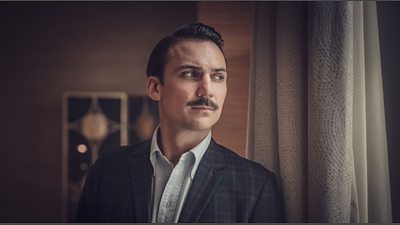
This is a story about paranoia and about the way that your mind can play tricks on you with the power of suggestion. In my opinion, we see the story through Mark’s eyes.
Can you describe the story of The Pale Horse?
The Pale Horse is a mystery, hidden within an enigma, hidden within a paranoid nightmare. We see the story through the mind’s eye of the central character, Mark Easterbrook, played by Rufus Sewell. It is a detective-mystery story tracing him trying to track down the significance of a list that he’s appeared on that may or may not have some ominous significance.
Can you describe your character?
You could call David a playboy. He is enamoured with living a decadent lifestyle, living fast and loose. He sees Mark as a father figure. In the script, Mark is his godfather, but in many ways I think of him more as a naughty uncle to David; someone that he can go out on the town with, share war stories and possibly get up to no good with, like a co-conspirator.
What’s it been like to work with Rufus?
Through David’s eyes, I can see why he looks up to him as a father figure. Rufus looks like James Bond - he’s chiselled, he’s got the suit and he’s got the car.
Which other characters do you find particularly intriguing?
Kaya is playing the character of Hermia who is such an interesting, exotic character. She reminds me of this fastidious Stepford Wife, seething with rage underneath.
How do you think the show will feel different to a usual whodunit?
This is a story about paranoia and about the way that your mind can play tricks on you with the power of suggestion. In my opinion, we see the story through Mark’s eyes.
What drew you to the script?
It’s very witty and macabre. It tells a love story about the period but isn’t handcuffed to it. Sarah has made her characters feel like real living, breathing, three-dimensional people. A lot of characters in this piece have public and private personas. That’s really interesting because in all these different scenes, she’s peeling off the veneer of what people say to the world and what their existence is like in private.
What do you think she’s trying to say about the 1960s?
Sarah uses the time period as a prism to show something quite contemporary. I genuinely do feel a sense of comfort when I go into a costume fitting and there are suits and ties on a rack. Given I don’t have a proper job in which I have to wear a uniform, I’m always reassured when there is one.
Why should people tune in for The Pale Horse?
It’s the amazing world of Agatha Christie but not in a way that you will have necessarily seen before. It’s disturbing, clinical, cold and scary.
What do you love about Agatha Christie?
The endless depth of her ability to conjure up intricate characters and stories is unparalleled. I would happily be stuck on a desert island with her back catalogue and get through them one by one, it’s such a rich body of work.
Series synopsis
London, 1961. Mark Easterbrook (Rufus Sewell) has everything a man could dream of - he’s rich, successful and popular, with a beautiful new wife (Kaya Scodelario) and perfect home. But scratch beneath the surface and he’s still grief-stricken by the loss of his first wife Delphine (Georgina Campbell). When Mark’s name is discovered on a piece of paper in a dead woman’s shoe everything starts to fall apart for him.
Why did Jessie Davies (Madeleine Bowyer) die, why is Mark’s name on a piece of paper in her shoe, and who are the other names on the list? Detective Inspector Lejeune (Sean Pertwee) interviews Mark and mentions that the names Tuckerton and Ardingly were also on the list. Mark has a connection with Thomasina Tuckerton and David Ardingly - and Thomasina is also dead…
As Mark tries to work out why he is on the list and what it means, everything seems to lead back to the village of Much Deeping. His first wife, Delphine, visited the area on the day of her death. Much Deeping seems to be an idyllic English village, but it is also a place of old traditions and strange beliefs, a place of witches, curses and spells. Jessie’s employer Zachariah Osborne (Bertie Carvel) tells Mark that witchcraft played a part in Jessie’s death, which Mark angrily rejects. But then he is sent a mysterious corn dolly. As more people named on the list are found dead, Mark starts to fear for his own life and sanity.
Mark is consumed with paranoia, fearful that his life is at risk and that the perpetrator is someone known to him. Mark feels his own death treading on his heels, breathing down his neck. To make matters worse, Detective Inspector Lejeune seems to be increasingly suspicious of him, and Mark feels even more alone.
He’s determined to find a rational explanation because there has to be one - this is the 1960s not the Dark Ages. Past and present collide for Mark as his investigations uncover the ties between Delphine and the trio of 'witches' (Sheila Atim, Kathy Kiera Clarke, Rita Tushingham) at Much Deeping, putting his relationship with second wife Hermia under great strain.
Terrified, Mark becomes hell-bent on uncovering the nature of the witches’ powers and their work at The Pale Horse. With each passing day, each disquieting moment, each tormented, terrifying night, Osborne’s beliefs seem less fantastical and more plausible. Mark starts to believe in the craft, in the dark arts, in the witches’ peculiar skills. If they are truly as powerful as they seem, can they save him from his nightmares, before whoever wants him dead catches up with him? How far will he go to save himself?
Pictured: Hermia Easterbrook (Kaya Scodelario), Inspector Lejeune (Sean Pertwee), Mark Easterbrook (Rufus Sewell), Osborne (Bertie Carvel), Delphine Easterbrook (Georgina Campbell)
KS