Interview with Lisa Chatfield
Lisa Chatfield is the Producer of The Luminaries.
Published: 15 June 2020
We see these characters make choices about how they make their fortunes: some of them will choose kindness and some of them will choose cruelty, some of them will value people and some of them will value gold.
What are the main themes behind The Luminaries?
The question behind the whole piece is, can you ever really start again? I find that a really interesting idea because the world of The Luminaries is this time of people traveling from one end of the Earth to the other to start a new life. The idea of starting again is something that really matters to people, but it's so hard to do.
It sounds lovely to want to become someone new, but what we forget as humans is that to truly change, you don't just have to give up the things you don't like about yourself, you're likely to have to give up the things you do like about yourself too. You might get to the other end of the world and discover that actually your strengths depend on some of your weaknesses.
What drew you to this project?
I hadn’t read the novel when I was first approached about this series. At the time that The Luminaries was published and winning the Man Booker Prize, my children were quite little, so the idea of sitting down and reading a big book was completely impossible.
When Tim White (Executive Producer) got in touch with me about getting involved I had two weekends to read the book, which is no mean feat for 800 pages! I really loved the book. As a New Zealander, this story is such a special experience because Eleanor has done this extraordinary thing in capturing the lives of a group of people. It felt completely contemporary, and I had the feeling that any of those characters could have been my great, great, great, great grandfather, or my great, great, great grandmother.
I had this sudden sense that it was not history, it was a bunch of entrepreneurs who were traveling around the world. There were people in Hokitika who had first come from the gold rush in San Francisco before travelling onto Australia to the Victorian gold fields, then to Hokitika in New Zealand and from here they went onto the gold rush in Canada. There was this real cycle of people hopping on boats, for anywhere between one to six months, with the potential of making a great fortune.
You absolutely have that sense of a bunch of men out scraping through the mud for this extraordinary possibility, and a completely open possibility. It didn't matter if you were rich or poor, literate or illiterate, or what language you spoke: the odds of you digging up gold were as good as the next persons, so it was an egalitarian event. It still generated an enormous amount of conflict but the actual gold itself has loyalty to no one. It belongs to whoever finds it. These people were chancers, they were in New Zealand for the opportunity to win the gold, and if they didn't win the gold they would keep moving.
The project was pitched to me as a really female-led project - female lead characters, Eleanor Catton’s scripts and Claire McCarthy directing, which I initially found confusing as the book is about 12 men involved in a crime. But once I read the first few scripts and realised how Eleanor had crafted the screenplay I was captivated. I feel privileged to have been asked. It has been one of the most significant commitments of my life. But, for Eleanor, it has been enormous. It's been ten years of this project living in her brain and becoming and growing into something more. To be alongside her as she experienced the nature of television storytelling, to see this huge group of people feeding in and bringing a project to life, has been totally extraordinary.
Will fans of the book still recognise the story?
Only Eleanor could have taken the story, turned it inside out, almost told it backwards and yet keep it totally truthful to the book. It's an extraordinary thing. Any process of adaptation is always tricky: there is never enough time in whatever you're making to fit all the detail that exists in a novel. But a true adaptation works when people who've read the book say "that's my story, that's the story I love". An adaptation has to capture the essence of the story and Eleanor has done that completely.
What do you like most about the book?
The book is incredibly rich in detail. When I read the book I felt like these characters could have been in my own family tree. They felt like real people both because they were incredibly rich in character but really grounded in the the sense of the organic nature of the world.
There is a lovely description at the beginning of the book, which I think our production designer Felicity Abbot and her team captured amazingly, of the smoking room in the Crown Hotel. It talks about how the hotels tried to recreate English smoking rooms, but their walls were rough sawn timber. The pool table had been sawn in half, in order to have been brought into Hokitika by boat, before being jammed back together. Everything is rough and it’s right on the edge of existence.
It's that same sense of detail that we've really managed to capture on screen that makes the world feel alive. It's not a traditional period piece where everything is lovely. It's not lovely. These people were living on the edge of the world and that's what it feels like. The big challenge was to take the level of detail that the novel achieves and condense it to six hours of television. Eleanor has been incredibly brave in how she's managed to achieve that. The BBC, Fremantle and Working Title all felt really excited about her capacity to do that.
How would you describe the story that we will see play out on the television version of The Luminaries?
The Luminaries is about the lives of two young lovers who are fated to be together, but forced apart by circumstance. They are joined by a number of migrants who have travelled to the far end of the world, all of them fighting for gold, looking for a new life and discovering how much is determined by fate and how much is determined by free will.
We see these characters make choices about how they make their fortunes: some of them will choose kindness and some of them will choose cruelty, some of them will value people and some of them will value gold. And all of those clashes come together at the far end of the world, in a place that nobody knows, and very few people understand.
What has filming in New Zealand meant to you?
One of the things that I loved, and we were really blessed with, is that we had so many people working on the project who were really excited to get to work on a New Zealand story. To get to work on something that they felt belonged in New Zealand. Our New Zealand crew, who are an extraordinary, world-class crew, work on all sorts of screen stories all the time but they're often working in the realms of fantasy, or the future. There isn’t a lot of period work that happens in New Zealand, and so to get to tell our own story and our own history was something really special. It just felt like reaching down into your own history and lifting it up to the light and that's been a real privilege.
How did you go about casting the series?
Without a doubt, the strength of Eleanor's scripts were a huge draw for cast. It was really exciting when Eva Green came on board as Lydia Wells. That was a magic moment and it set the tone for the series ability to attract really, really strong performers. Eva is amazing and extraordinarily professional; what I found fascinating working around her wasn't just her performance on screen but her dedication and commitment off-screen with accent training and research, and how she applied all her learnings to the scripts. She made everybody up their game again. She is totally, totally focused and you've got to be up to it. As as a female filmmaker it was really exciting how Eva worked.
We were incredibly lucky to get Eve Hewson to play Anna Wetherell. This is Eve’s first major lead role and boy she worked hard! Eve delivered every day and kept coming back with the same energy. Both Eve and Eva had two hours every morning in hair, make-up and costume and so their days started so early and finished so late. We've been lucky to be the first to showcase Eve Hewson's extraordinary talent, her luminous quality and her ability to capture this really complex character.
Himesh Patel coming on board as Emery was wonderful. For Himesh to come to the other side of the world for months and months and months to play a role that's so different from anything he's played before really was a privilege for us. All of these amazing actors were prepared to take that jump because of the strength of the scripts and because they felt like there was something really distinctive in this world. It has offered the opportunity for a number of the actors to push back against type and to explore a different kind of character.
Richard Te Are, who plays Te Rau Tauwhare, sent himself on a research trip down to Hokitika to have a look around, to see the land and to put his hands in the awa [river] and feel connected to the area, which was fantastic. He also spent time talking to our Ngāti Waewae consultants, which was really great, and he's brought something special to life. Te Rau Tauwhare is a fictional character but unlike all the characters in the novel, the surname Tauwhare is a surname that belongs to that area. It's one of the key figures of Ngāti Waewae and there are lots of people who are descendants of Tauwhare, and the Tauwhare name is still quite common.
After the publishing of the novel, Ngāti Waewae invited Eleanor Catton and her husband to Hokitika to be welcomed onto the marae. And Ngāti Waewae have done this really beautiful thing by almost incorporating the character of Te Rau Tauwhare into their own life story. So even though he's a fictional character he has a real place of warmth there, which has been really special.
How essential is the role of gold within The Luminaries?
The role of of gold within The Luminaries is interesting, particularly regarding its relationship to pounamu [jade or greenstone], which also has a space in the series. It's really hard to think of a contemporary experience that is at all similar to a gold rush. I guess my children might think it might be like standing in line for the iPhone 11, but to have a whole group of people feel like they had the opportunity to find gold was extraordinary.
That gold rush era in world history is unique. It's very specific, and it grew quite suddenly. It created this egalitarianism, where it didn't matter if you couldn't read and write, you simply needed to be able to work a spade to be in with a chance. Not everybody arrived in New Zealand to make their fortune, some of them were people who had money behind them already but who wanted to be adventurous. But, for everyone, it was hard work. It was filthy and miserable, and particularly in Hokitika. You read some of the history and those guys were cold and starving, almost all of the time. It's a rough environment and if you had come from the other side of the world, to a land you didn’t know, these people would have had had no idea what they could grow, eat or catch, they would have been hungry a lot of the time.
The Chinese gold diggers had it even harder. They weren't allowed to dig in the places that other people were digging and they were absolutely ostracised. So when I say the gold made it egalitarian, it made it egalitarian in that you could never pre-judge who was going to make a strike, who was going to get rich. But the reality of gold is also greed, and greed is not ever going to bring out the best in people. It created a really fierce, violent environment where some people felt they had the right to gold and the right to win.
There was that spirit of adventure, entrepreneurship and opportunity that brought people together, but it was offset by an absolute underlying greed and a desire to win at any cost. The gold continually snakes its way through the story and Eleanor has crafted ways for the gold to rub up against all the characters, and set off these different reactions in people, without everybody in the series fully understanding the path that the gold has taken.
I also love how Eleanor has scripted a way to talk about the contrast between pounamu and gold. The river in Hokitika, where gold was being found, also holds pounamu, which is the Māori word for greenstone, and was considered an absolute treasure in New Zealand for Māori culture because it's pretty much indestructible and it was used for things like jewellery and weapons.
It could only be found on the West Coast, so the West Coast pre-European times had this resource that nobody else had and it was considered a treasure of its time. But when the gold rush arrives into the West Coast, everything becomes about gold, which was not something that the Māori valued. The thing about gold is it's not actually very useful: it's soft, it looks pretty, it's hard to find but it's not actually a very useful thing, whereas pounamu had this absolute function.
Suddenly all these Europeans came into this area fighting for treasure; and of course the Māori already knew there was treasure there, but it wasn't the same treasure. There's a really lovely story that runs through the series which questions whether or not the Europeans are looking for the right treasure, and if they really know what to place value on. That’s a cultural question, but it's a fact that people all over the world have fought for gold for so long. Gold is worth a lot of money because it's rare, whereas pounamu was fundamentally important to a culture in terms of the place that it held as a stone that could be shaped to work and to actually provide value.
The character of Te Rau Tauwhare knows what value lays in the river. Emery Staines came to follow gold, but the day he arrives he discovers something more important, and that's Anna, and he has to re-evaluate and re-question what he's come to the other end of the world for. When Te Rau Tauwhare tells him, "You're chasing the wrong treasure" there's a lovely kind of roundness there.
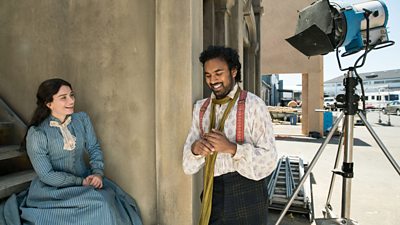
Pictured: Anna Wetherell (Eve Hewson), Emery Staines (Himesh Patel)
An introduction by Eleanor Catton
It took me five years to write The Luminaries, and another seven to adapt the novel for the screen. As a novelist I tend to write only one draft, constantly circling back to the beginning, and refining as I go; once I reach the end, the book is done. Screenwriting couldn’t be more different. By the time we started shooting in late 2018, I had written perhaps 200 drafts of the first episode alone, and throughout the shoot, the scripts continued to change in order to fit the budget and the schedule, both of which got tighter by the day.
This was often heartbreaking - a novelist never has to cut a scene they think is working! But it could be exhilarating too, as when the set design introduced new possibilities for action, or when the actors had ideas for improvements to their scenes.
Episode six would have wound up quite differently if it hadn’t been for the brilliant plot solutions provided by Eva Green and Márton Csokas (Lydia Wells and Francis Carver), whom I inadvertently offended early in the shoot by referring to their characters as ‘the villains’. I didn’t mean it at all pejoratively - I love villains! - but immediately had to backtrack when I saw that I had caused offence. Of course: Eva was Lydia, and Márton was Carver; they experienced the story from their characters’ points of view. For them, it was a tragedy and they were the doomed heroes. (This is what makes them such great villains.)
Sitting in a make-up tent listening to Eve Hewson (Anna Wetherell) describe her character’s inner life was unexpectedly moving to me: She understands Anna so much better than I ever did, I thought, but then of course - she was Anna, she knew her from the inside out.
Near the end of the shoot, I saw Himesh Patel (Emery Staines) pass something to Eve on camera. When the take had ended, I asked the script supervisor what he’d given her. It was the button from her sleeve that she’d given him in episode one; he’d had the idea to surprise her by giving it back, in what is now one of the loveliest moments in the show. How very like Emery, to do that, I thought, and of course, it was.
People often asked me on set, is it like what you imagined, when you wrote the book? The answer - very happily - was "not in the slightest". So many different kinds of artistry and expertise go into the making of a television series, and every frame of the finished product shows the talent and efforts of hundreds of people in hundreds of ways. It’s far greater than anything any one person’s imagination could contain.
When The Luminaries was first published, I knew the book so well that if someone opened the book at random and read out three or four words, I could finish the sentence - and then keep going, sometimes for more than a page. I can’t do that any more; in fact, when I open the novel now, it feels very alien and even a little frightening. I start to doubt that I was ever its author in the first place.
The strangeness is partly due to the fact that the show reinvents the novel so thoroughly, turning the story inside out and back to front, beginning near the end of the book, splitting the narrative into two different timelines, and following characters who in the novel are important but largely obscured.
In a deeper sense, though, the story no longer feels as though it belongs to me alone. I’ve lived with these characters and this world for all my adult life, and it’s a great feeling, now, to see the story all grown up and leaving home.