Stacey Dooley Investigates
Stacey Dooley, one of BBC Three’s most popular documentary-makers fronts two powerful, hard-hitting investigations: Young Sex For Sale In Japan and Canada’s Lost Girls.
Published: 15 February 2017
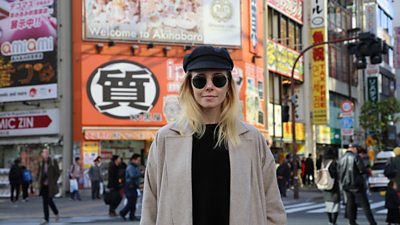
I'm still hesitant to call myself a journalist. I see myself as a documentary maker, who is trusted with hard hitting, current affairs issues. It's no secret I didn't come through the traditional route, and actually, I think often that tends to work in my favour.
In Japan, Stacey examines the serious problem of the sexualisation of children, from bars where men pay to meet schoolgirls to suggestive pictures of very young children.
In Canada, Stacey questions why thousands of woman and girls from the indigenous community have been tragically murdered or disappeared, with many not receiving justice.
Q&A with Stacey Dooley
These are very hard-hitting docs, how do they differ to other investigations you have done?
They are hard hitting docs for sure! I feel like they have a similar tone to the last few we've made. Prior to Canada and Japan we were in Northern Iraq, following Yazidi women. So there is a definite strength now, that didn't necessarily exist at the very start of my career.
How do you feel you have developed as a presenter?
In terms of my own personal development, I would say I've definitely matured and learnt what it takes to make sure these, often, vulnerable, desperate individuals, have the platform they deserve to tell their stories.
I suppose it’s like any industry, no one starts at the top of their game and you have to work hard and constantly try and improve.
I'm still hesitant to call myself a journalist. I see myself as a documentary maker, who is trusted with hard hitting, current affairs issues. It's no secret I didn't come through the traditional route, and actually, I think often that tends to work in my favour.
Japan
What was the aim of this doc?
Our documentary on Japan essentially focuses on the fact that they [the Government of Japan] only made it illegal to possess child pornography in 2014. We set out to try and understand why it took a privileged country, like Japan, so long to come to this conclusion and also to see if the change in their law had made any real difference on the ground.
Did you find the law to ban child pornography has had much of an effect?
My personal belief is that their needs to be a shift in some peoples mentality, and more broadly in some subcultures, for us to see real change. For me, more can be done and there needs to be a serious sense of urgency.
Having made this doc how do you think Japan can do more to stop the sexualisation of children?
You can change laws as much as you like. But I guess you need individuals, and perpetrators, to truly see children in a different way to how they currently view them. A totally different mind-set.
Can you reveal one of the stories from the doc?
I spent time with a man who described his ultimate desire to me; to have a sexual relationship with a child. He was very candid and matter of fact re his wishes, and failed to see why others within society couldn't understand, or accept, his orientation.
Canada
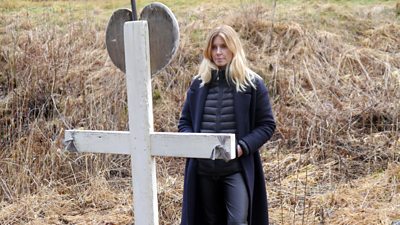
Why did you want to make this doc?
I'm pleased this episode was commissioned because I genuinely believe this a story few of us outside of Canada are that familiar with. The number of indigenous women that go missing or are murdered is totally disproportionate [with the size of the population].
What did you learn about the indigenous community from making this programme?
Spending time on the ground with these girls and seeing first-hand what their realities are was a complete eye-opener. In some circumstances it feels like the indigenous communities feel like they are treated and seen as second class citizens. A revelation, when you are in a country like Canada, with a leader like Trudeau.
What do you think is the main reason indigenous woman and girls are targeted?
The girls are often living chaotic lives and, inevitably find themselves in a more vulnerable position. Perfect for sexual predators wanting to exploit these individuals.
Stacey Dooley biography
Stacey Dooley is one of BBC Three’s most loved documentary-makers. Stacey has been involved in BBC Three since her life took an unexpected turn when she travelled to India in 2007 as a contributor for the series Blood, Sweat And T-Shirts to live and work alongside the people in the Indian fashion industry.
Since then she has embarked on a series of investigations, on a variety of topics from domestic abuse in the UK, sex trafficking and underage sex slavery in Cambodia and the dark side of tourism in Thailand and Kenya. Stacey produced two series of Stacey Dooley In The USA, which took an objective look at issues affecting teens across the pond such as: Girls Behind Bars, Border Wars, Homelessness and Kids In The Crossfire.
More recently she travelled to Northern Iraq, for Guns, Girls And ISIS, to meet the extraordinary all-female Yazidi battalion, who are fuelled to take revenge against the so-called Islamic State.
EJ

