Rules of The Game: Meet the cast and creators
The cast and creators of Rules of The Game discuss the new drama

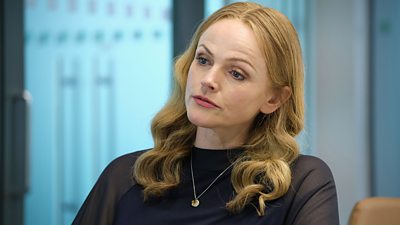
Sam is ruthless, abrasive, and her willingness to play along with the boys means she’s climbed to the top of the ladder at sportswear company Fly. As COO, it’s a view she’s comfortable with. Maya, the newly hired HR Director, has a very different perspective.
She and Sam clash from their very first meeting, and when Maya begins to unpick the toxic culture of the workplace, dark secrets begin to emerge. Soon both she and Sam are asking questions about a young female employee, Amy, who died in mysterious circumstances after a company party some years ago.
Rocked by a sudden terrible death on company premises, Sam faces questions from the police, and finds herself pulled in all directions: by her loyalty to the company, by her own family, by Maya, and by new revelations about the death of Amy, ten years ago. Two deaths, one toxic workplace. Just how culpable is the company - and how guilty is Sam?
Rules of The Game starts Tuesday 11 Jan on BBC One and BBC iPlayer at 9pm. All episodes will be available as a boxset on BBC iPlayer.
HW
Cast & Crew
Cast
Sam Thompson - Maxine Peake
Maya Benshaw - Rakhee Thakrar
DI Eve Preston - Susan Wokoma
Gareth Jenkins - Kieran Bew
Owen Jenkins - Ben Batt
Tess Jones - Callie Cooke
Anita - Alison Steadman
Vanessa Jenkins - Zoe Tapper
Carys Jenkins - Katherine Pearce
Crew
Writer - Ruth Fowler
Director - Jennifer Sheridan
Executive Producer - George Faber
Executive Producer - Mark Pybus
Executive Producer - Lucy Richer
Executive Producer - Ayela Butt
Producer - Simon Meyers
Introduction by Writer, Ruth Fowler
Seven years before the #metoo movement abruptly brought sexual assault into sharp focus, I had written a play about a young British woman who ends up in Manhattan without a work permit, and finds herself in the apartment of a New York banker who trades glimpses of her bare flesh in lieu of rent. The young woman wasn’t me, though I was all too familiar with the tangled economics of sex and money and power - and not just because I spent several years in my twenties swinging around a stripper pole in a dark club in midtown Manhattan. I related to #metoo because of the tangled messages of consent and blame I’d grown up with as a teenager in the late 90’s, because of the subtle, insidious career disappointments I’d faced in my twenties, watching the men around me catapult to success while I flailed blindly around in the corridors, staring blankly at locked doors behind which decisions were made without me. In my thirties I started writing about what I was experiencing - something which was quite hard to articulate. It wasn’t as clear cut as simply proclaiming that my life was screwed up because I was a woman, or that I wasn’t as successful as X, Y or Z because of my gender. I’d had a great education, I’d achieved some level of success, and I’d built up a hard sediment against the unwanted touches, the brutal assaults, the subtle slights, the drunken groping and the overt come-ons I’d experienced in every industry I’d ever worked in - catering, restaurants, publishing, journalism, TV, film. I suppose I felt jaded and deflated, a husk of a human. A male friend of mine who is an incredibly successful writer told me to confront it in my work. I did - and no one wanted to touch it. It was too dark. Too nasty. Too unpleasant. Too shocking.
Until 2017. The politics of being a woman in a man’s world had never really interested us until Harvey Weinstein went down for it, and then suddenly everyone wanted to know the gory details. What was too nasty, unpleasant and shocking in 2010 became hard currency in 2017, and it was OK to be a woman, writing about women and assault and that insidious place we all occupy when our gender defines our status, our power, our jobs, our roles, our identities and we must either play the game or let it destroy us.
When I was asked to write a drama loosely based on #metoo in a fictional British workplace, I was more than ready to write it. I’d spent my entire life waiting for this moment to create Sam - a woman who had clawed her way to the top, and had been used and abused as much as she had used and abused others. The grey areas of complicity surrounding behaviour that had once been OK fascinates me. So many victims of Weinstein, Epstein and others had spoken out, but no one listened, or believed them, or wanted to stand up for what was right because power trumps truth. Who were those people who ignored those women? What were they thinking? What did they do? If they were women - had they not experienced the same things? Did they think it was OK? Towards the end of writing Rules, the lead defence attorney in Harvey Weinstein’s rape and sexual assault trial, Donna Rotunno, responded to a question about whether she had ever been sexually assaulted on ‘The Daily’ podcast. “I have not because I would never put myself in that position. I’ve always made choices from college age on where I never drank too much. I never went home with someone that I didn’t know. I just never put myself in any vulnerable circumstances ever.” I took her words and gave them to Sam. Sam who thinks that what had happened to her as a teenager was OK, was normal, was just… what you had to do to get by. Sam who blanches when the idea that her own daughter may have to go through the same trial by fire.
Even now, when we are apparently more evolved and enlightened humans who can comprehend that the power differential between a boss and an employee, a male boss and a female employee, a man and a woman, a drunk man and a drunk woman - constitutes an abuse of some kind that makes any notion of consent murky and indistinct, our understanding of the rules of this game are still being formed. Still being learned. Still being rewritten. Still being profoundly misunderstood.
Power now cares about diversity quotas and cancel culture, about characters that are brown, and black, and queer, and trans, and powerless, and marginalized. Power now cares about the victims it previously ignored, and power now wants to examine those topics it once deemed too dark and too nasty and too shocking. The result is that the locked door has been cranked open just a tiny bit. Enough that those of us previously excluded can now place a foot in that crack and resolutely refuse to move it even when the door crashes down upon us.
Rules is a foot in that door.
Interview with Maxine Peake
Can you tell us about the plot of Rules of the Game?
The show is set in a family-run sportswear company run by the Jenkins family. There is a strong air of toxic masculinity that runs through the work force and the work practices. Maya, a young woman who takes on the role of the new HR director, comes in to investigate and things start to unravel, secrets from the past are exposed. It encompasses a lot about acceptable behaviour over the decades, what was seen as acceptable then and what is now. My character is at the centre of this and for me, it’s about whether she is implicit or a victim of this whole dynamic. Obviously it’s not just about this company, it’s about something that is systemic in all forms at workplaces and institutions.
In what ways is the show relevant today?
This show is so relevant and important now because we had this explosion with the Me Too movement, but obviously like everything else we need to continue that. I found the movement made me uncomfortable in some ways because it focussed very much on our industry, Film and TV, when actually this is happening in every workforce and to people who have no way of speaking out. This show takes it out of a show-business focussed scenario, and shows it’s systemic in our society. I think it’s important we keep telling these stories and keep the momentum. Things are changing, but not fast enough. There are still issues to be tackled, and it’s not going away anytime soon. I know we’re not changing the world, but we’re making sure that these issues don’t go away, we have something that is a drama but has a strong political vein running through it.
What did you think of the scripts when you first read them?
Selfishly, when I read a script I look at the character that I’ve been offered. I just loved the fact that Sam to me, felt real. I felt I knew Sam, she had a sense of humour, she was incredibly flawed. She is warm and compassionate, but other times she’s selfish – she’s likeable and unlikeable in equal measure. I liked the challenge of not making her some striding businesswoman nightmare, but making her real. Also, the fact that she herself has been a victim, but is only starting to realise and be honest with herself.
How does it keep audiences hooked in?
I think the show keeps us hooked in because it’s got a great cast of characters, especially the women. The women are fully-rounded and they’re funny and flawed. Each woman within this, whatever the size of the part, has a journey. I’m a big fan of character-based drama, you will engage with these people, there’s a lot of toing and froing about who’s side you’re on. It’s very clever in that it’s got such a strong theme and it’s very relevant, but it’s also a whodunnit story. I think it’s got so many elements to it, not just “let’s guess who the killer is”.
Have you enjoyed filming in Manchester?
It’s great being up North because I live in Salford, I’m from Bolton originally and then I lived in London for about 12 years and then I came home – I call Salford home. My character’s house was a ten minute walk from where I live, which has never happened to me. Polling day was great because I could walk to my local polling centre, went in my wig and cast my vote in my scene off. That was a bonus, because a lot of the time you’re away, and after the year we’ve all had, being able to work from home has eased me back into filming after having a bit of a break.
Interview with Rakhee Thakrar

Can you describe Rules of the Game in one sentence?
Rules of the Game is a peek behind the curtain of a company that on the surface is shiny and happy, but is actually completely toxic.
How does the series start?
It starts with a death and the big question is how did that person die, who is it and how is it interlinked with a timeline from ten years ago, where there was also a death. There is a reoccurring theme with the way this company treats its employees.
What are the key themes of the show?
The key themes for me are really looking at the way young employees are treated in these corporate worlds. For instance, in our show, Amy and Tess are coerced into taking drugs and performing sexual favours, and you see how badly that ends. It feels like we’re looking at someone doing things that they don’t want to do because they can’t say no.
There is also a lot of uncovering truth in the series, which is something we’ve seen in the media recently, people who have done bad things ten years ago and the past catches up with them.
Why is the series so relevant today?
I feel the story is relevant because these abuses of power are still going on and what we’re seeing now are public bodies helping voices come forward anonymously. I don’t think we had as much licence to do that before and now it’s giving power to the people who were too scared to come out. As a consequence, hopefully what will happen is that culture will shift slightly and you don’t completely see in our story, but you do see an uncovering of the problematic behaviour in the company and how that can be changed.
Can you describe your character?
Maya is the definition of optimism, she absolutely loves her job, she loves HR. HR is problem-solving and looking at people and seeing how can I help them be the best that they can be and she loves seeing people thrive. She likes yoga, she has a lovely cat called Audrey, she’s vegan. On the surface she’s very simple and appears that she’s got her life together, but then you see that it requires a lot of work to be like that.
Interview with Director, Jennifer Sheridan
How did you get involved with Rules of the Game?
I read the scripts and instantly got hooked into the characters and the world. It is rare to find a show that navigates the grey areas of this subject matter so brilliantly. I really appreciated that and so was thrilled when The Forge asked me come and direct it.
Were you involved in the casting process?
Yes and I couldn’t be happier with our whole cast. There are some pretty unlikeable characters in our show, but these actors brought such charisma to the roles you end up loving them all. Even the really, really bad ones.
Are there any moments you’re really proud of?
There are quite a few, but it’s impossible to claim credit for them. From the actors’ performances that bring me to tears; to the beautiful lighting and set designs that fill out the world, there are so many brilliant people involved. Mainly I’m proud of bringing the right people on the journey, so that we could create a safe space to portray really difficult things, with love and laughter.
What do you hope the audience reaction will be?
I feel the show’s strength is that it doesn’t ram anything down your throat, it allows you to make up your own mind about people and then challenges that perception. By the end of it I want the audience to be thinking about what these characters might’ve learnt and what, if anything we can learn from them.
